Supreme Court upholds life imprisonment in dowry death case
Source:Indian Express ↗
Why It Matters
The judgment is highly relevant for GS1 (Social Issues) and GS2 (Social Justice/Polity) as it highlights the systemic societal and legal challenges surrounding dowry deaths, the evidentiary burden in matrimonial homes, and the critical role of medical jurisprudence in delivering justice.
Summary
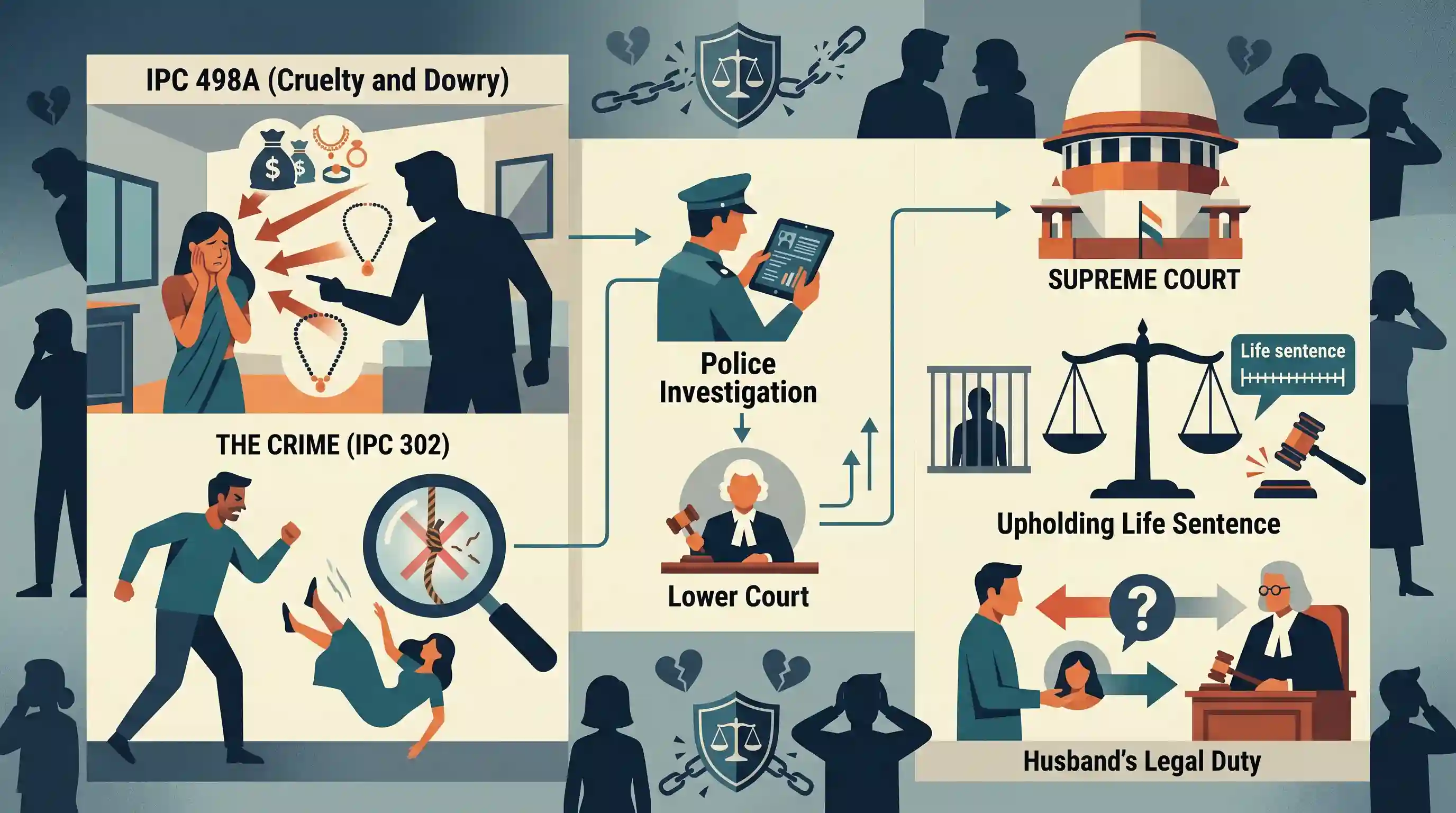
The Supreme Court upheld a life sentence for a Tripura man who murdered his wife over dowry and staged her death as suicide. Validating convictions under IPC Sections 302 and 498A, the Court relied on forensic evidence of homicidal hanging and reaffirmed the husband's legal duty to explain unnatural deaths occurring in the matrimonial home. The ruling delivered a strong indictment of the societal pressure that ignores cries for help and forces women to endure domestic abuse, often leading to fatal consequences.
Key Points
- The Supreme Court upheld the life sentence of a man for murdering his wife for dowry and attempting to disguise it as a suicide.
- The conviction under IPC Sections 302 (murder) and 498A (cruelty) was heavily supported by medical evidence proving 'homicidal hanging' as opposed to suicide.
- The Court reiterated the legal principle that a husband is legally obligated to explain the circumstances of his wife's unnatural death inside the matrimonial home.
- The judgment severely criticized the societal pressure and apathy that forces young brides back into abusive households to avoid social stigma, describing the victim as being 'thrown to the wolves'.
Important Terms
IPC Section 302

This section prescribes the punishment for murder, mandating either the death penalty or life imprisonment along with a fine. It requires proving the intention to cause death (mens rea).
UPSC context
GS Paper II/IV: Essential for understanding criminal justice, the 'rarest of rare' doctrine for capital punishment, and judicial sentencing powers.
IPC Section 498A
Introduced in 1983, it criminalizes 'cruelty' by a husband or his relatives against a woman, covering harassment for dowry or acts driving her to suicide.
UPSC context
GS Paper I/II: Significant for Social Justice (women's rights) and discussions on the legal misuse versus protection of domestic violence victims.
IPC Section 304B
Defines death occurring within seven years of marriage under unnatural circumstances where the woman was subjected to dowry-related cruelty soon before her death.
UPSC context
GS Paper I/II: A key social issue (Dowry) and a critical legal provision often compared with Section 302 in criminal trials.
Section 106, Indian Evidence Act
A legal principle stating that when a fact is especially within the personal knowledge of a person, the burden of proving that fact lies on them.
UPSC context
GS Paper II: Vital for understanding 'burden of proof' shifts in custodial or domestic crimes where direct evidence is unavailable.
Supreme Court of India
The highest judicial forum and final court of appeal under the Constitution of India, with powers of judicial review and the authority to settle legal precedents.
UPSC context
GS Paper II: Core topic for Indian Polity; tests knowledge of its appellate jurisdiction and role as the protector of Fundamental Rights.
Matrimonial Home
The shared residence where a married couple lives. Legally, deaths occurring here trigger specific 'burden of proof' requirements for the surviving spouse under circumstantial evidence rules.
UPSC context
GS Paper II: Important for understanding the judiciary's approach to domestic crimes and the legal sanctity of the private sphere.
Prelims Trap
In dowry death cases, the burden of proof rests entirely on the prosecution from start to finish.
Under Section 106 of the Evidence Act/BSA, if an unnatural death occurs in matrimonial secrecy, the burden shifts to the husband/in-laws to explain the circumstances.
Static Concepts Connected
How does the law address the burden of proof in dowry death cases?
- Reverse Burden: Once cruelty for dowry is established before an unnatural death, the burden shifts to the accused to prove innocence.
- Statutory Presumption: The Evidence Act (now BSA) dictates courts must presume a dowry death occurred under these circumstances, creating an exception to the 'innocent until proven guilty' norm.
- Matrimonial Secrecy: This legal shift applies because the crime happens within the privacy of the home, where only the inmates know the true facts.
Which Constitutional provisions mandate state action against domestic violence and dowry?
- Article 15(3): Empowers the State to create special protective laws and provisions specifically for the welfare of women and children.
- Article 21: Interpreted by the Supreme Court to encompass the fundamental right to live with human dignity and free from violence.
- Article 51A(e): Imposes a Fundamental Duty on all citizens to renounce practices that are derogatory to the dignity of women.
Cross-Topic Patterns
BSA 2023 and forensic mandates
The transition to the Bharatiya Sakshya Adhiniyam (BSA) standardizes the use of medical jurisprudence to distinguish homicidal hangings from suicides in domestic crimes, vital for GS-2 governance and justice.
Societal stigma vs Statutory laws
Examines how the sociological stigma of divorce compels women to stay in abusive homes, highlighting why statutory frameworks like the Dowry Prohibition Act fail in GS-1 Society contexts.

Prelims 2026 may test 'reverse burden of proof' under Bharatiya Sakshya Adhiniyam (BSA), contrasting general criminal law principles.
Linked PYQs · 3
Linked PYQs · 3
- 2023MainsGS1
Explain why suicide among young women is increasing in Indian society.
- 2014MainsGS1
How does patriarchy impact the position of a middle class working woman in India?
- 2023MainsGS2
Explain the constitutional perspectives of Gender Justice with the help of relevant Constitutional Provisions and case laws.
