Executive Authority Overrides Humanitarian Immigration Protections
Source:The Hindu ↗
Why It Matters
Shifts in US immigration and deportation policies have profound implications for global migration patterns, humanitarian rights norms, and international relations. For UPSC aspirants, understanding these trends is vital as stringent Western immigration policies indirectly influence debates on the Indian diaspora, skilled visa regimes (like H-1B), and global human rights standards.
Summary
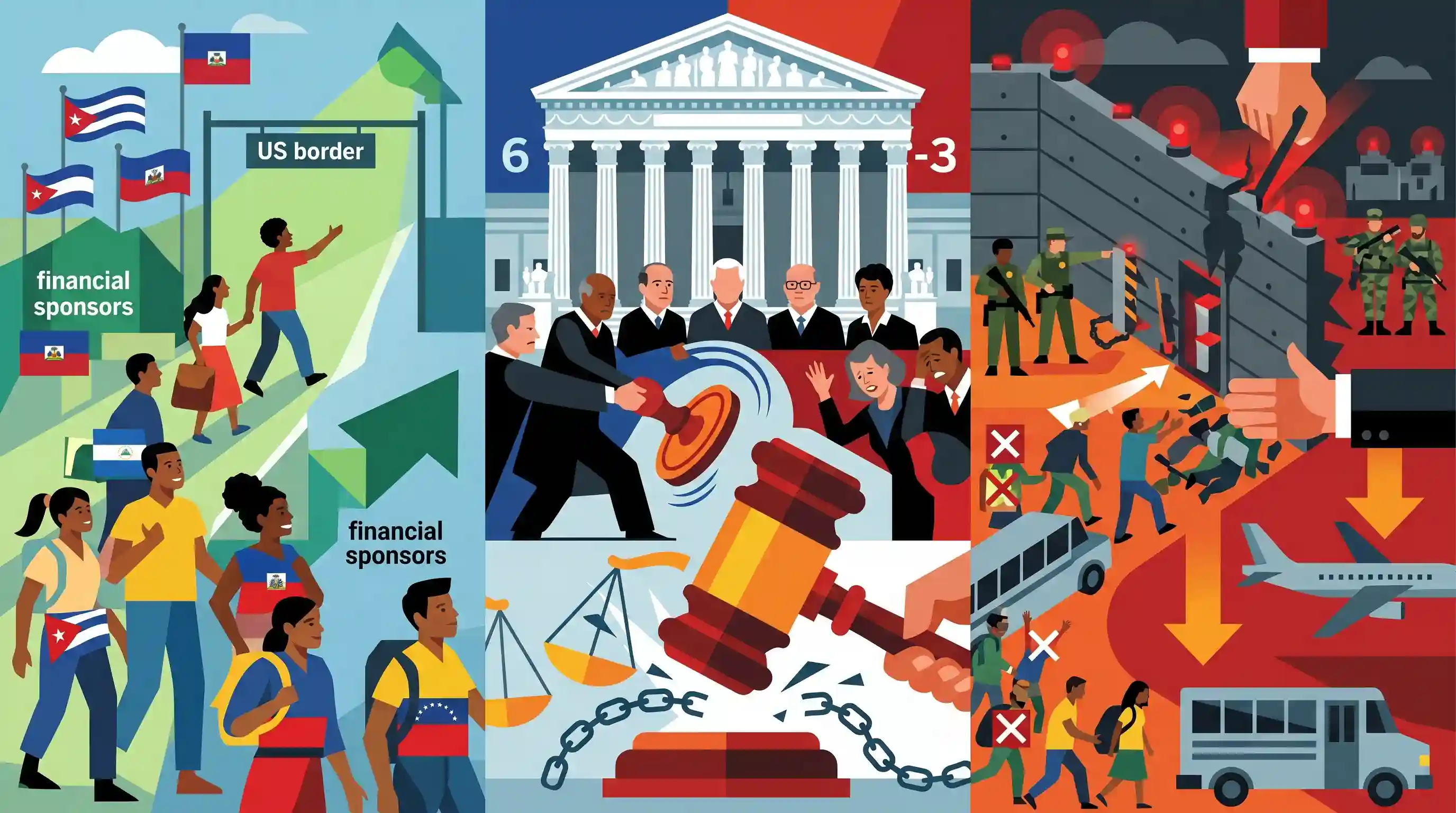
The US Supreme Court has granted the Trump administration the authority to end humanitarian parole for over 500,000 migrants from Cuba, Haiti, Nicaragua, and Venezuela, lifting a lower court's block. The Biden-era program had allowed migrants to legally reside in the US with a financial sponsor. The 6-3 Supreme Court decision, over dissents from liberal justices, sided with the Justice Department's argument that the Department of Homeland Security possesses broad, unreviewable power to revoke such temporary legal protections. The ruling marks a significant victory for the administration's broader push toward stringent immigration enforcement and mass deportations.
Key Points
- The US Supreme Court allowed the Trump administration to revoke humanitarian parole for over 500,000 migrants, overturning a lower-court injunction.
- The affected individuals are primarily from Cuba, Haiti, Nicaragua, and Venezuela, having entered the US under a Biden-era initiative requiring financial sponsors.
- The Justice Department successfully argued that the Department of Homeland Security (DHS) holds broad authority to end these temporary protections without judicial interference.
- The 6-3 decision saw dissents from Justices Ketanji Brown Jackson and Sonia Sotomayor, who warned of potential administrative chaos.
- The ruling underscores a broader executive shift toward stringent immigration enforcement and mass deportation strategies.
Important Terms
Humanitarian Parole Programme

A discretionary US immigration tool allowing foreign nationals temporary entry for urgent humanitarian reasons or significant public benefit without granting permanent residency. (Specifically the Biden-era CHNV program).
UPSC context
GS Paper-II (International Relations): Policies of developed countries affecting global migration and diaspora.
US Supreme Court
The apex judicial body of the United States with the power of final constitutional interpretation and judicial review over executive and legislative actions.
UPSC context
GS Paper-II (Comparative Constitutions): Understanding judicial independence and executive-judicial relations in major democracies.
Department of Homeland Security (DHS)
The US federal executive department responsible for public security, including border control, immigration enforcement, and citizenship services, similar to India’s Ministry of Home Affairs.
UPSC context
GS Paper-II (Governance/International Relations): Administrative bodies shaping international migration flows and bilateral security cooperation.
Justice Department (US)
The US executive department responsible for enforcing federal laws and representing the government in legal matters, headed by the Attorney General.
UPSC context
GS Paper-II (Polity): Executive branch roles in legal enforcement and litigation compared to Indian systems.
Judicial Review
The power of a court to examine and potentially invalidate government actions (legislative or executive) that conflict with the constitution or law.
UPSC context
GS Paper-II (Polity): Scope and limits of the judiciary’s power to check executive discretion in democracies.
Global Diaspora
A community of people living outside their original or ancestral homeland. US policy shifts on migration significantly impact the influence and security of such global populations.
UPSC context
GS Paper-II (International Relations): Effect of policies of developed countries on India’s interests and the Indian diaspora.
Prelims Trap
Humanitarian parole provides permanent legal residency and formal refugee status under the 1951 UN Convention.
Parole is a temporary, discretionary executive permission to enter or stay for urgent humanitarian reasons. It is not a permanent legal status or formal refugee designation.
Static Concepts Connected
How does international law distinguish between refugees, asylum seekers, and economic migrants?
- Refugees: Individuals fleeing persecution or conflict, possessing a well-founded fear of return, protected under the 1951 Convention.
- Asylum Seekers: Individuals who have crossed international borders seeking protection but whose formal refugee status remains unconfirmed.
- Economic Migrants: Individuals crossing borders primarily for economic opportunity rather than escaping persecution; lacking specific international refugee protection.
What is India's legal and policy stance regarding the 1951 UN Refugee Convention?
- Non-Signatory: India has not signed the 1951 UN Refugee Convention or its 1967 Protocol, citing security and border concerns.
- Domestic Law: India lacks specific refugee legislation; all refugees and asylum seekers are governed under the Foreigners Act, 1946.
- Non-Refoulement: Despite being a non-signatory, India generally respects this customary international law principle, prohibiting forced return to persecution.
Cross-Topic Patterns
US migration policy and economic spillover
Stringent US deportation policies disrupt vital remittance flows to Latin America, compounding the very economic crises and state failures that originally drove the forced migration.
Push factors in Latin America
The mass exodus from Cuba, Haiti, Nicaragua, and Venezuela highlights how regime sanctions, democratic backsliding, and severe economic collapse act as overwhelming push factors for regional migration.

Expect a 2026 Prelims statement distinguishing temporary 'Humanitarian Parole' from formal 'Refugee' status under the 1951 UN Convention.
Linked PYQs · 2
Linked PYQs · 2
- 2020MainsGS2
Indian diaspora has a decisive role to play in the politics and economy of America and European Countries'. Comment with examples.
- 2023MainsGS2
Indian diaspora has scaled new heights in the West. Describe its economic and political benefits for India.
