Supreme Court examines constitutional limits of legislative privileges
Source:Indian Express ↗
ఇది ఎందుకు ముఖ్యం
It directly affects the checks and balances between key organs of democracy (Legislature and Judiciary) and defines the limits of legislative privileges vis-à-vis fundamental rights.
సారాంశం
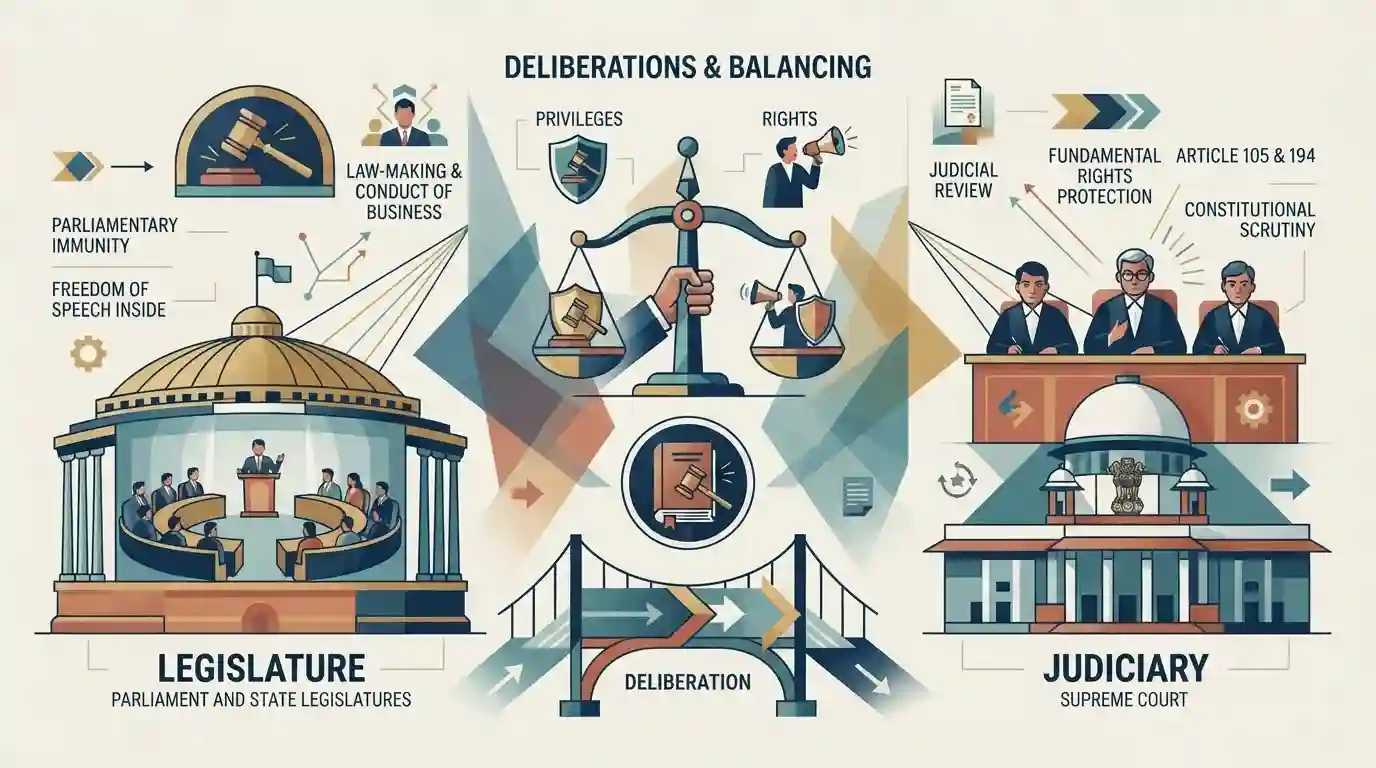
An analysis of the Supreme Court's deliberations on legislative privileges versus fundamental rights, exploring the legal and constitutional nuances surrounding parliamentary immunity, freedom of speech, and the boundaries of judicial review under Articles 105 and 194 of the Indian Constitution.
ముఖ్య అంశాలు
- The Supreme Court is examining the interplay between legislative privileges (Articles 105 and 194) and fundamental rights, notably freedom of speech (Article 19).
- The core constitutional question centers on whether legislators enjoy immunity from prosecution for taking bribes or making statements inside the legislature, and how far judicial review extends over legislative privileges.
- This involves balancing legislative independence and dignity with constitutionalism, rule of law, and accountability.
ముఖ్యమైన పదాలు
Article 105

Constitutional provision providing powers, privileges, and immunities to Parliament, its members, and committees, including freedom of speech within the House and protection from legal proceedings for statements made or votes cast.
UPSC context
GS Paper II (Indian Polity): Tests understanding of parliamentary privileges, legislative immunity, and the separation of powers between the judiciary and legislature.
Article 194
Constitutional provision granting equivalent powers, privileges, and immunities to State Legislatures and their members, ensuring legislative independence and freedom of speech subject to constitutional provisions.
UPSC context
GS Paper II (Indian Polity): Focuses on federal dynamics, powers of state legislatures, and the balance between legislative immunity and fundamental rights.
ప్రిలిమ్స్ ఉచ్చు
Lawmakers enjoy absolute criminal immunity under Articles 105 and 194 for any action, including bribery, performed within the legislature.
Aspirants often confuse absolute immunity of speech under Articles 105(2) and 194(2) with immunity from criminal acts like bribery, assuming all legislative actions inside the House are completely shielded from judicial scrutiny.
అనుసంధానమైన స్థిర భావనలు
What are the constitutional provisions governing legislative privileges and immunities of MPs and MLAs in India?
- Article 105: Article 105 deals with the powers, privileges, etc., of Parliament, its members, and committees, specifically granting freedom of speech and immunity from court proceedings.
- Article 194: Article 194 mirrors Article 105, extending similar powers, privileges, and immunities to members and committees of State Legislatures.
- Sita Soren Case: The 2024 Sita Soren judgment overruled the 1998 P.V. Narasimha Rao ruling, holding that bribery is not protected by legislative immunity.
అంతర-అంశ నమూనాలు
Legislative Immunity vs Prevention of Corruption Act
The curtailment of criminal immunity for legislative bribery directly impacts the anti-decorruption framework under the Prevention of Corruption Act and Tenth Schedule disqualification proceedings.
Judicial Review vs Legislative Privileges Doctrine
The 7-judge Constitution Bench ruling balancing parliamentary privilege against judicial review connects legislative autonomy with the basic structure doctrine and judicial oversight.

Expect a statement-based prelims question testing whether parliamentary privileges override fundamental rights or the Prevention of Corruption Act.
అనుసంధాన PYQలు · 3
అనుసంధాన PYQలు · 3
- 2020MainsGS2
Judicial Legislation is antithetical to the doctrine of separation of powers as envisaged in the Indian Constitution. In this context justify the filing of large number of public interest petitions praying for issuing guidelines to executive authorities.
- 2019MainsGS2
From the resolution of contentious issues regarding distribution of legislative powers by the courts, 'Principle of Federal Supremacy' and 'Harmonious Construction' have emerged. Explain.
- 2022MainsGS2
Discuss the procedures to decide the disputes arising out of the election of a Member of the Parliament or State Legislature under The Representation of the People Act, 1951. What are the grounds on which the election of any returned candidate may be declared void ? What remedy is available to the aggrieved party against the decision ? Refer to the case laws.
