Supreme Court Examines Interplay of Legislative Privileges
Source:Indian Express ↗
Why It Matters
It directly addresses the core constitutional checks and balances between the legislature and the judiciary, highlighting the boundaries of parliamentary privileges and freedom of speech versus accountability.
Summary
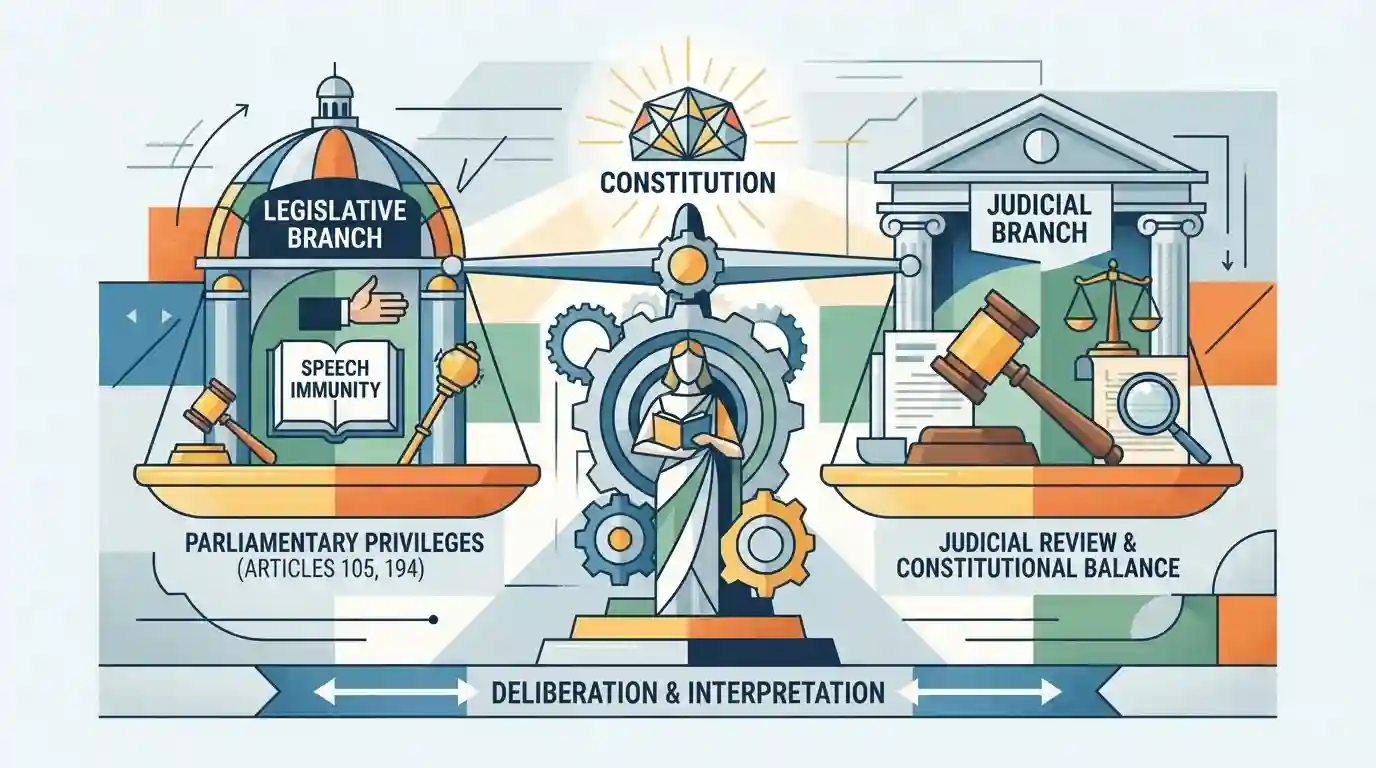
This article explores the Supreme Court's deliberations on legislative privileges and freedom of speech, analyzing the constitutional balance between parliamentary immunities under Articles 105 and 194 and the power of judicial review.
Key Points
- The Supreme Court is examining the interplay between legislative privileges and fundamental rights, specifically concerning free speech and criminal acts by legislators.
- Legislative privileges under Articles 105 and 194 grant certain immunities to lawmakers, but their limits vis-a-vis judicial review and corruption/bribery remain a subject of intense legal scrutiny.
- Uncodified nature of legislative privileges in India often leads to tension between the legislature and the judiciary regarding the extent of oversight.
Important Terms
Article 105

Constitutional provision granting powers, privileges, and freedom of speech to Parliament and its members, ensuring unhindered legislative debate and protection from legal action for speeches or votes.
UPSC context
GS Paper 2 (Indian Polity - Parliament structure, functioning, and privileges). Tests understanding of legislative immunities and the separation of powers.
Article 194
Constitutional provision that extends powers, privileges, and immunities equivalent to those under Article 105 to State Legislatures and their members.
UPSC context
GS Paper 2 (State Legislatures and Privileges). Tests candidates on federal legislative autonomy, state-level parliamentary privileges, and judicial oversight.
Supreme Court of India
The apex judicial body in India that acts as the final interpreter of the Constitution and exercises judicial review over legislative and executive actions.
UPSC context
GS Paper 2 (Judiciary, Separation of Powers). Essential for questions on checks and balances, judicial activism, and review of parliamentary privileges.
Prelims Trap
Legislative privileges under Articles 105 and 194 are codified in Indian law and are absolute against judicial review.
Aspirants often assume parliamentary privileges in India are codified in a single statute or are absolute and immune from judicial scrutiny. In reality, they are largely uncodified and subject to judicial review.
Static Concepts Connected
What are the constitutional provisions governing legislative privileges and their relation to fundamental rights in India?
- Parliamentary Privileges: Article 105 covers powers and privileges of Parliament and its members, including freedom of speech subject to constitutional provisions and rules.
- State Legislatures: Article 194 governs similar powers, privileges, and immunities for State Legislatures and their members.
- Fundamental Rights: Privileges are subject to fundamental rights, particularly Article 19 and Article 21, though legislative freedom of speech operates within the House.
- Landmark Ruling: The 2024 Sita Soren case established that bribery is not protected under legislative immunity.
Cross-Topic Patterns
Legislative Privileges vs British Parliamentary Sovereignty
While Articles 105 and 194 draw from British parliamentary practice, Indian courts exercise judicial review over legislative actions, distinguishing our constitutional setup from British parliamentary sovereignty.
Parliamentary Immunity vs Prevention of Corruption Act
The Sita Soren ruling directly impacts anti-corruption statutes like the Prevention of Corruption Act, ensuring criminal liability supersedes legislative immunity for bribery.

Expect a statement-based question pairing Articles 105/194 privileges with the 2024 Sita Soren judgment on bribery and judicial review.
Linked PYQs · 1
Linked PYQs · 1
- 2014MainsGS2
The 'Powers, Privileges and Immunities of Parliament and its Members' as envisaged in Article 105 of the Constitution leave room for a large number of un-codified and un-enumerated privileges to continue. Assess the reasons for the absence of legal codification of the 'parliamentary privileges'. How can this problem be addressed ?
