Constitutional Balance Between Legislative Privileges and Free Speech
Source:Indian Express ↗
આ શા માટે મહત્વનું છે
Crucial for understanding the constitutional boundary between legislative autonomy/privileges and fundamental rights, which directly impacts accountability, anti-corruption frameworks, and the doctrine of separation of powers in Indian democracy.
સારાંશ
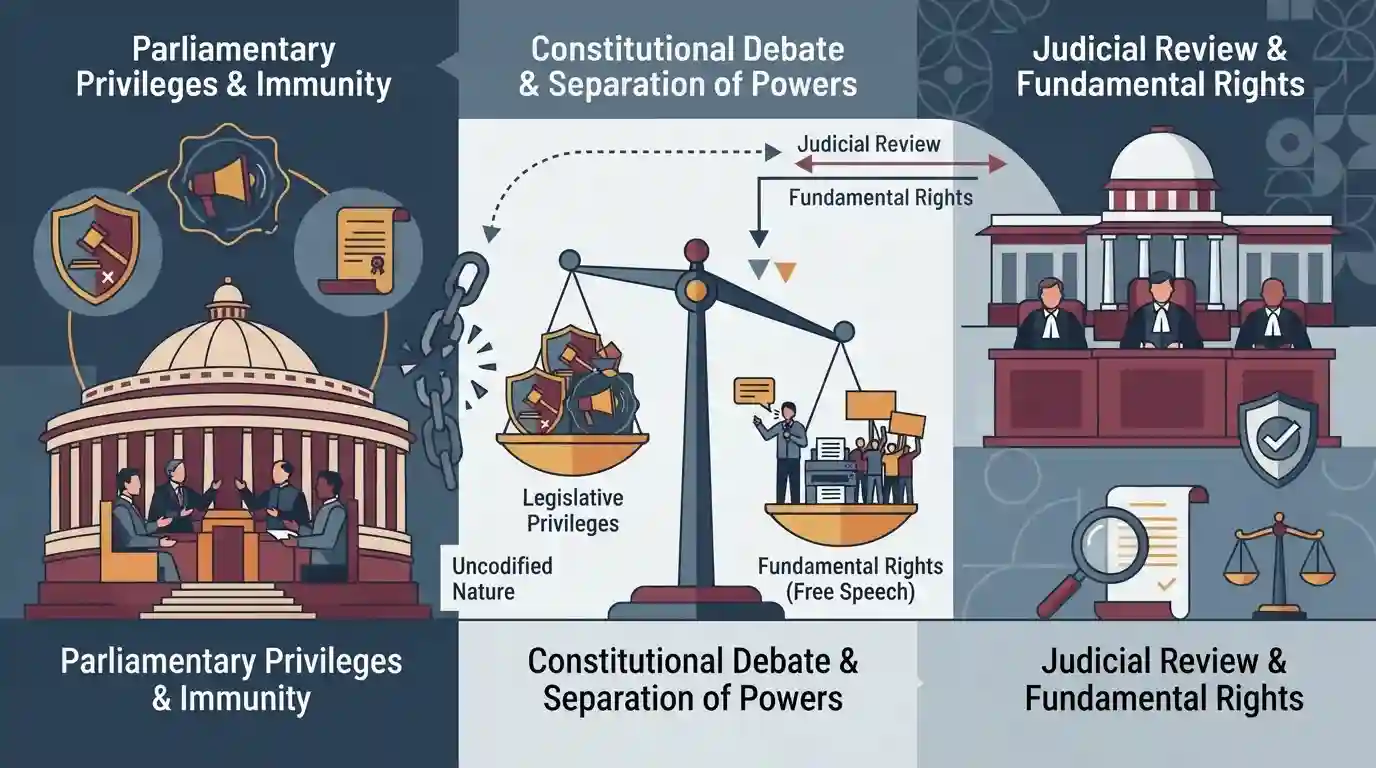
An analysis of the Supreme Court proceedings and constitutional debates surrounding legislative privileges versus fundamental rights to free speech, highlighting the complex dynamics of parliamentary immunity, judicial review, and the uncodified nature of privileges in India.
મુખ્ય મુદ્દા
- The Supreme Court examines the balance between legislative privileges (Articles 105 and 194) and fundamental rights, particularly free speech (Article 19(1)(a)).
- The debate centers on whether legislators enjoy absolute immunity from judicial scrutiny for actions or speeches inside the legislature, even if they cross into criminality or corruption (such as taking bribes for votes/speeches).
- Uncodified and un-enumerated nature of parliamentary privileges continues to generate legal complexities and recurring friction between legislative autonomy and judicial review.
મહત્વપૂર્ણ શબ્દો
Article 105

Constitutional provision that grants members of Parliament freedom of speech and immunity from court proceedings for anything said or voted in Parliament or its committees.
UPSC context
UPSC CSE GS Paper II (Polity & Governance - Parliament and State Legislatures: Structure, Functioning, Conduct of Business, Powers & Privileges).
Article 194
Constitutional provision that mirrors Article 105, conferring powers, privileges, and immunities upon state legislatures, their members, and committees.
UPSC context
UPSC CSE GS Paper II (Polity & Governance - Powers, Privileges and Immunities of State Legislatures).
Article 19(1)(a)
A fundamental right guaranteed to all citizens under Part III of the Constitution, subject to reasonable restrictions under Article 19(2).
UPSC context
UPSC CSE GS Paper II (Fundamental Rights, Judicial Review, and Freedom of Speech versus Legislative Privileges).
પ્રિલિમ્સ ટ્રેપ
Parliamentary privileges in India are fully codified through a comprehensive statute enacted under Article 105.
Aspirants often assume parliamentary privileges in India are codified in a comprehensive statute enacted by Parliament, but they remain largely uncodified under Articles 105(3) and 194(3).
સંલગ્ન સ્થિર ખ્યાલો
What are the constitutional provisions governing legislative privileges in India?
- Constitutional Basis: Article 105 governs Parliament and its members, while Article 194 governs State Legislatures and their members.
- Core Immunity: Guarantees freedom of speech inside the House and immunity from court proceedings for anything said or any vote given.
- Limitations: Subject to other provisions of the Constitution, including fundamental rights like Article 21, as clarified in recent rulings.
આંતર-વિષય પેટર્ન
Legislative Corruption vs Constitutional Immunity Precedents
The 2024 Sita Soren ruling altered decades-old immunity precedents, demonstrating how apex court benches can overturn constitutional interpretations on parliamentary ethics and anti-corruption frameworks.
Uncodified Privileges and Colonial Legal Transplants
The uncodified nature of privileges relies on British conventions, linking domestic constitutional law directly to comparative constitutionalism and evolution of colonial legal transplants in India.

Sita Soren 7-judge bench ruling + Articles 105/194 + uncodified nature of privileges = prime candidate for a multi-statement prelims Q.
સંલગ્ન PYQ · 1
સંલગ્ન PYQ · 1
- 2014MainsGS2
The 'Powers, Privileges and Immunities of Parliament and its Members' as envisaged in Article 105 of the Constitution leave room for a large number of un-codified and un-enumerated privileges to continue. Assess the reasons for the absence of legal codification of the 'parliamentary privileges'. How can this problem be addressed ?
