BNSS Section 20 Validity and Prosecution Service Judicial Officers
Source:The Hindu ↗
Why It Matters
The ruling reinforces the nuance in the doctrine of separation of powers in India and clarifies how the new criminal codes (like BNSS) intersect with constitutional principles. Understanding Article 50 and the independence of the judiciary is highly relevant for GS Paper II and Prelims.
Summary
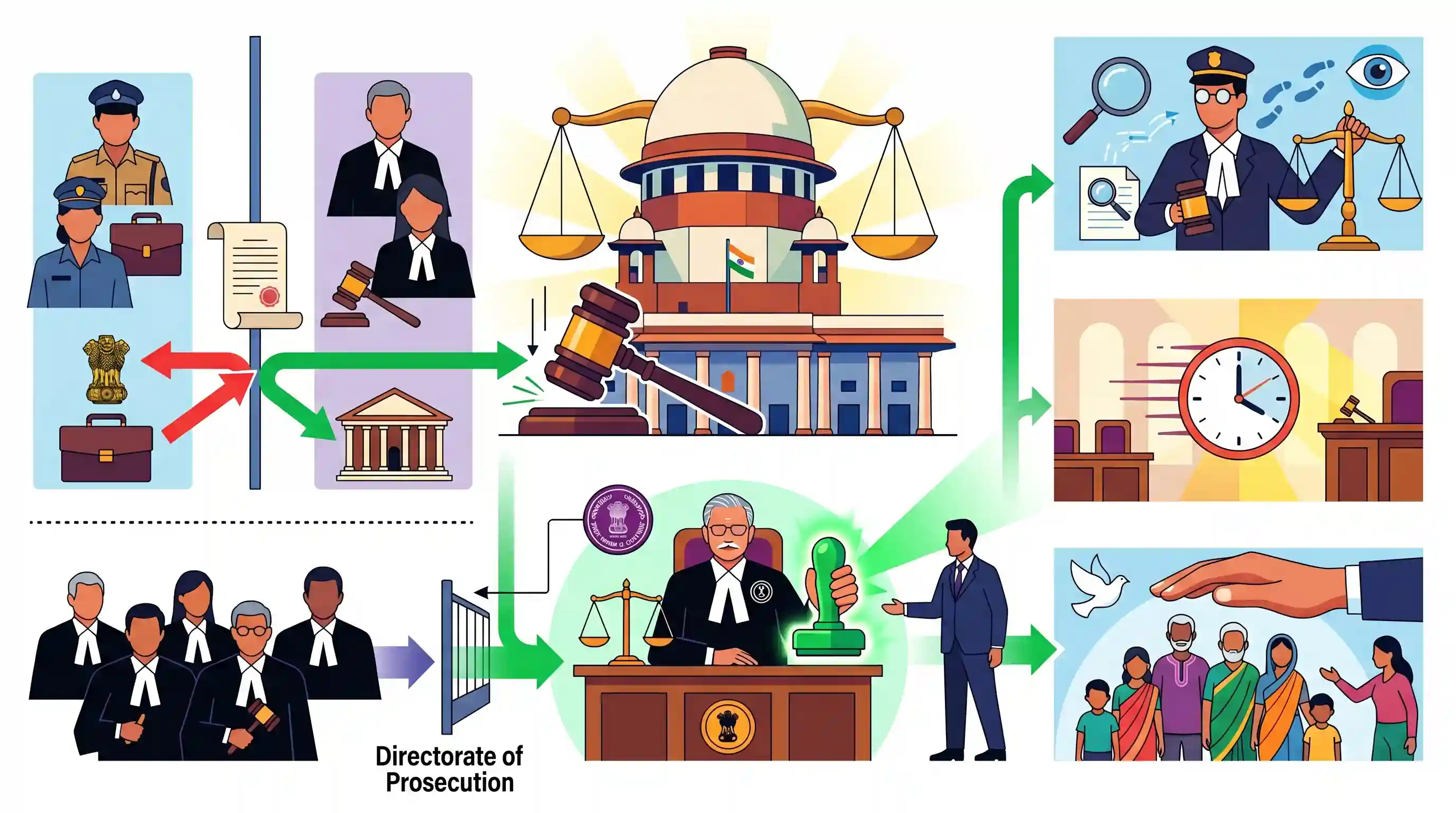
The Supreme Court has upheld the validity of Section 20 of the Bharatiya Nagarik Suraksha Sanhita (BNSS), 2023, which permits the appointment of serving or retired judicial officers to the Directorate of Prosecution. Rejecting a plea that claimed the provision violated the constitutional doctrine of separation of powers and Article 50, the Court emphasized that the mandatory consent of the High Court Chief Justice for such appointments safeguards judicial independence from executive interference. The bench highlighted that bringing experienced judicial officers into the prosecution machinery would ensure fair investigations, expedite trials, and protect the rights of victims and marginalized groups.
Key Points
- The Supreme Court dismissed a plea challenging the constitutionality of Section 20 of the Bharatiya Nagarik Suraksha Sanhita (BNSS), 2023.
- Section 20 allows serving or retired judicial officers to be appointed as directors or deputy directors in the Directorate of Prosecution.
- Petitioners argued this provision violates Article 50 (separation of judiciary from executive) and undermines judicial independence by blending executive and judicial functions.
- The Court rejected the argument, noting the mandatory consent of the High Court Chief Justice protects against executive encroachment.
- The bench reasoned that introducing judicial minds into the prosecution system enhances the fairness of investigations and trials, balancing the rights of both accused and victims.
Important Terms
Bharatiya Nagarik Suraksha Sanhita (BNSS), 2023

The primary statute governing criminal procedure in India, replacing the CrPC (1973). It modernizes investigative processes, introduces digital evidence norms, and restructures the prosecution machinery through Section 20.
UPSC context
GS Paper 2 (Criminal Justice Reforms). Tests understanding of procedural law updates and their impact on fundamental rights.
Separation of Powers
A constitutional doctrine dividing government functions into Legislative, Executive, and Judicial branches to prevent power concentration. India follows functional separation with a system of checks and balances.
UPSC context
GS Paper 2 (Polity). Essential for analyzing the basic structure of the Constitution and inter-organ relationships.
Article 50
A Directive Principle of State Policy (Part IV) that mandates the State to separate the judiciary from the executive in public services to ensure impartial justice.
UPSC context
GS Paper 2 (DPSP/Judiciary). Tests knowledge of constitutional directives aimed at protecting judicial autonomy from executive interference.
Directorate of Prosecution
The state agency overseeing criminal prosecutions. It monitors cases, scrutinizes police reports, and advises on appeals. Under BNSS, it includes Director, Deputy Director, and Assistant Director tiers.
UPSC context
GS Paper 2 (Governance). Tests understanding of the institutional machinery responsible for trial efficiency and prosecutorial independence.
Judicial Independence
The principle that the judiciary must be free from external influence—particularly from the executive and legislature—to ensure impartial adjudication and uphold the rule of law.
UPSC context
GS Paper 2 (Judiciary). A "Basic Structure" element; tested via cases on appointments and autonomy of judicial officers.
Prelims Trap
Appointing judicial officers to the Directorate of Prosecution violates the separation of powers under Article 50.
The SC upheld BNSS Section 20, ruling it merely sets eligibility. It prohibits simultaneous judge/prosecutor roles, and HC Chief Justice consent prevents executive overreach.
Static Concepts Connected
What is the constitutional position of Article 50?
- DPSP Mandate: It directs the State to separate the judiciary from the executive in the public services of the State, positioned under Part IV (DPSP).
- Functional Separation: Unlike the rigid US model, India follows a functional separation of powers, allowing overlaps that are governed by institutional checks and balances.
- Historical Implementation: The mandate was significantly realized by stripping executive magistrates of judicial trial powers and vesting them in judicial magistrates via the CrPC 1973.
How is the Directorate of Prosecution structured under current law?
- Statutory Basis: Originally introduced via Section 25A of the CrPC (2005 amendment), it is now governed and structurally decentralized by Section 20 of the BNSS, 2023.
- Administrative Control: The Directorate functions under the administrative control of the Home Department of the respective State government.
- Judicial Safeguard: Appointments of eligible judicial officers as Directors/Deputy Directors require the mandatory concurrence of the High Court Chief Justice.
Cross-Topic Patterns
BNSS and Prosecutorial Independence
The structural shift in BNSS connects with the long-standing Prakash Singh police reform directives aimed at insulating investigation and prosecution from political executive pressure.
Procedural Law vs Basic Structure
Challenges to the new criminal codes often invoke structural doctrines, demonstrating how procedural laws (like BNSS) are actively tested against the Basic Structure and DPSPs in real-time.

Expect a multi-statement Prelims question pairing Article 50 (DPSP) with BNSS provisions on prosecutorial appointments and HC consent.
Linked PYQs · 4
Linked PYQs · 4
- 2020MainsGS2
Judicial Legislation is antithetical to the doctrine of separation of powers as envisaged in the Indian Constitution. In this context justify the filing of large number of public interest petitions praying for issuing guidelines to executive authorities.
- 2023MainsGS2
“Constitutionally guaranteed judicial independence is a prerequisite of democracy.” Comment.
- 2025PrelimsGS1
Consider the following pairs : Provision in the Constitution of India Stated under I. Separation of Judiciary from the Executive in the public services of the State : The Directive Principles of the State Policy II. Valuing and preserving of the rich heritage of our composite culture : The Fundamental Duties III. Prohibition of employment of children below the age of 14 years in factories : The Fundamental Rights How many of the above pairs are correctly matched?
- 2020PrelimsGS1
In India, separation of judiciary from the executive is enjoined by
