Supreme Court Judges Bill and Judicial Structure Reform
Source:Indian Express ↗
Why It Matters
It examines parliamentary authority over judicial composition and statutory changes affecting the Supreme Court's administrative framework, core topics for Indian Polity and Governance under GS Paper 2.
Summary
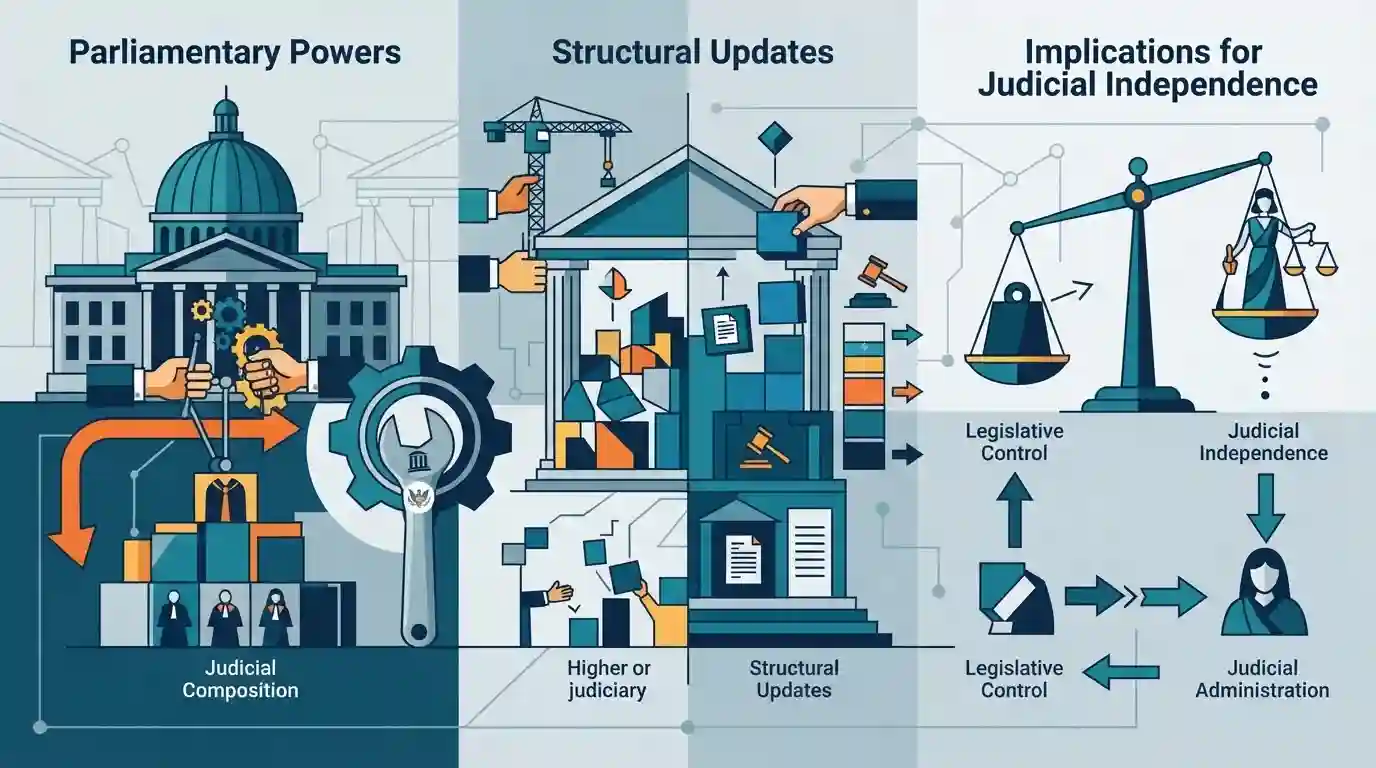
An overview of the Supreme Court Judges Bill, highlighting parliamentary powers over judicial composition, structural updates for the higher judiciary, and implications for judicial administration and independence.
Key Points
- The Supreme Court Judges Bill addresses administrative and structural framework matters related to the top court.
- Under Article 124(1) of the Constitution, Parliament holds the authority to regulate the strength and composition of the Supreme Court.
- Legislative measures concerning higher judiciary structures often intersect with discussions on judicial independence, administrative efficiency, and case backlog management.
Important Terms
Supreme Court Judges Bill

Legislative measure introduced to modify the sanctioned strength of judges in the Supreme Court of India under Article 124, reflecting parliamentary authority over court composition.
UPSC context
GS Paper II (Polity & Governance) - Structure, organization and functioning of the Executive and the Judiciary.
Supreme Court of India
The apex judicial authority of India established under Part V of the Constitution, serving as the highest court of appeal and guardian of the Constitution.
UPSC context
GS Paper II - Structure, organization and functioning of the Judiciary and its role in constitutional interpretation.
Parliament
The supreme legislative body of India comprising the President, Lok Sabha, and Rajya Sabha, possessing law-making powers including judicial administration.
UPSC context
GS Paper II - Parliament and State Legislatures—structure, functioning, conduct of business, powers & privileges.
Static Concepts Connected
How is the strength and composition of the Supreme Court of India regulated constitutionally?
- Article 124(1):: Original Constitution set the Supreme Court strength at a Chief Justice and 7 other judges, leaving further increases to Parliament.
- Statutory Power:: Parliament exercises this authority by enacting laws such as the Supreme Court (Number of Judges) Amendment Act, without needing a constitutional amendment.
Cross-Topic Patterns
Judicial Independence vs. Parliamentary Supremacy
Parliament's undisputed power to fix judge strength under Article 124 intersects with debates on judicial accountability, standardizing appointments, and the limits of legislative interference.

Article 124(1) power allocation between Parliament and the judiciary will likely feature in a statement-based Polity question.
Linked PYQs · 2
Linked PYQs · 2
- 2014PrelimsGS1
The power to increase the number of judges in the Supreme Court of India is vested in
- 2025MainsGS2
Discuss the evolution of collegium system in India. Critically examine the advantages and disadvantages of the system of appointment of the Judges of the Supreme Court of India and that of the USA.
