Supreme Court Judges Bill for Judicial Capacity
Source:Indian Express ↗
हे का महत्त्वाचे आहे
Understanding legislative changes regarding the strength of the Supreme Court is crucial for analyzing judicial capacity, governance, and institutional reforms aimed at tackling pendency.
सारांश
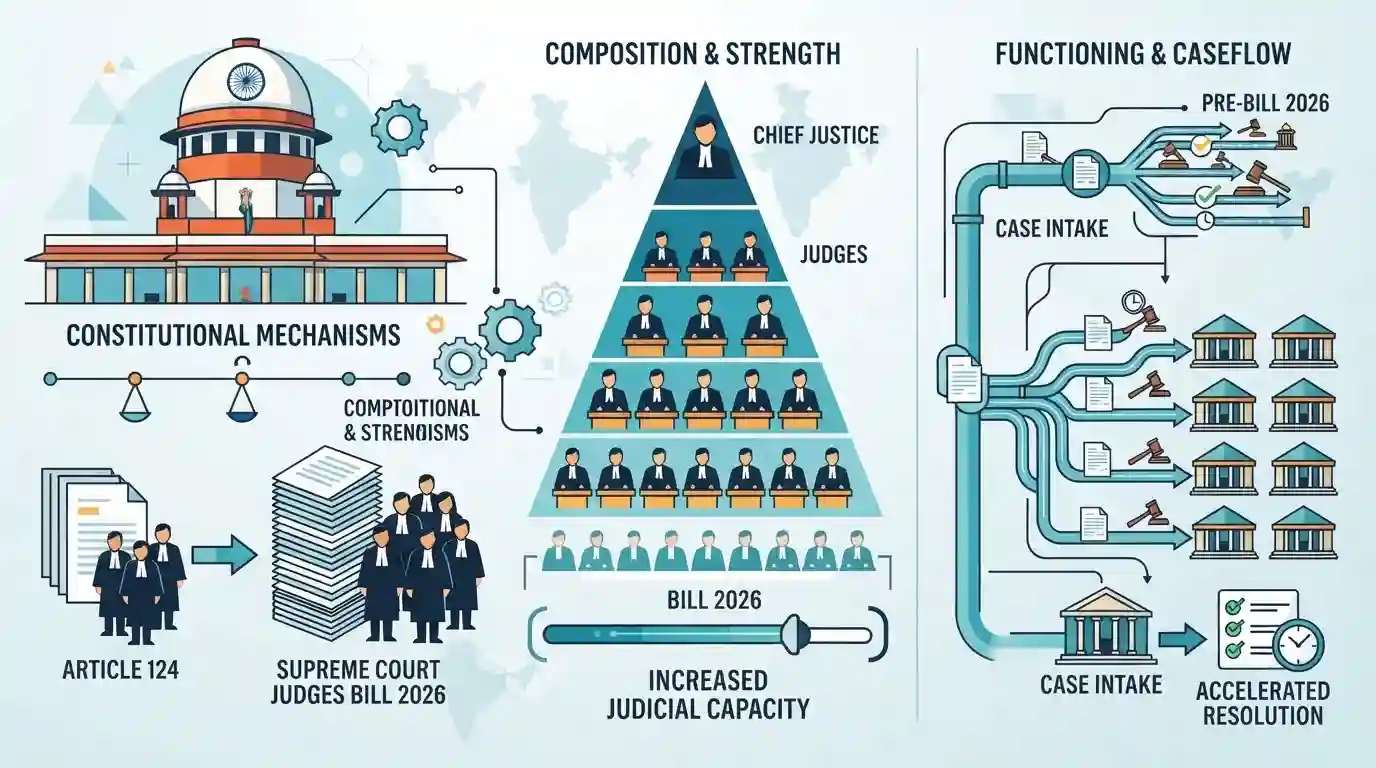
An explanation of the Supreme Court Judges Bill 2026, detailing its implications for the composition, strength, and functioning of India's apex judiciary, as well as the constitutional mechanisms governing judge strength.
मुख्य मुद्दे
- The Supreme Court Judges Bill 2026 addresses the strength and operational framework of the Supreme Court of India.
- Changes to the number of Supreme Court judges require parliamentary legislation under Article 124 of the Constitution.
- Such legislative measures reflect administrative responses to expanding judicial backlogs and workload management in the apex court.
महत्त्वाच्या संज्ञा
Supreme Court Judges Bill 2026

A legislative measure introduced to amend the Supreme Court (Number of Judges) Act to increase the apex court's sanctioned judge strength to manage burgeoning case pendency.
UPSC context
GS Paper II (Indian Constitution—Features and Significant Provisions; Judiciary). Tests understanding of legislative changes to judicial capacity and administrative management of backlogs.
Supreme Court (Number of Judges) Act
The principal parliamentary legislation under Article 124 that determines and regulates the sanctioned number of judges in the Supreme Court of India.
UPSC context
GS Paper II (Structure, Organization, and Functioning of the Judiciary). Tests constitutional mechanisms and statutory power governing judicial strength.
Supreme Court of India
The apex judicial tribunal of India established under Article 124 of the Constitution, possessing original, appellate, and advisory jurisdiction.
UPSC context
GS Paper II (Polity and Governance). Tests constitutional structure, role as the guardian of the Constitution, and apex adjudicatory framework.
Parliament
The bicameral national legislature of India, comprising the Lok Sabha and Rajya Sabha, empowered under Article 124 to regulate the Supreme Court's composition and strength.
UPSC context
GS Paper II (Parliament and State Legislatures—Structure, Functioning, and Conduct of Business). Tests the separation of powers and legislative supremacy over statutory judicial parameters.
पूर्वपरीक्षा सापळा
Changes to the sanctioned strength of the Supreme Court require a constitutional amendment under Article 368.
Aspirants often confuse altering judge strength (which requires a simple parliamentary majority under Article 124 via an ordinary Act) with a constitutional amendment under Article 368.
संबंधित स्थिर संकल्पना
How is the sanctioned strength of the Supreme Court of India determined under the Constitution?
- Article 124: Constitutional provision under Article 124(1) states the Supreme Court shall consist of a Chief Justice and other judges, whose number is prescribed by Parliament.
- Ordinary Legislation: Statutory vehicle requires amendments to the Supreme Court (Number of Judges) Act rather than a constitutional amendment under Article 368.
आंतर-विषय नमुने
Judicial Strength vs Judicial Appointments
While Parliament determines judge strength under Article 124, the executive retains appointment powers via the Collegium system, highlighting the delicate separation of powers.

Article 124's explicit provision on parliamentary power to fix SC judge strength is a frequent source of tricky matching statements.
संबंधित PYQ · 2
संबंधित PYQ · 2
- 2025MainsGS2
Discuss the evolution of collegium system in India. Critically examine the advantages and disadvantages of the system of appointment of the Judges of the Supreme Court of India and that of the USA.
- 2017MainsGS2
Critically examine the Supreme Court's judgement on 'National Judicial Appointments Commission Act, 2014' with reference to appointment of judges of higher judiciary in India.
