Supreme Court seeks response on child labour in spas and orchestras
Source:The Hindu ↗
Why It Matters
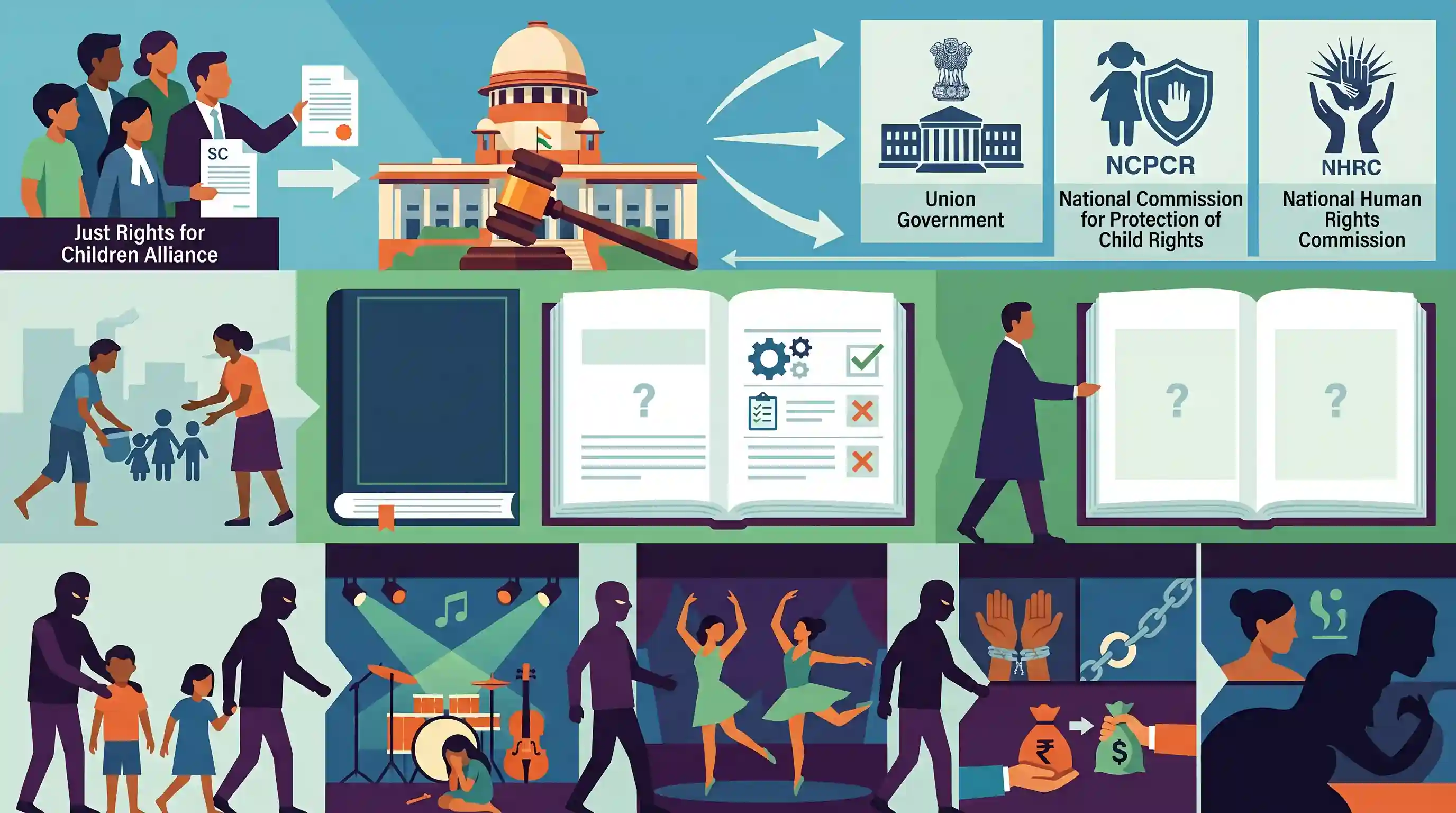
This issue exposes critical legislative loopholes in the Child and Adolescent Labour (Prohibition and Regulation) Act (CALPRA), 1986. It illustrates how regulatory ambiguities can be exploited for organized crime, human trafficking, and commercial sexual exploitation, making it highly relevant for questions on child rights, vulnerable sections, and internal security.
Summary
The Supreme Court of India has issued notices to the Union Government, the National Commission for Protection of Child Rights (NCPCR), and the National Human Rights Commission (NHRC) regarding a Public Interest Litigation (PIL) that demands a total ban on the employment of children and adolescents in orchestras, dance troupes, massage parlours, and spas. Filed by the child rights collective 'Just Rights for Children Alliance', the PIL exposes a critical enforcement gap in the Child and Adolescent Labour (Prohibition and Regulation) Act (CALPRA), 1986. Currently, the Act merely regulates, rather than bans, adolescent employment in spas, while completely omitting orchestras and dance troupes. Petitioners argue that these loopholes allow such sectors to operate as fronts for child trafficking, commercial sexual exploitation, and modern-day slavery, preying on vulnerable minors from impoverished communities.
Key Points
- The Supreme Court sought responses from the Centre, NCPCR, and NHRC on a PIL demanding an absolute ban on employing children and adolescents in orchestras, dance troupes, spas, and massage parlours.
- The PIL highlights an enforcement vacuum in the Child and Adolescent Labour (Prohibition and Regulation) Act (CALPRA), 1986, which merely "regulates" adolescent employment in spas and completely unlists orchestras and dance troupes.
- Petitioners argue that these unregulated sectors serve as clandestine fronts for organized human trafficking, commercial sexual exploitation, and debt bondage.
- The vulnerability of minors is exacerbated in these sectors; reports indicate that over 44% of identified trafficking victims are minors often lured from impoverished backgrounds.
Important Terms
Child and Adolescent Labour (Prohibition and Regulation) Act (CALPRA), 1986

An Indian law prohibiting children (<14) from all occupations and adolescents (14-18) from 'hazardous' ones. It establishes penalties for violations and mandates regulation of non-hazardous adolescent work.
UPSC context
GS II: Social Justice & Welfare Laws. Tests knowledge of legal frameworks protecting vulnerable sections and amendments (2016) regarding adolescent work.
National Commission for Protection of Child Rights (NCPCR)
A statutory body established under the CPCR Act, 2005, to ensure all laws and policies in India align with child rights and the UN Convention on the Rights of the Child.
UPSC context
GS II: Statutory and Regulatory Bodies. Tests understanding of the administrative machinery for child welfare and implementation of POCSO/RTE.
National Human Rights Commission (NHRC)
A statutory body established under the Protection of Human Rights Act, 1993, to monitor, investigate, and recommend action against human rights violations, acting as the nation's human rights watchdog.
UPSC context
GS II: Statutory Bodies. Essential for questions on human rights governance, quasi-judicial powers, and the protection of civil liberties.
Public Interest Litigation (PIL)
A legal action filed in a court for the protection of 'public interest.' It relaxes 'locus standi,' allowing public-spirited citizens to represent those unable to seek justice.
UPSC context
GS II: Judiciary. Key concept for judicial activism, access to justice, and the Supreme Court’s role as a social transformer.
Hazardous Occupations (Schedule)
A list of industries (Part A and B of the Schedule to CALPRA) where employing minors is strictly banned or regulated due to physical or moral risks.
UPSC context
GS II: Social Justice. Important for understanding the 'regulatory gap' between prohibited and regulated labour sectors for adolescents.
Just Rights for Children Alliance (JRCA)
A coalition of over 270 civil society organizations in India that works to combat child trafficking, commercial sexual exploitation, and modern-day slavery through advocacy and litigation.
UPSC context
GS II: Civil Society & NGOs. Example of the role of non-governmental collectives in driving policy change through judicial interventions.
Prelims Trap
The CALPRA Act 2016 completely prohibits the employment of both children and adolescents in all commercial establishments.
The 2016 amendment bans all child labour (<14) but only prohibits adolescents (14-18) in *hazardous* occupations. Unlisted sectors like spas are merely regulated, creating the loophole.
Static Concepts Connected
How do Articles 23 and 24 differ regarding forced and child labour?
- Article 23: Prohibits traffic in human beings, begar, and similar forms of forced labour. It offers protection against exploitation to individuals of all ages.
- Article 24: Specifically prohibits the employment of children below 14 years in factories, mines, or any other hazardous employment, focusing entirely on child protection.
What are ILO Conventions 138 and 182 regarding child labour?
- Convention 138: Mandates states to set a minimum age for employment. India ratified it in 2017, aligning domestic laws with the CALPRA 2016 amendment.
- Convention 182: Focuses on immediate elimination of the 'worst forms' of child labour, including trafficking and commercial sexual exploitation. Also ratified by India in 2017.
Cross-Topic Patterns
Trafficking nexus in unregulated sectors
The link between labour law loopholes and human trafficking bridges GS2 (vulnerable sections) and GS3 (organized crime). Modern slavery increasingly thrives in urban service sectors rather than traditional bonded labour.
NCPCR and child artists regulations
UPSC often tests statutory body mandates. CALPRA permits children to work as 'artists' in audio-visual entertainment, a legal exception currently scrutinized for widespread abuse in informal dance troupes and orchestras.

Expect a multi-statement Prelims question testing the exact definitions of 'child' vs 'adolescent' and the hazardous list under CALPRA.
Linked PYQs · 4
Linked PYQs · 4
- 2025MainsGS2
The National Commission for Protection of Child Rights has to address the challenges faced by children in the digital era. Examine the existing policies and suggest measures the Commission can initiate to tackle the issue.
- 2014MainsGS2
National Human Rights Commission (NHRC) in India can be most effective when its tasks are adequately supported by other mechanisms that ensure the accountability of a government. In light of the above observation assess the role of NHRC as an effective complement to the judiciary and other institutions in promoting and protecting human rights standards.
- 2016MainsGS2
Examine the main provisions of the National Child Policy and throw light on the status of its implementation.
- 2018MainsGS3
India's proximity to two of the world's biggest illicit opium-growing states has enhanced her internal security concerns. Explain the linkages between drug trafficking and other illicit activities such as gunrunning, money laundering and human trafficking. What counter-measures should be taken to prevent the same?
