Supreme Court Review of State Anti-Conversion Laws and Secularism
Source:The Hindu ↗
Why It Matters
The debate over anti-conversion laws strikes at the heart of India's secularism and Fundamental Rights (Articles 21 and 25). It frequently appears in UPSC Mains regarding the limits of state intervention in individual autonomy, the right to privacy, and the definition of 'propagate' versus 'convert'.
Summary
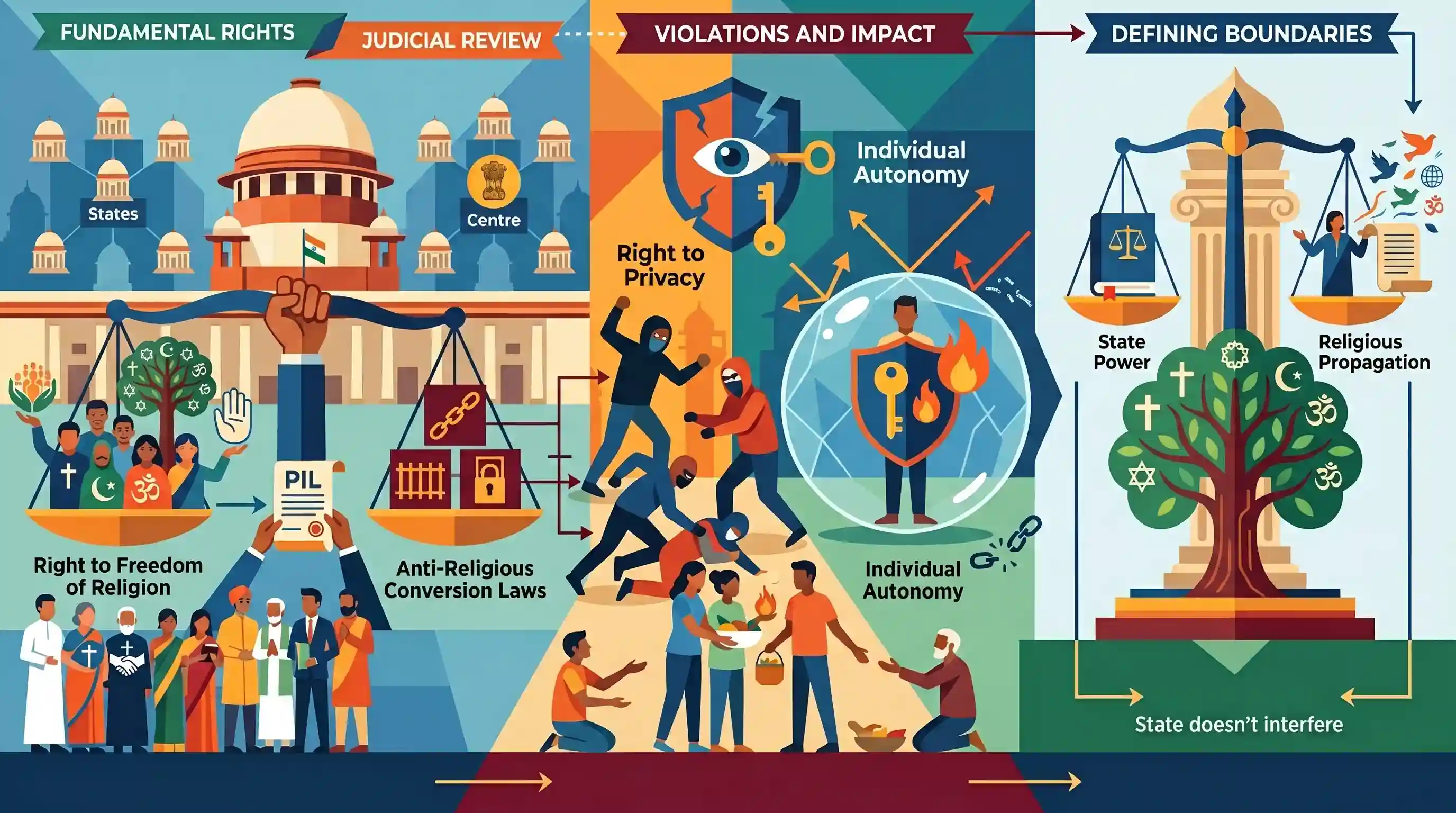
The Supreme Court has sought responses from the Centre and 12 state governments following a Public Interest Litigation (PIL) by the National Council of Churches in India (NCCI) challenging the validity of anti-religious conversion laws. The petitioners argue that these state enactments violate Article 25(1) of the Constitution, which guarantees the right to freely profess, practice, and propagate religion. Furthermore, they contend that the laws are being exploited by vigilante groups to harass minorities engaged in charity, undermining individual autonomy and the right to privacy (referencing the 2018 Shafin Jahan ruling). This judicial scrutiny will be pivotal in defining the boundaries of religious propagation, secularism, and state power in India.
Key Points
- The Supreme Court issued notices to the Centre and 12 States responding to a PIL by the NCCI challenging the constitutional validity of state-level anti-religious conversion laws.
- The petitioner argues that these laws restrict the fundamental right to profess, practice, and propagate religion as guaranteed under Article 25(1) of the Constitution.
- The PIL raises concerns that vigilante groups weaponize these state acts against minority communities performing charitable works by falsely labeling them as illegal conversion attempts.
- The legal challenge balances on precedents like the Shafin Jahan (2018) case, asserting individual autonomy and right to privacy, versus older judgements like Rev. Stainislaus (1977) concerning forced conversions.
Important Terms
Anti-conversion laws

State-level 'Freedom of Religion' Acts regulating religious conversions through force, fraud, or allurement; currently enacted in 12 Indian states like UP, MP, and Gujarat.
UPSC context
GS Paper 2: Government policies, Fundamental Rights, and communal harmony; tests understanding of secularism and state power.
Article 25(1)
Constitutional provision guaranteeing all persons freedom of conscience and the right to freely profess, practice, and propagate religion, subject to public order, morality, and health.
UPSC context
GS Paper 2: Fundamental Rights; core to the debate on religious freedom and individual vs. state rights.
Rev. Stainislaus v/s State of Madhya Pradesh (1977)
A 1977 Supreme Court ruling which held that the right to 'propagate' religion does not include a fundamental right to convert another person.
UPSC context
GS Paper 2: Landmark Judgments; defines the legal boundary between propagation and conversion in India.
Shafin Jahan case (2018)
A 2018 Supreme Court judgment affirming that the right to choose a partner and religion is an intrinsic part of individual autonomy and privacy.
UPSC context
GS Paper 2: Judiciary, Individual Liberty; tests the application of 'Right to Privacy' in personal life choices.
Article 21
Guarantees the Right to Life and Personal Liberty; interpreted by the Supreme Court to include the right to privacy and individual autonomy.
UPSC context
GS Paper 2: Fundamental Rights; the most widely interpreted article regarding personal liberty and judicial activism.
National Council of Churches in India (NCCI)
An ecumenical body representing various Protestant and Orthodox churches in India, acting as a key petitioner against state anti-conversion enactments.
UPSC context
GS Paper 2: Pressure groups and formal/informal associations and their role in the Polity.
Prelims Trap
"The right to propagate religion under Article 25 includes the fundamental right to convert another person."
The Supreme Court in Rev. Stainislaus (1977) explicitly ruled that "propagate" means transmitting tenets, not a fundamental right to convert, as that impinges on another's freedom of conscience.
Static Concepts Connected
What are the specific constitutional limitations on Article 25?
- Explicit grounds: The right is explicitly subject to public order, morality, and health.
- Other Fundamental Rights: It is strictly subject to other provisions of Part III, meaning it cannot violate rights like equality (Art 14) or life/liberty (Art 21).
- State regulation: The State can still regulate or restrict economic, financial, political, or other secular activities associated with religious practices.
How does judicial precedent balance religious conversion and personal liberty?
- Stainislaus (1977): Upheld state anti-conversion acts, ruling that the right to propagate does not grant the right to convert others.
- Shafin Jahan (2018): Held that an adult's right to choose their faith and partner is an intrinsic part of individual autonomy and protected under Article 21.
- Constitutional Morality: Acts as a check on majoritarian laws by protecting individual rights and minority freedoms from arbitrary state interference.
Cross-Topic Patterns
Article 21 vs. Article 25 evolution
UPSC increasingly tests the intersection of fundamental rights. The shift from examining conversions purely under Art 25 (Stainislaus) to individual autonomy under Art 21 (Shafin Jahan) highlights privacy's expanding scope.
Federalism, State List, and Public Order
State anti-conversion acts are justified under 'Public Order' (State List, Entry 1). A Supreme Court review of 12 states simultaneously tests the limits of state legislative competence.

Expect a 2026 Prelims question contrasting the Stainislaus ruling (Art 25) with the Shafin Jahan privacy doctrine (Art 21).
Linked PYQs · 4
Linked PYQs · 4
- 2024MainsGS2
Right to privacy is intrinsic to life and personal liberty and is inherently protected under Article 21 of the constitution. Explain. In this reference discuss the law relating to D.N.A. testing of child in the womb to establish its paternity.
- 2023MainsGS2
“The Constitution of India is a living instrument with capabilities of enormous dynamism. It is a constitution made for a progressive society.” Illustrate with special reference to the expanding horizons of the right to life and personal liberty.
- 2017MainsGS2
Examine the scope of Fundamental Rights in the light of the latest judgement of the Supreme Court on Right to Privacy.
- 2024MainsGS2
Discuss India as a secular state and compare with the secular principles of the US constitution.
