SEIAA environmental clearances and EIA governance loopholes
Source:The Hindu ↗
Why It Matters
Provides a crucial real-world case study on the misuse of 'deemed approval' provisions in the EIA Notification, 2006. It highlights institutional failures, bypassing of statutory environmental bodies (SEIAA/SEAC), and the role of the judiciary in checking administrative subversion of environmental laws. Relevant for GS3 (Environment) and GS4 (Ethics).
Summary
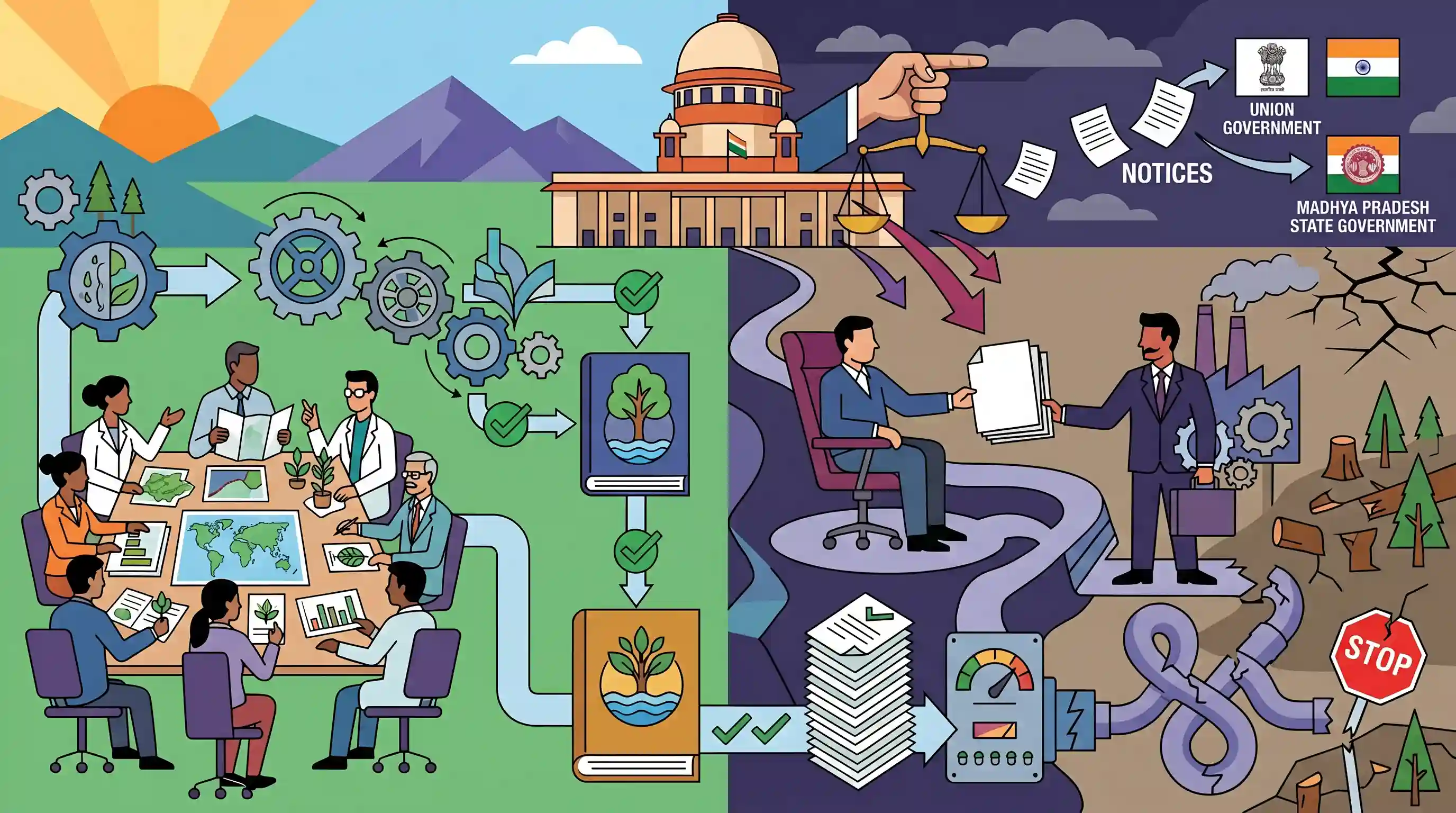
The Supreme Court has issued notices to the Union Government and Madhya Pradesh regarding a plea challenging 237 environmental clearances allegedly granted illegally by the State Environment Impact Assessment Authority (SEIAA) member-secretary. The petition claims the clearances bypassed the mandatory collective decision-making process by exploiting "deemed approval" loopholes and were issued unilaterally without proper SEIAA or SEAC meetings. This alleged collusion between officials and industrial lobbies circumvented the Environment (Protection) Act, 1986, and the EIA Notification, 2006, highlighting severe breaches in state-level environmental governance.
Key Points
- The Supreme Court issued notices to the Centre, Madhya Pradesh, and SEIAA regarding 237 environmental clearances allegedly granted illegally.
- The plea claims a SEIAA member-secretary granted the clearances unilaterally, bypassing mandatory committee meetings and exploiting 'deemed approval' provisions.
- The actions allegedly violated the Environment (Protection) Act, 1986, and the EIA Notification, 2006, by intentionally letting statutory appraisal periods lapse.
- The petition highlights systemic collusion between senior public officials and mining/industrial lobbies, overriding warnings from the SEIAA chairman.
Important Terms
Environment (Protection) Act, 1986

Enacted under Article 253 following the 1984 Bhopal tragedy, it provides an 'umbrella' framework for the Central Government to coordinate environmental protection activities and set national standards.
UPSC context
GS Paper 3: Environment. Tests understanding of statutory frameworks and the 'umbrella' nature of environmental legislation in India.
Environmental Impact Assessment (EIA) Notification, 2006
A statutory mandate under the 1986 Act that decentralizes project clearances into Category A (Central) and Category B (State), outlining mandatory stages like screening, scoping, and public hearing.
UPSC context
GS Paper 3: Environmental Governance. Tests knowledge of the regulatory process for balancing industrial development with ecological conservation.
State Environment Impact Assessment Authority (SEIAA)
A three-member state-level body (including a Chairman and Member-Secretary) constituted by the Centre to grant or reject environmental clearances for Category 'B' projects based on expert recommendations.
UPSC context
GS Paper 2/3: Statutory Bodies/Environment. Relevant for questions on federal environmental governance and institutional accountability.
State Expert Appraisal Committee (SEAC)
A multidisciplinary panel of experts that provides technical appraisal and recommendations to the SEIAA for Category 'B' projects, functioning on the principle of collective responsibility.
UPSC context
GS Paper 3: Environmental Impact Assessment. Focuses on the technical 'Appraisal' stage of the clearance process.
Deemed Approval
A provision in the EIA Notification 2006 (Clause 8(iii)) where a project is automatically granted clearance if the regulatory authority fails to convey its decision within specified statutory timelines.
UPSC context
GS Paper 2: Probity in Governance. Highlights regulatory loopholes and the risk of 'collusion' to bypass environmental scrutiny.
Supreme Court of India
The apex judicial body in India that exercises 'Judicial Review' and 'Environmental Jurisprudence' to ensure state authorities adhere to the rule of law and sustainable development principles.
UPSC context
GS Paper 2: Judiciary. Focuses on the court's role in enforcing environmental accountability and Public Interest Litigations (PILs).
Prelims Trap
"SEIAA and SEAC are statutory bodies constituted by the respective State Governments."
Despite functioning at the state level, both SEIAA and SEAC are constituted by the Central Government under Section 3(3) of the Environment (Protection) Act, 1986.
Static Concepts Connected
How does the EIA Notification 2006 categorize projects for clearance?
- Category A: Appraised at the national level by the Expert Appraisal Committee (EAC) and cleared by the MoEFCC. Covers large-scale developmental projects.
- Category B: Appraised at the state level by the State Expert Appraisal Committee (SEAC) and cleared by the SEIAA. Covers smaller-scale projects.
- Public Consultation: Mandatory for both Category A and Category B1 projects, but completely exempt for Category B2 projects.
What is the 'Deemed Approval' clause under the EIA Notification, 2006?
- 45-day window: Triggered if the regulatory authority (MoEFCC or SEIAA) fails to communicate its decision within 45 days of the expert committee's recommendation.
- Automatic clearance: The environmental clearance is legally considered granted based strictly on the expert committee's final recommendations.
- Judicial stance: Courts have ruled deemed clearance cannot legitimize violations; it requires full procedural compliance prior to the period lapsing.
Cross-Topic Patterns
EIA loopholes & Probity in Governance
The intentional delay of meetings to trigger "deemed approvals" serves as a classic GS4 case study on how bureaucrats exploit statutory loopholes for collusive corruption.
Delegated Legislation & Environmental Federalism
Highlights the friction in environmental federalism, where powers delegated to state-level bodies (SEIAA) under a Central Act (EPA 1986) suffer from weak central oversight mechanisms.

Expect a Prelims question targeting the Central constitution of state-level SEIAAs and the exact triggers for 'deemed' EIA clearances.
Linked PYQs · 5
Linked PYQs · 5
- 2024MainsGS3
What role do environmental NGOs and activists play in influencing Environmental Impact Assessment (EIA) outcomes for major projects in India? Cite four examples with all important details.
- 2020MainsGS3
How does the draft Environment Impact Assessment (EIA) Notification, 2020 differ from the existing EIA Notification, 2006?
- 2014MainsGS3
Environmental Impact Assessment studies are increasingly undertaken before a project is cleared by the Government. Discuss the environmental impacts of coal-fired thermal plants located at coal pitheads.
- 2022MainsGS2
“The most significant achievement of modern law in India is the constitutionalization of environmental problems by the Supreme Court.” Discuss this statement with the help of relevant case laws.
- 2022PrelimsGS1
Which one of the following has been constituted under the Environment (Protection) Act, 1986?
