Supreme Court judicial review of West Bengal OBC certification
Source:livelaw ↗
Why It Matters
This case touches upon the constitutional and legal dynamics of OBC reservations, state-issued certificates, and judicial review by High Courts and the Supreme Court, which is vital for civil services preparation concerning federalism, rights, and governance.
Summary
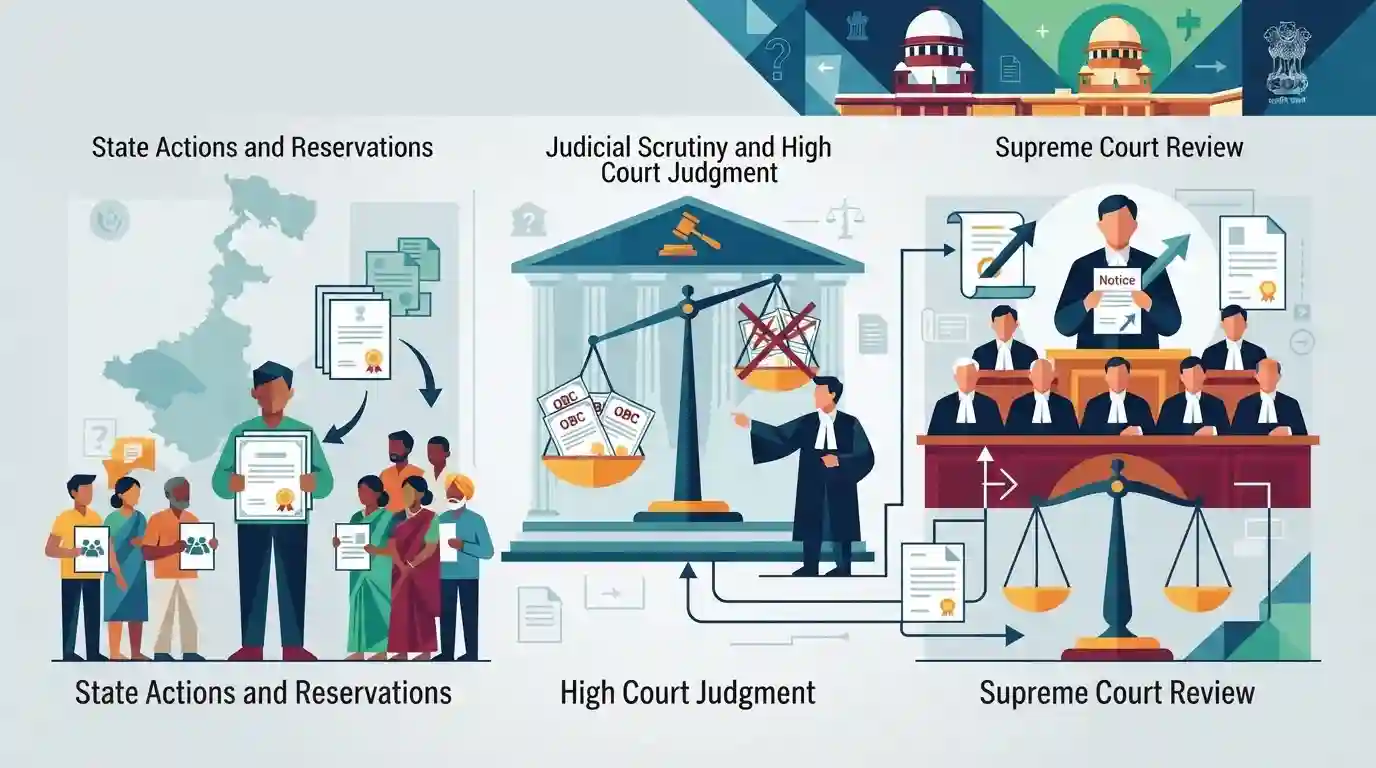
The Supreme Court of India issued a notice on a plea challenging the Calcutta High Court judgment which had invalidated several OBC certificates issued in West Bengal. The case highlights crucial legal questions regarding reservation policies, backward classes documentation, and judicial scrutiny of state actions in West Bengal.
Key Points
- The Supreme Court has issued notice on a special leave petition challenging the Calcutta High Court judgment that invalidated certain OBC certificates issued in West Bengal.
- The Calcutta High Court had earlier declared several OBC certificates issued or updated under state laws/mechanisms as invalid, raising major administrative and legal questions concerning reservations in the state.
- The matter involves critical issues surrounding the constitutional validity of state-backed backward class reservations and administrative procedures.
Important Terms
Supreme Court

The apex judicial body of India, serving as the final court of appeal, protector of the Constitution, and arbiter of disputes between states and the Centre under Article 132-143.
UPSC context
Crucial for WBCS Polity and Governance (Paper V), testing knowledge of judicial review, appellate jurisdiction, and constitutional adjudication.
Calcutta High Court
The oldest High Court in India, exercising original, appellate, and writ jurisdictions over West Bengal and the Andaman and Nicobar Islands under Article 226.
UPSC context
Essential for WBCS West Bengal Administration and Judiciary topics (Paper V), testing state-level judicial hierarchy and writ jurisdiction.
Static Concepts Connected
What are the constitutional provisions governing reservation and backward classes in India?
- Articles 15 & 16: Ensures equality of opportunity in matters of public employment and prohibits discrimination on grounds of religion, race, caste, sex, or place of birth.
- Article 15(4) & 16(4): Empowers the State to make provisions for the advancement of any socially and educationally backward classes of citizens or for SCs and STs.
- Article 338B: Provides for the establishment of a National Commission for Backward Classes (NCBC) with constitutional status under Article 338B.
Cross-Topic Patterns
Reservation Validity & Judicial Review
Judicial scrutiny of state-backed reservation lists intersects with Article 16(4) and the constitutional mandate of adequate representation, frequently tested in WBCS Mains Paper V.

Expect a 2-statement question on the constitutional limits of state-backed OBC categorizations vs. statutory authority.
Linked PYQs · 2
Linked PYQs · 2
- 2019WBCS_PRELIMSGS1
The Constitution Bill (123rd Amendment), 2017 deals with
- 2023WBCS_PRELIMSGS1
Who is the head of the commission for the sub-categorization of OBC's?
