Supreme Court Ruling on Internet Access for Children
Source:Indian Express ↗
কেন এটি গুরুত্বপূর্ণ
It addresses the evolving interpretation of Fundamental Rights (Article 21) in the digital age, specifically concerning vulnerable demographics like children, balancing access with online safety and digital inclusion.
সারসংক্ষেপ
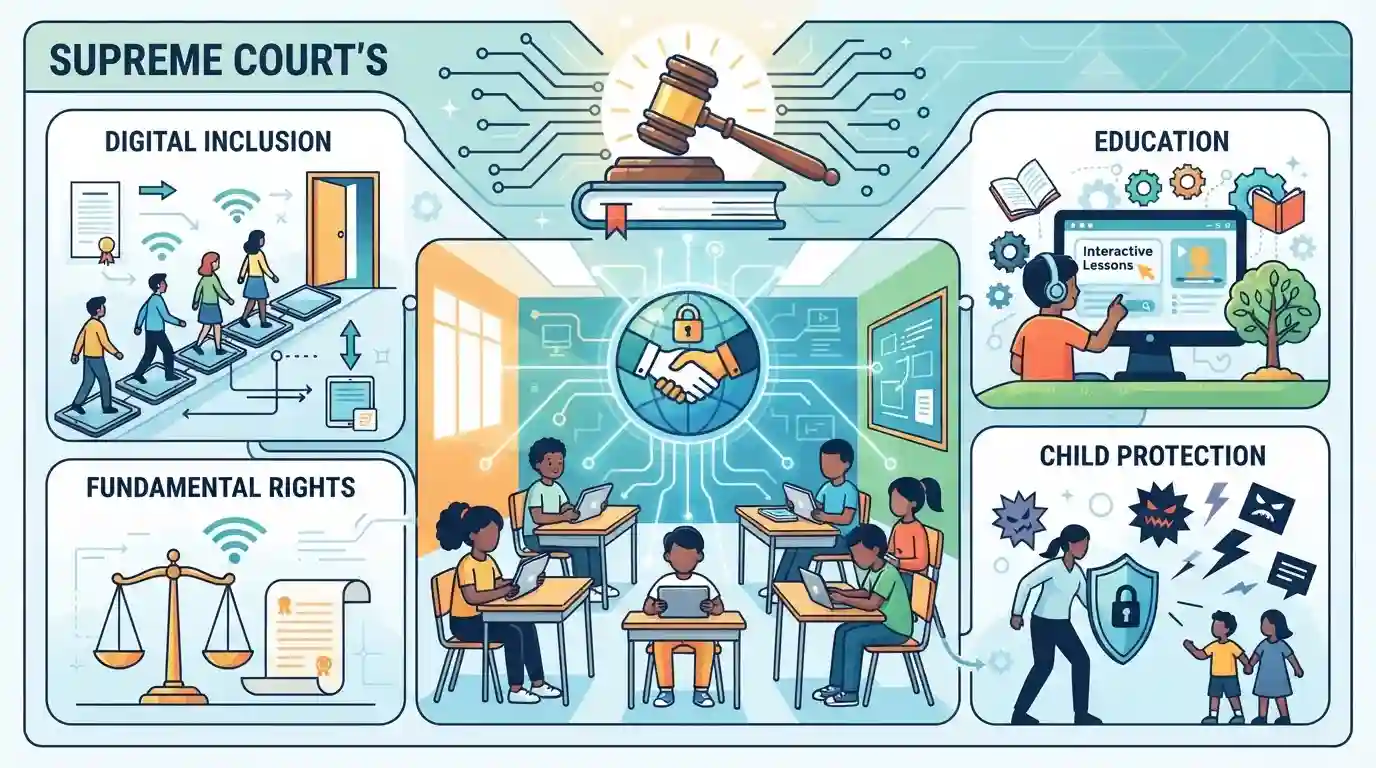
The article discusses the Supreme Court's perspectives and judicial pronouncements regarding internet access as a fundamental right, with a specific focus on children's rights, digital inclusion, education, and protection in the modern era.
মূল বিষয়
- The Supreme Court has addressed the question of internet access as a fundamental right, specifically concerning children and their digital rights.
- Digital equity and access to the internet have become critical components of modern education, development, and exercise of fundamental freedoms.
- Balancing children's rights to information and education via the internet with online safety, privacy, and protection from digital harms is a key governance challenge.
গুরুত্বপূর্ণ শব্দ
Article 21

A fundamental right guaranteed under Part III of the Indian Constitution ensuring protection of life and personal liberty, which the Supreme Court has expanded to include internet access and digital inclusion.
UPSC context
GS Paper II (Indian Constitution - Evolution, Features, Amendments, Basic Structure, and Fundamental Rights). Crucial for questions on judicial activism and evolving rights.
Right to Education Act
Enacted pursuant to Article 21A, this legislation makes free and compulsory education a fundamental right for children aged 6 to 14, intersecting with digital access for modern learning.
UPSC context
GS Paper II (Governance and Social Sector - Education and Child Rights). Essential for policies on universal schooling, equity, and modern pedagogical reforms.
Supreme Court
The apex constitutional court of India, responsible for judicial review and landmark pronouncements interpreting fundamental rights, including the recognition of digital access for all individuals, including minors.
UPSC context
GS Paper II (Judiciary, Structure, Organization, and Functioning). Tested regarding judicial review, public interest litigation (PIL), and the expansion of constitutional rights.
প্রিলিমস ফাঁদ
internet access was recognized as an independent, standalone fundamental right exclusively under Article 21.
The Supreme Court in Anuradha Bhasin explicitly tied internet access to Article 19(1)(a) and 19(1)(g), not directly as a standalone sub-clause under Article 21.
সংযুক্ত স্থির ধারণা
What are the constitutional provisions and judicial milestones governing internet access and child rights in India?
- Anuradha Bhasin (2020): Freedom of speech and expression and freedom of trade via the internet are protected under Article 19(1)(a) and 19(1)(g).
- Puttaswamy (2017): Right to privacy is a fundamental right under Article 21, extending robust data protection imperatives to minors in digital spaces.
- Article 21A & RTE Act: Makes free and compulsory education for children aged 6-14 years a fundamental right, increasingly interpreted to cover digital learning tools.
আন্তঃবিষয় প্যাটার্ন
Internet Access and Right to Education
Digital access as an educational equalizer intersects with Article 21A, transforming remote schooling into a justiciable constitutional mandate rather than a policy perk.
Free Speech versus Digital Protection of Minors
The tension between unhindered information access and data privacy for minors links Article 19 freedoms directly with Puttaswamy privacy standards.

Expect a multi-statement prelims question linking Article 19 internet rulings, Article 21A, and statutory child protection mandates.
সংযুক্ত PYQ · 3
সংযুক্ত PYQ · 3
- 2024MainsGS2
Right to privacy is intrinsic to life and personal liberty and is inherently protected under Article 21 of the constitution. Explain. In this reference discuss the law relating to D.N.A. testing of child in the womb to establish its paternity.
- 2017MainsGS2
Examine the scope of Fundamental Rights in the light of the latest judgement of the Supreme Court on Right to Privacy.
- 2025MainsGS2
The National Commission for Protection of Child Rights has to address the challenges faced by children in the digital era. Examine the existing policies and suggest measures the Commission can initiate to tackle the issue.
