Supreme Court Fixes Notional Income for Homemakers to Recognize Labor
Source:Indian Express ↗
Why It Matters
This ruling directly addresses the debate around the 'care economy' versus the 'monetized economy'—a specific theme in recent UPSC Mains (e.g., GS3 2023). It provides vital judicial precedent and statistical context (Time Use Survey) for answers related to gender equity, inclusive growth, and the structural barriers limiting female workforce participation in India.
Summary
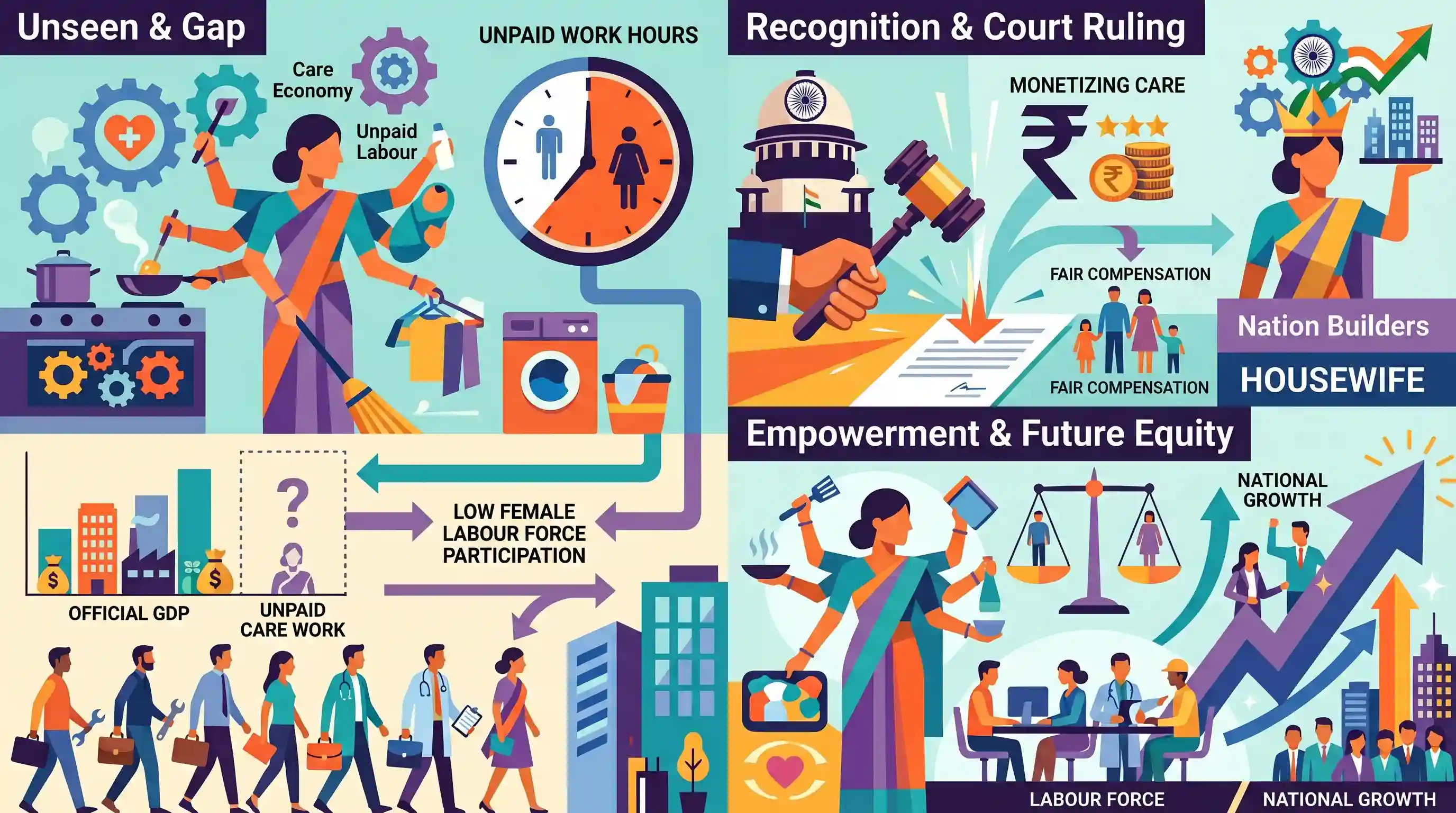
The Supreme Court of India has established a notional monthly income of Rs 30,000 for homemakers in accident compensation claims, marking a significant judicial step in recognizing the economic value of unpaid domestic labor. Rejecting the archaic term "housewife," the Court described homemakers as "nation builders" whose unquantified care work—such as cooking, cleaning, and caregiving—underpins the formal economy but remains invisible in conventional GDP metrics. Citing the 2019 Time Use Survey, the ruling emphasized the stark gender disparity in unpaid work hours, drawing a direct link between this unequal burden and India's persistently low Female Labour Force Participation. By effectively monetizing an aspect of the 'care economy,' the judiciary aims to ensure fair compensation while highlighting the structural need for gender equity and societal recognition of women's labor.
Key Points
- The Supreme Court fixed a notional monthly income of Rs 30,000 for homemakers in a motor accident compensation case, recognizing the economic value of unpaid domestic labour.
- The bench officially endorsed the term "homemaker" over "housewife," describing them as "nation builders" whose caregiving sustains the paid workforce.
- The judgment highlighted that unpaid domestic work is systematically excluded from GDP calculations, rendering women's economic contributions largely invisible.
- The Court cited the 2019 Time Use Survey, which revealed that Indian women spend over 7 hours a day on unpaid domestic services, compared to less than 3 hours for men.
- This judicial recognition directly intersects with the economic challenge of India's low Female Labour Force Participation (FLFP) by addressing the structural burden of the care economy.
Important Terms
Care Economy

An economic sector encompassing paid and unpaid activities related to caregiving (childcare, eldercare, domestic chores). It supports the formal economy but is often excluded from traditional GDP calculations.
UPSC context
GS Paper III (Economy) and Paper I (Social Issues). Relevant for discussions on inclusive growth and gender-responsive budgeting.
Female Labour Force Participation Rate (FLFPR)
A measure of the percentage of the female population (age 15+) that is either working or actively seeking employment. India's FLFP has seen a recent rise, primarily in rural areas.
UPSC context
GS Paper III (Employment/Economy). Tests understanding of labor market trends and gender-based economic disparities.
Notional Income
An estimated income assigned by courts to individuals (like homemakers) who do not earn a market wage, used to calculate fair compensation in legal claims.
UPSC context
GS Paper II (Judiciary) and GS Paper III (Economy). Related to judicial activism and economic valuation of labor.
Time Use Survey (TUS)
A statistical survey measuring time spent by individuals on various activities. The NSO's 2019 survey highlighted the significant time women spend on unpaid domestic work versus men.
UPSC context
GS Paper III (Statistics/Economy). Essential for evidence-based policy making regarding the gender gap and unpaid labor.
Unpaid Domestic Work
Essential services (cooking, cleaning, caregiving) performed within households without monetary exchange. It is a major factor in the 'Double Burden' faced by working women.
UPSC context
GS Paper I (Role of Women). Tests awareness of the socio-economic status of women and structural barriers to empowerment.
Prelims Trap
"The Supreme Court mandated the inclusion of unpaid domestic labor in India's official GDP calculation."
The SC established a 'notional income' strictly for accident compensation claims. Unpaid domestic labor remains outside the UN System of National Accounts (SNA) and is NOT added to official GDP.
Static Concepts Connected
Why is unpaid domestic labor excluded from official GDP calculations?
- Production boundary: The UN System of National Accounts (SNA) excludes domestic services produced for own final consumption due to the statistical difficulty of market valuation.
- Valuation challenge: Assigning a monetary value to subjective household chores is complex and lacks observable market-clearing prices.
- Third-party criterion: Activities are typically counted if they can be delegated to a third party for a wage, which is ambiguous for intimate family caregiving.
What is the Time Use Survey (TUS) conducted in India?
- Nodal agency: Conducted by the National Sample Survey Office (NSSO) under the Ministry of Statistics and Programme Implementation (MoSPI).
- Core objective: To measure the amount of time individuals spend on various activities, thereby quantifying the invisible 'care economy' and unpaid domestic work.
- SDG alignment: It provides essential data for tracking Sustainable Development Goal (SDG) 5.4, which mandates the recognition and valuation of unpaid care work.
Cross-Topic Patterns
Care Economy and the FLFP U-curve
Despite rising female education, India's FLFP remains low. The disproportionate burden of unpaid care work, as mapped by the TUS, is the primary structural bottleneck explaining this U-shaped paradox.
DPSPs and Feminist Economics
Monetizing unpaid labor for accident compensation echoes DPSP Article 39 directives on economic justice, bridging constitutional welfare goals with modern feminist economic theory.

Mains GS-1/GS-3 question highly likely in 2026 linking the 'Care Economy' and Time Use Survey data to India's FLFP paradox.
Linked PYQs · 3
Linked PYQs · 3
- 2023MainsGS3
Distinguish between 'care economy' and 'monetized economy'. How can care economy be brought into monetized economy through women empowerment?
- 2024MainsGS1
Distinguish between gender equality, gender equity and women's empowerment. Why is it important to take gender concerns into account in programme design and implementation?
- 2017PrelimsGS1
Which of the following gives 'Global Gender Gap Index' ranking to the countries of the world?
