Supreme Court Balances Secularism In Bhojshala Complex Dispute
Source:The Hindu ↗
Why It Matters
This development represents a critical study in how the Indian judiciary navigates inter-faith disputes, positive secularism, and public order. It directly intersects with constitutional protections of composite culture under Fundamental Duties (Article 51A(f)), religious freedom (Articles 25-28), and the contested legal boundaries of the Places of Worship (Special Provisions) Act, 1991.
Summary
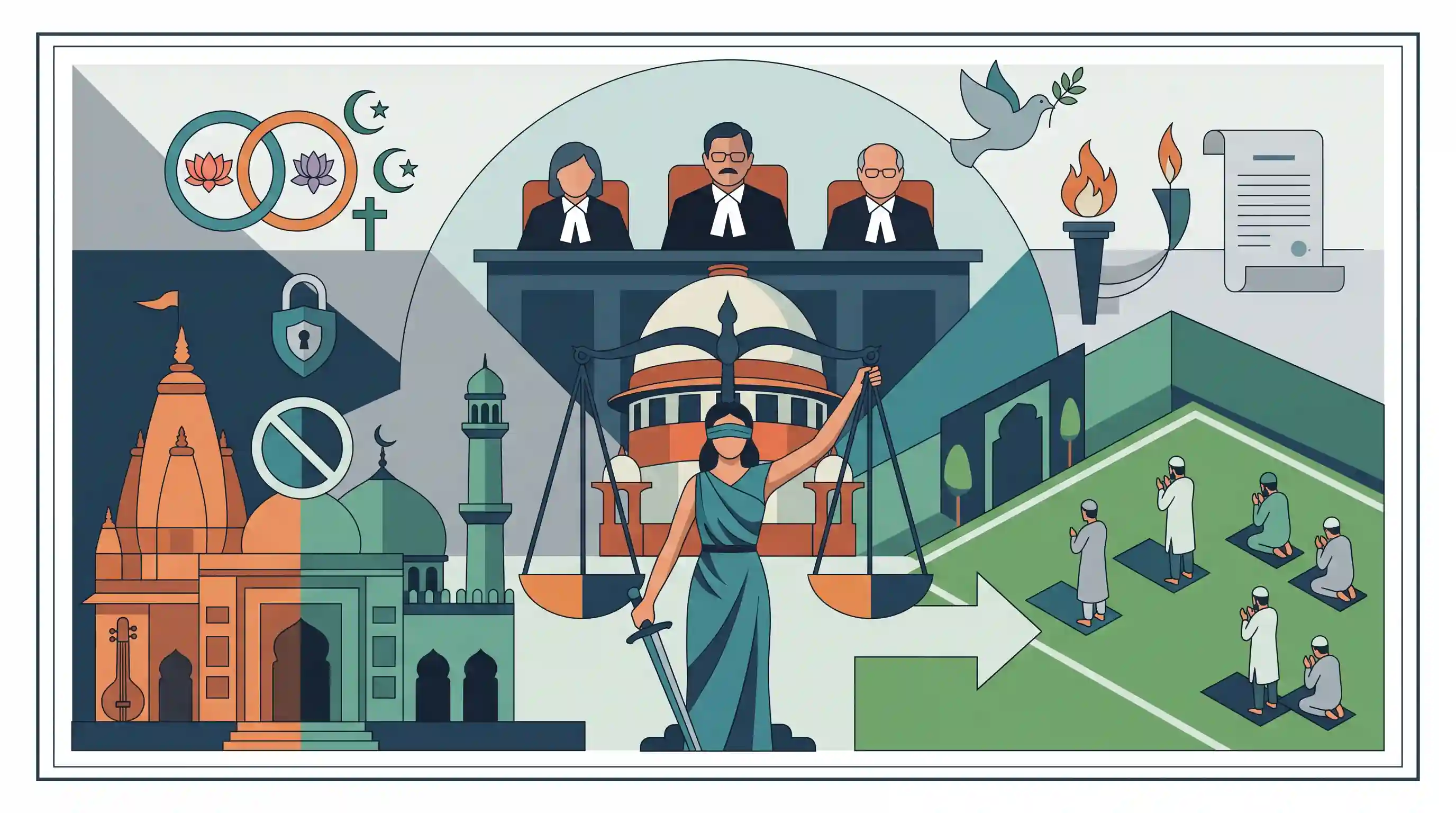
In July 2026, a three-judge Bench of the Supreme Court of India, led by Chief Justice Surya Kant, heard the sensitive Bhojshala-Kamal Maula Mosque dispute. Rather than restoring the status quo ante following the Madhya Pradesh High Court's May 2026 ruling (which declared the disputed complex a temple of Goddess Saraswati and banned Friday prayers), the SC chose a balancing approach. It directed the state to find an alternative open space nearby for Friday prayers and barred the ASI from making any structural alterations to the monument, emphasizing communal peace and preservation while the court decides the case on its merits.
Key Points
- The Supreme Court (headed by CJI Surya Kant) declined to restore the status quo ante in the Bhojshala-Kamal Maula Mosque dispute, aiming to avoid communal tension on a highly sensitive issue.
- As an ad-hoc measure, the SC directed the Madhya Pradesh government to identify an alternative open space near the disputed site for the Muslim community to perform Friday prayers between 1 p.m. and 3 p.m.
- The SC strictly prohibited the Archaeological Survey of India (ASI) from carrying out or allowing any structural alterations to the disputed 11th-century monument without the apex court\'s prior permission.
- The legal challenge arose after the Madhya Pradesh High Court\'s May 15, 2026 ruling, which declared the complex to be a temple dedicated to Goddess Saraswati, barred Friday namaaz, and quashed a 2003 ASI order allowing shared worship.
- The appellants argued that the Places of Worship (Special Provisions) Act, 1991 was enacted specifically to lock the religious character of ancient sites as of August 15, 1947, to prevent endless historical disputes.
Important Terms
Places of Worship (Special Provisions) Act, 1991

A Central Act that freezes the religious character of any place of worship as it existed on August 15, 1947, prohibiting conversion and promoting communal harmony.
UPSC context
GS Paper II (Polity & Governance). Relevant for understanding secularism, minority rights, and judicial interpretations of historical religious disputes.
Archaeological Survey of India (ASI)
The premier government agency under the Ministry of Culture responsible for archaeological research, conservation, and protection of historic monuments and sites.
UPSC context
GS Paper I (Art & Culture) and GS Paper II. Tests knowledge of institutional heritage conservation and ancient monument laws.
Supreme Court of India
The apex judicial body of India, serving as the ultimate court of appeal and the guardian of the Constitution.
UPSC context
GS Paper II (Polity). Essential for studying the structure, jurisdiction, and power of the judiciary in resolving federal and communal disputes.
Madhya Pradesh High Court
The highest state-level judicial body in Madhya Pradesh, possessing constitutional powers to issue writs and adjudicate disputes within its territorial jurisdiction.
UPSC context
GS Paper II (Polity). Tests understanding of State Judiciary, writ jurisdiction, and the hierarchy of courts in handling civil and communal disputes.
Prelims Trap
The Places of Worship (Special Provisions) Act, 1991 uniformly freezes the religious character of all historical and archaeological monuments in India.
Section 4(3)(a) of the 1991 Act explicitly exempts ancient and historical monuments or archaeological sites covered by the AMASR Act, 1958 from its freeze on religious character.
Static Concepts Connected
What are the key exemptions under the Places of Worship (Special Provisions) Act, 1991?
- Ayodhya dispute exemption: Section 5 of the Act explicitly exempted the Ram Janmabhoomi-Babri Masjid land dispute from the legislation's application.
- AMASR Act exemption: Section 4(3)(a) exempts any ancient and historical monument, archaeological site, or remains covered under the AMASR Act, 1958.
- Settled disputes: The Act does not apply to matters settled by final court decisions or mutual agreements before its commencement.
What are the literary and architectural contributions of King Raja Bhoja of Dhar?
- Sanskrit treatises: He authored Sarasvatīkaṇṭhābharaṇa (grammar), Śṛṅgaraprakāśa (poetics/rhetoric), and Samarāṅgaṇasūtradhāra (architecture).
- Bhojshala and temples: He established the Bhojshala educational center at Dhar and commissioned the massive, unfinished Bhojeshwar Temple near Bhopal.
- Paramara dynasty polymath: He was a celebrated 11th-century polymath and ruler of the Paramara dynasty who patronized Sanskrit learning.
Cross-Topic Patterns
Secularism vs Archaeological Preservation
Balancing minority worship rights with state-mandated monument conservation under Articles 25 and 26 and the AMASR Act, 1958, showcases the judiciary's role as a social peacekeeper.
History as a judicial battleground
The increasing reliance on scientific ASI excavations to settle medieval and ancient title disputes tests the constitutional boundaries of historical revisionism.

Exemptions under the Places of Worship Act 1991 and AMASR Act 1958 are highly likely to be tested in Prelims 2026.
Linked PYQs · 3
Linked PYQs · 3
- 2022MainsGS1
Are tolerance, assimilation and pluralism the key elements in the making of an Indian form of secularism? Justify your answer.
- 2024MainsGS2
Discuss India as a secular state and compare with the secular principles of the US constitution.
- 2025PrelimsGS1
Consider the following pairs : Provision in the Constitution of India Stated under I. Separation of Judiciary from the Executive in the public services of the State : The Directive Principles of the State Policy II. Valuing and preserving of the rich heritage of our composite culture : The Fundamental Duties III. Prohibition of employment of children below the age of 14 years in factories : The Fundamental Rights How many of the above pairs are correctly matched?
