Supreme Court Hearing on Pellet Gun Use and Crowd Control SOPs
Source:The Hindu ↗
આ શા માટે મહત્વનું છે
The article directly tackles the balance between democratic rights (freedom of assembly) and the state's policing powers. For UPSC aspirants, it is a critical case study on human rights, police accountability, and the judicial limits in intervening in executive standard operating procedures for crowd control.
સારાંશ
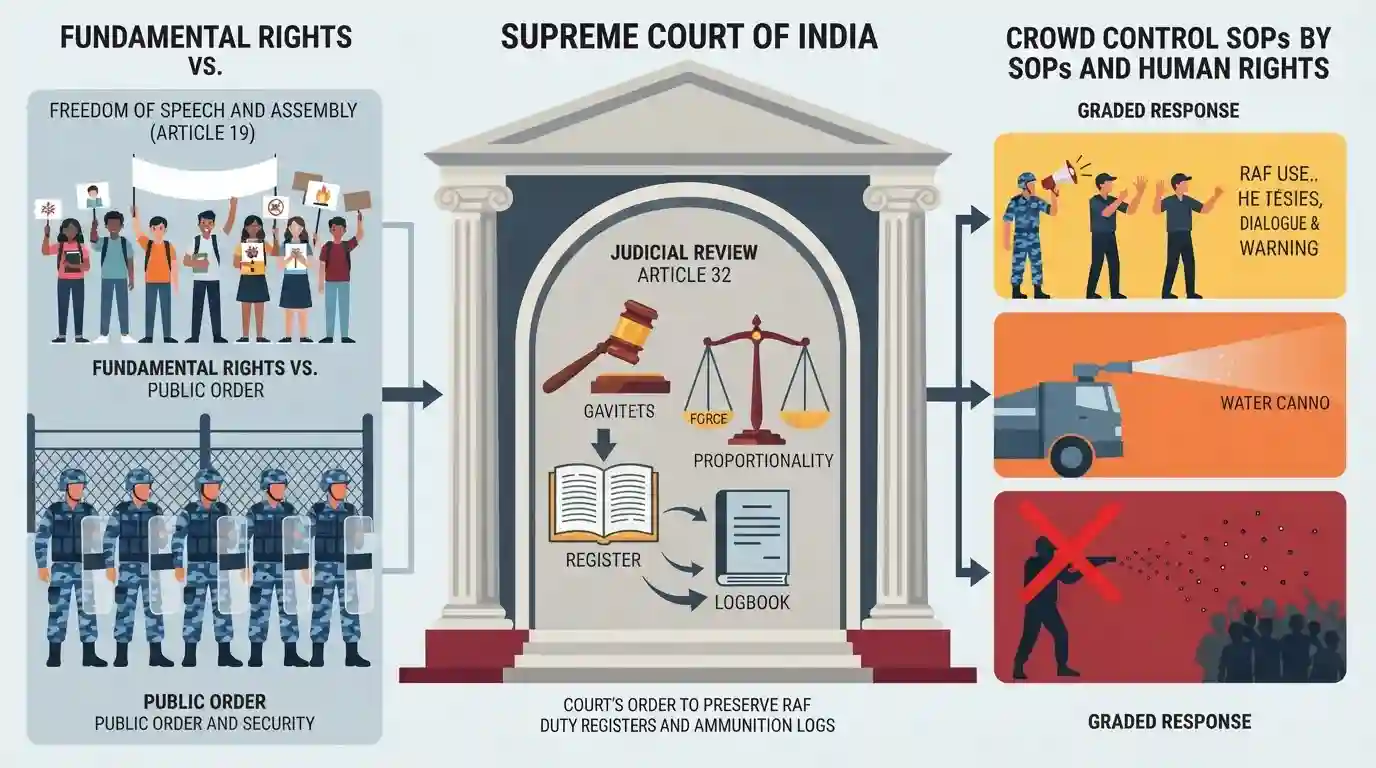
The Supreme Court of India is examining the deployment and use of pellet guns by the Rapid Action Force (RAF) during crowd control operations. Sparked by alleged police excesses at a July 20 student protest at Jantar Mantar over exam paper leaks, the Court has ordered the preservation of RAF duty registers and ammunition logs. While scrutinizing the proportionality of force used against protesters, the Court clarified that it cannot issue a blanket ban on pellet guns via an Article 32 writ petition unless the specific statutory rules authorizing their use are challenged. The government defends pellet guns as a non-lethal 'graded response' in exceptional law-and-order situations.
મુખ્ય મુદ્દા
- The Supreme Court is hearing a petition demanding a ban on the use of pellet guns by the Rapid Action Force (RAF) and police against protesters.
- The Court declined to impose a blanket ban under an Article 32 petition, stating the petitioner must formally challenge the specific rules that authorize the use of such weapons.
- The Court recognized that while pellet guns are meant for 'exceptional circumstances', law enforcement often relies on them as part of a 'graded response' to manage violent protests.
- The Supreme Court ordered the Centre to preserve RAF ammunition logs, duty rosters, and weapons distribution records related to the July 20 protest at Jantar Mantar to ensure accountability.
- The case highlights the ongoing tension between citizens' fundamental right to peaceful protest and the state's mandate to maintain public order using non-lethal crowd control methods.
પ્રિલિમ્સ ટ્રેપ
An order issued under Section 163 BNSS (prohibitory orders) automatically authorizes police to use civil force to disperse any gathering.
Section 163 BNSS (formerly CrPC 144) only issues preventive prohibitions. Dispersing crowds and using civil force require a separate legal command under Section 148 BNSS (formerly CrPC 129).
સંલગ્ન સ્થિર ખ્યાલો
What is the 'Doctrine of Proportionality' used by Indian Courts to review State actions?
- Origin & Definition: A judicial standard ensuring that the nature and extent of state restrictions on fundamental rights are proportionate to the legitimate objective sought.
- Four-Prong Test: Established in *Puttaswamy* (2017): requires a legitimate goal, suitable measures, necessity (least restrictive option), and a balance between rights and social interest.
- Application: Applied to assess executive excesses in crowd control, internet shutdowns (e.g., Anuradha Bhasin case), and preventive detentions.
How do BNSS Sections 163 and 148 differ regarding public order management?
- Section 163 BNSS: Successor to CrPC Section 144; empowers Executive Magistrates to issue preventive prohibitory orders to avert public nuisance or danger.
- Section 148 BNSS: Successor to CrPC Section 129; specifically authorizes the dispersal of 'unlawful assemblies' (or potential disturbances) using civil force.
- Legal Distinction: A restriction under Section 163 does not automatically license physical force; dispersal and force deployment require distinct authorization under Section 148.
આંતર-વિષય પેટર્ન
Police Reforms & Non-Lethal Weapons
Connects internal security (GS3) with police reforms, focusing on training CAPFs like RAF in standard operating procedures (SOPs) that align with international human rights laws.
Judicial Restraint & Fundamental Rights
Highlights the limits of Article 32 writ jurisdiction. The Court’s refusal to ban pellet guns without direct statutory challenge illustrates procedural separation of powers.

Mains 2026: Expect questions on balancing public order under BNSS with the right to protest, analyzed through the prism of proportionality.
સંલગ્ન PYQ · 4
સંલગ્ન PYQ · 4
- 2023MainsGS2
“The Constitution of India is a living instrument with capabilities of enormous dynamism. It is a constitution made for a progressive society.” Illustrate with special reference to the expanding horizons of the right to life and personal liberty.
- 2022MainsGS2
“Right of movement and residence throughout the territory of India are freely available to the Indian citizens, but these rights are not absolute.” Comment.
- 2017MainsGS3
Mob violence is emerging as a serious law and order problem in India. By giving suitable examples, analyze the causes and consequences of such violence.
- 2015MainsGS3
Human rights activists constantly highlight the view that the Armed Forces (Special Powers) Act, 1958 (AFSPA) is a draconian act leading to cases of human rights abuses by the security forces. What sections of AFSPA are opposed by the activists? Critically evaluate the requirement with reference to the view held by the Apex Court.
