Supreme Court Rules Existing Laws Sufficient to Combat Hate Speech
Source:The Hindu ↗
Why It Matters
This judgment is a critical reference point for Mains GS2 answers concerning hate speech, the limits of judicial intervention (separation of powers), and the practical application of the new criminal laws (BNS and BNSS). It updates the jurisprudence established in the Tehseen Poonawalla case regarding police accountability, FIR registration, and magisterial cognisance.
Summary
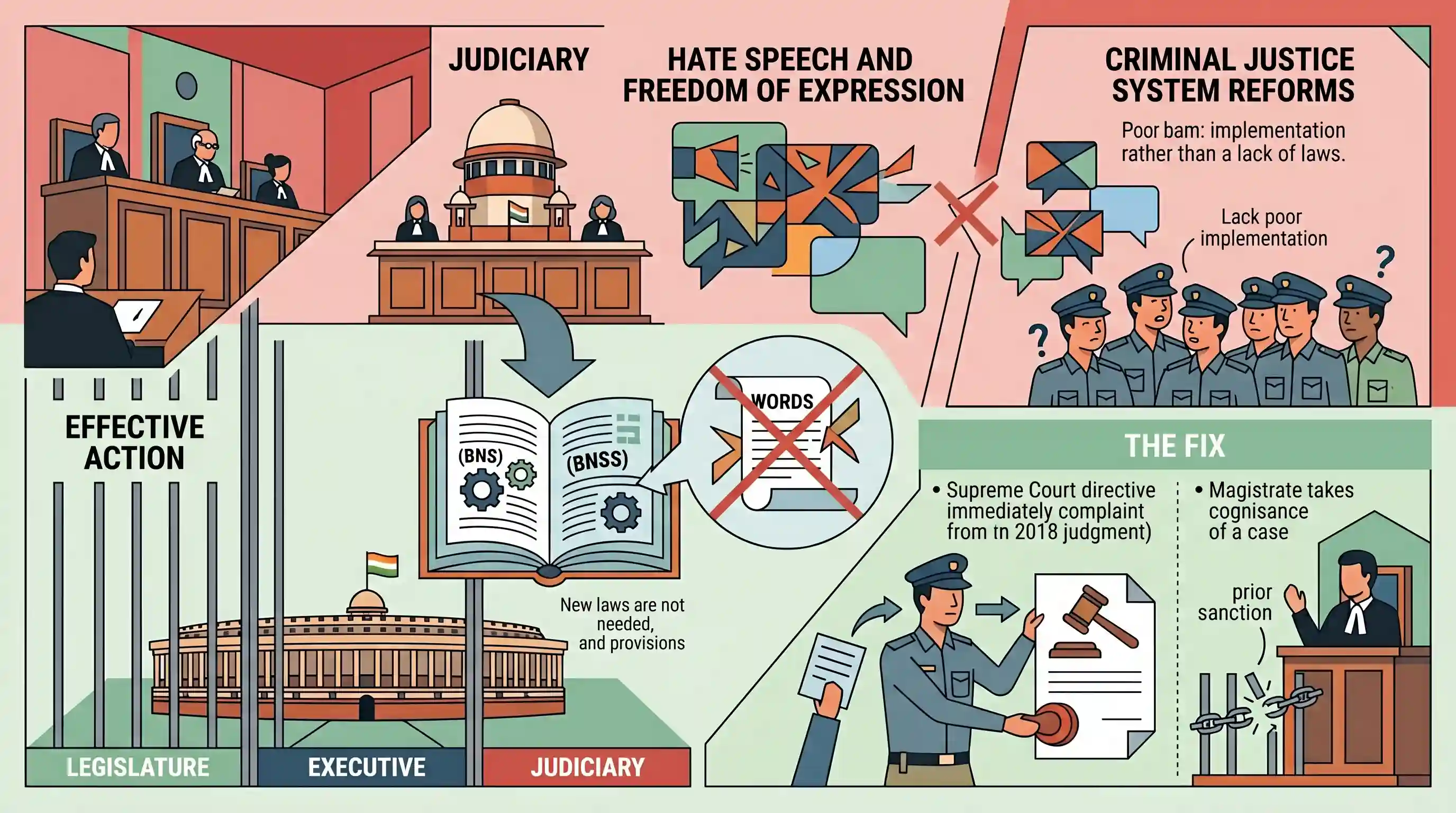
The Supreme Court has emphasized that the poor enforcement of existing laws, rather than a lack of legislation, is the root cause of persistent hate crimes in India. A Bench comprising Justices Vikram Nath and Sandeep Mehta noted that there is no "legislative vacuum" regarding hate speech, highlighting relevant provisions in the newly enacted Bharatiya Nyaya Sanhita (BNS) and the Bharatiya Nagarik Suraksha Sanhita (BNSS). Underscoring the doctrine of separation of powers, the Court declined to issue new guidelines or laws against hate speech, stating it cannot encroach upon Parliament's exclusive legislative domain. The Court also reiterated its 2018 Tehseen Poonawalla judgment, directing police officers to immediately register FIRs upon receiving hate speech complaints and affirming that prior sanction is not needed for a Magistrate to take cognisance.
Key Points
- The Supreme Court asserted that existing laws are sufficient to combat hate speech, attributing ongoing hate crimes to poor law enforcement rather than a lack of legislation.
- Citing the separation of powers doctrine, the Court declined to frame new anti-hate speech guidelines, noting that courts cannot legislate for Parliament.
- The Court emphasized there is no legislative vacuum, pointing out that provisions in the Bharatiya Nyaya Sanhita (BNS) such as Sections 196, 197(1), 299, 302, and 356 comprehensively cover hate crimes.
- Under Section 173(4) of the Bharatiya Nagarik Suraksha Sanhita (BNSS), 2023, if local police refuse to register a cognisable offence, complainants can report it via post to the Superintendent of Police.
- The Court reiterated the 2018 Tehseen Poonawalla judgment, directing police to register FIRs immediately for hate speech complaints without awaiting prior sanction for a Magistrate to take cognisance.
Important Terms
Bharatiya Nyaya Sanhita (BNS)

India's primary criminal code replacing the IPC from July 2024. It modernizes penalties, including Section 196 for promoting group enmity and Section 103 specifically codifying mob lynching as an offense.
UPSC context
GS Paper II (Polity/Governance) and III (Security); tests knowledge of legal reforms and modern criminal law.
Bharatiya Nagarik Suraksha Sanhita (BNSS)
The procedural law replacing the Code of Criminal Procedure (CrPC). It introduces technology-driven processes like e-FIRs, mandatory forensic investigations for serious crimes, and fixed timelines for trials.
UPSC context
GS Paper II (Judiciary/Governance); tests understanding of procedural reforms in the criminal justice system.
Tehseen Poonawalla Judgment (2018)
A landmark 2018 Supreme Court judgment providing guidelines to curb mob lynching and hate crimes. It mandated preventive measures like district nodal officers and punitive measures like fast-track courts.
UPSC context
GS Paper II (Important Judgments); crucial for answers on social justice, communal harmony, and police accountability.
Separation of Powers
A constitutional doctrine dividing responsibilities between the Legislature, Executive, and Judiciary. It ensures checks and balances, preventing one branch from performing the core functions of another.
UPSC context
GS Paper II (Constitutional Features); core concept for understanding the limits of judicial power versus legislative sovereignty.
Judicial Restraint
A judicial philosophy where judges limit the exercise of their power, deferring to the legislature for law-making and policy decisions unless they clearly violate the Constitution.
UPSC context
GS Paper II (Judiciary); tests the ability to distinguish between proactive judicial intervention and constitutional boundary maintenance.
Prelims Trap
"Police must obtain prior sanction from the government before registering an FIR for hate speech."
Prior sanction is legally required only at the stage of a Magistrate taking cognisance of the offence, not for the police to register an initial FIR.
Static Concepts Connected
How is the Separation of Powers structured in the Indian Constitution?
- Article 50: Mandates the State to separate the judiciary from the executive in the public services of the State.
- Checks and Balances: India follows functional overlap with checks and balances; courts can strike down laws (judicial review) but cannot enact them (judicial restraint).
- Basic Structure: The separation of powers between the legislature, executive, and judiciary is a recognized part of the basic structure doctrine.
What are the key directives of the Tehseen Poonawalla judgment (2018)?
- Nodal Officers: Appointment of a designated police officer (Superintendent rank) in each district to prevent mob violence, lynching, and hate crimes.
- Immediate FIRs: Immediate registration of FIRs for hate speech and mob violence, without waiting for prior magisterial cognisance.
- Victim Compensation: State governments must establish a victim compensation scheme for victims of mob violence and hate crimes.
Cross-Topic Patterns
Hate Speech & Article 19(2) Restrictions
Hate speech jurisprudence directly invokes Article 19(2) 'reasonable restrictions' concerning public order, decency, morality, and incitement to an offence.
IPC to BNS Transition Mapping
Historic IPC Sections 153A (promoting enmity) and 295A (outraging religious feelings) are now structurally tested via their new BNS counterparts (Sections 196 and 299).

Expect a 2026 prelims question pairing the Tehseen Poonawalla guidelines with the constitutional limits of judicial restraint.
Linked PYQs · 2
Linked PYQs · 2
- 2014MainsGS2
What do you understand by the concept "freedom of speech and expression"? Does it cover hate speech also ? Why do the films in India stand on a slightly different plane from other forms of expression ? Discuss.
- 2020MainsGS2
Judicial Legislation is antithetical to the doctrine of separation of powers as envisaged in the Indian Constitution. In this context justify the filing of large number of public interest petitions praying for issuing guidelines to executive authorities.
