Criminal Justice System Procedural Delays and Agency Accountability
Source:The Hindu ↗
Why It Matters
Highlights the systemic issues of procedural delays and bureaucratic casualness within prosecuting agencies like the NCB. It draws attention to the functioning of appellate mechanisms in the criminal justice system (CrPC/BNSS) and the role of the higher judiciary in penalising administrative lethargy to ensure accountability.
Summary
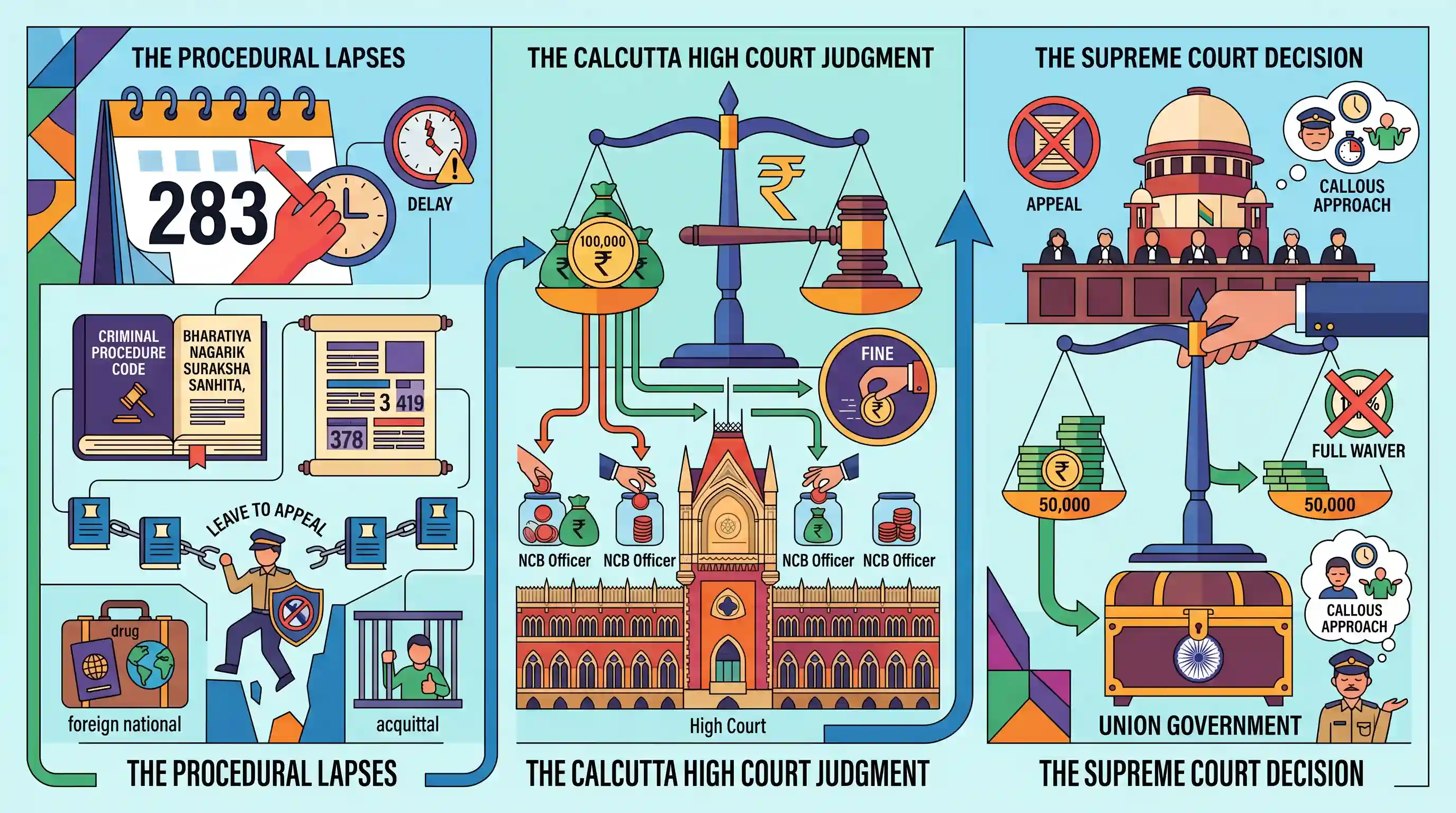
The Supreme Court halved a ₹1 lakh cost imposed by the Calcutta High Court on the Narcotics Control Bureau (NCB) for procedural delays and lapses in appealing the acquittal of a foreign national in a drug case. The NCB had filed the appeal after a delay of 283 days without the mandatory application for leave to appeal under Section 378(3) of the CrPC (corresponding to Section 419(3) of the BNSS). While reducing the fine to ₹50,000 and directing the Union government to pay it rather than recovering it from the officers, the Supreme Court refused to completely waive the penalty, citing the agency's callous approach.
Key Points
- The Supreme Court reduced a fine imposed by the Calcutta High Court on the Narcotics Control Bureau (NCB) from ₹1 lakh to ₹50,000.
- The fine was imposed due to NCB's procedural blunders and significant delays in filing an appeal against an acquittal in a narcotics case involving a foreign national.
- NCB failed to file the mandatory application for leave to appeal under Section 378(3) of the CrPC (now Section 419(3) of the BNSS).
- The Supreme Court modified the High Court's directive, ruling that the Union government must pay the penalty instead of recovering it from the individual officers involved.
- The Court refused to completely waive the cost, acknowledging that the agency's casual approach resulted in a delay of 283 days.
Important Terms
Narcotics Control Bureau (NCB)

India's nodal drug law enforcement and intelligence agency under the Ministry of Home Affairs, established under the NDPS Act, 1985 to combat drug trafficking and coordinate national control efforts.
UPSC context
GS Paper II (Statutory Bodies) and GS Paper III (Internal Security); relevant for drug trafficking and institutional oversight.
Bharatiya Nagarik Suraksha Sanhita (BNSS)
The 2023 procedural law replacing the 1973 CrPC to modernize India’s criminal justice system via technology-driven processes, mandatory forensic investigations, and time-bound trial resolutions.
UPSC context
GS Paper II (Governance/Law); critical for understanding criminal justice reforms and the transition from colonial-era legal frameworks.
Code of Criminal Procedure (CrPC)
The 1973 procedural law (now replaced by BNSS) that established the machinery for investigating crimes, apprehending suspects, and conducting trials while safeguarding the rights of the accused.
UPSC context
GS Paper II; historical and legal context for criminal trials, fundamental for understanding procedural law evolution.
Supreme Court of India
The apex judicial authority in India with ultimate appellate jurisdiction (Articles 132-136), exercising powers of judicial review and serving as the final interpreter of the Constitution.
UPSC context
GS Paper II (Judiciary); vital for judicial activism, separation of powers, and protection of fundamental rights.
High Court
The highest judicial institution at the state level with original and appellate jurisdiction; it possesses the authority to grant 'leave to appeal' in criminal cases.
UPSC context
GS Paper II (Judiciary); tests knowledge of state-level judicial powers, appellate processes, and supervisory jurisdiction.
Leave to Appeal
A mandatory procedural permission from a higher court (e.g., High Court) required by the prosecution to file an appeal against an order of acquittal.
UPSC context
GS Paper II (Justice Delivery System); specific procedural requirement under CrPC/BNSS that prevents frivolous appeals against acquittals.
Prelims Trap
"Investigative agencies have an absolute statutory right to appeal a trial court acquittal."
Agencies cannot automatically appeal. They must first file a mandatory application seeking formal permission ("leave to appeal") from the High Court, as acquittals reinforce the presumption of innocence.
Static Concepts Connected
What is the mandate and statutory backing of the Narcotics Control Bureau (NCB)?
- Statutory Origin: Constituted in 1986 under the Narcotic Drugs and Psychotropic Substances (NDPS) Act, 1985 (it does not have a separate NCB Act).
- Nodal Ministry: Functions under the Ministry of Home Affairs (MHA), coordinating actions among various state and central agencies.
- Core Mandate: Implements India's obligations under international UN drug conventions and coordinates intelligence on drug trafficking.
How do appeals against acquittal work under India's criminal procedure?
- No Automatic Right: The state cannot appeal an acquittal as a matter of routine or absolute right.
- Leave to Appeal: Requires mandatory formal permission ("leave to appeal") from the High Court before the substantive appeal is entertained.
- BNSS Transition: Currently governed by Section 419 of the Bharatiya Nagarik Suraksha Sanhita (BNSS), which replaced Section 378 of the CrPC.
Cross-Topic Patterns
Internal Security + Judicial Pendency
Procedural lapses by agencies like the NCB exacerbate judicial backlogs (the government constitutes ~46% of litigants) while weakening the systemic fight against narco-terrorism.
Criminal Law Overhaul (BNSS)
This case highlights the exact systemic delays the new Bharatiya Nagarik Suraksha Sanhita (BNSS) aims to fix through stringent statutory timelines for police investigations and appeals.

Expect a 2026 prelims question testing the procedural shifts from CrPC to BNSS, particularly focusing on 'leave to appeal' and timelines.
Linked PYQs · 3
Linked PYQs · 3
- 2024MainsGS3
Explain how narco-terrorism has emerged as a serious threat across the country. Suggest suitable measures to counter narco-terrorism.
- 2018MainsGS3
India's proximity to two of the world's biggest illicit opium-growing states has enhanced her internal security concerns. Explain the linkages between drug trafficking and other illicit activities such as gunrunning, money laundering and human trafficking. What counter-measures should be taken to prevent the same?
- 2024MainsGS2
Explain the reasons for the growth of public interest litigation in India. As a result of it, has the Indian Supreme Court emerged as the world's most powerful judiciary ?
