Supreme Court Ruling on Haldwani Evictions and PMAY Rehabilitation
Source:Indian Express ↗
Why It Matters
This judgment illustrates the practical application of Article 21 (right to shelter/livelihood) in cases of state-led evictions. It highlights the proactive role of Legal Services Authorities (SLSAs/NALSA) in bridging the gap between displaced citizens and government welfare schemes like PMAY, a recurring theme in GS-II (Governance and Social Justice).
Summary
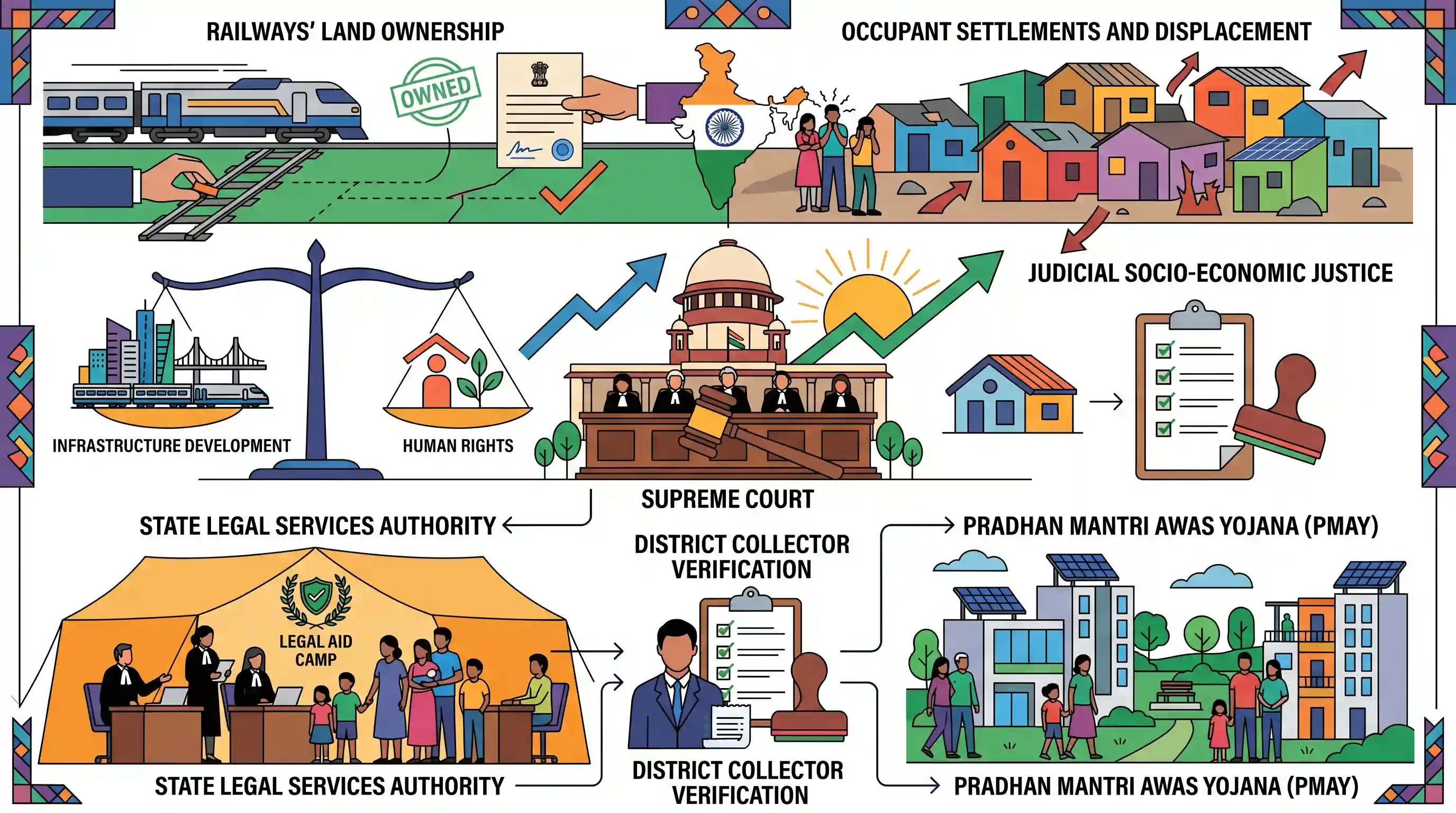
The Supreme Court affirmed the Railways' ownership of encroached land in Haldwani, Uttarakhand, but ordered the rehabilitation of occupants under the Pradhan Mantri Awas Yojana (PMAY) to mitigate displacement shocks. Stressing a balanced approach between infrastructural development and human rights, the bench directed the State Legal Services Authority to establish camps assisting affected families in applying for housing schemes. The District Collector was tasked with verifying family-wise eligibility. The ruling reflects the judiciary’s emphasis on socio-economic justice, ensuring that vulnerable groups are integrated into state welfare frameworks during administrative evictions.
Key Points
- The Supreme Court affirmed that the encroached land in Haldwani legally belongs to the Railways, paving the way for infrastructural development.
- The Court emphasized a balanced approach, stating that the humanitarian aspects of eviction—such as children's schooling, shelter, and drinking water—cannot be ignored.
- The Uttarakhand State Legal Services Authority was directed to organize camps to help displaced families apply for rehabilitation under the Pradhan Mantri Awas Yojana (PMAY).
- The local District Collector has been tasked with verifying the eligibility of the affected families on a case-by-case basis.
- The judgment underscores the judiciary's role in mitigating the socio-economic shocks of displacement by ensuring access to state welfare frameworks prior to eviction.
Important Terms
Pradhan Mantri Awas Yojana (PMAY)

A flagship mission launched in 2015 to provide "Housing for All" through financial assistance and interest subsidies for urban (PMAY-U) and rural (PMAY-G) low-income households.
UPSC context
GS Paper 2: Welfare schemes for vulnerable sections; GS Paper 3: Urbanization and housing infrastructure.
State Legal Services Authority (SLSA)
A statutory body established under the Legal Services Authorities Act, 1987, to provide free legal services to weaker sections and organize Lok Adalats for amicable dispute settlement.
UPSC context
GS Paper 2: Statutory bodies and judiciary; tests understanding of Article 39A and access to justice.
Right to Shelter (Article 21)
An interpreted fundamental right under Article 21, where the judiciary recognizes that the "Right to Life" includes a dignified dwelling with basic amenities, not just physical survival.
UPSC context
GS Paper 2: Fundamental Rights and judicial activism; crucial for topics on displacement and human rights.
Legal Services Authorities Act, 1987
The 1987 law mandating the creation of NALSA, SLSAs, and DLSAs to operationalize the constitutional promise of free legal aid and equal justice for all citizens.
UPSC context
GS Paper 2: Important acts and governance; tests the statutory framework for legal empowerment.
Article 39A
A Directive Principle of State Policy (DPSP) that directs the State to ensure equal justice and provide free legal aid to the poor and disabled.
UPSC context
GS Paper 2: Constitution and DPSP; frequently tested in the context of legal aid and social justice.
Rehabilitation
The planned relocation and provision of resources (like housing under PMAY) to families displaced by public infrastructure projects to mitigate socio-economic shocks.
UPSC context
GS Paper 1: Social empowerment; GS Paper 3: Infrastructure vs. Human Rights; relevant for administrative ethics.
Prelims Trap
Encroachers on public land are immune from eviction due to the Right to Shelter under Article 21.
Article 21 mandates humane rehabilitation to prevent homelessness, but the Supreme Court explicitly noted encroachers have "no legal right" to retain occupied public land.
Static Concepts Connected
How is the 'Right to Shelter' protected under the Indian Constitution?
- Article 21: Recognized as a fundamental facet of the right to life under Article 21, notably affirmed in the Chameli Singh vs. State of UP case.
- Olga Tellis Case: The landmark Olga Tellis judgment established that eviction without alternative livelihood or shelter impacts the right to life, mandating humane procedures.
- No Absolute Right: It does not grant ownership over encroached public property; lawful eviction is valid provided the state follows reasonable procedures and rehabilitation protocols.
What is the statutory mandate of Legal Services Authorities?
- Constitutional Backing: Enacted to implement Article 39A (free legal aid), ensuring that opportunities for securing justice are not denied to any citizen by reason of economic disabilities.
- Proactive Welfare Role: Beyond courtroom litigation, they proactively organize camps and act as statutory facilitators to help marginalized groups access government entitlements.
- Lok Adalats: They organize Lok Adalats to promote amicable, out-of-court dispute resolution, thereby reducing the immense backlog on the formal judicial system.
Cross-Topic Patterns
Judiciary as Welfare Facilitator
Courts are shifting from merely staying evictions to actively mandating statutory bodies like SLSAs to ensure last-mile delivery of housing schemes (PMAY) for displaced groups.
Urban vs. Tribal Displacement Paradigms
Unlike tribal displacement governed by statutory frameworks like LARR 2013 and FRA, urban encroachment eviction relies heavily on judicial precedents (Article 21) and scheme-based rehabilitation.

A GS2 question will likely test the judicial balance between public infrastructure development and the Article 21 Right to Shelter.
Linked PYQs · 4
Linked PYQs · 4
- 2022MainsGS2
“Right of movement and residence throughout the territory of India are freely available to the Indian citizens, but these rights are not absolute.” Comment.
- 2022MainsGS2
Besides the welfare schemes, India needs deft management of inflation and unemployment to serve the poor and the underprivileged sections of the society. Discuss.
- 2013PrelimsGS1
With reference to National Legal Services Authority, consider the following statements : 1. Its objective is to provide free and competent legal services to the weaker sections of the society on the basis of equal opportunity. 2. It issues guidelines for the State Legal Services Authorities to implement the legal programmes and schemes throughout the country. Which of the statements given above is/are correct?
- 2020PrelimsGS1
In India, Legal Services Authorities provide free legal services to which of the following type of citizens? 1. Person with an annual income of less than ₹ 1,00,000 2. Transgender with an annual income of less than ₹ 2,00,000 3. Member of Other Backward Classes (OBC) with an annual income of less than ₹ 3,00,000 4. All Senior Citizens Select the correct answer using the code given below:
