TET Deadline Extended for In-Service Teachers
Source:The Hindu ↗
Why It Matters
This ruling is critical for GS2 (Social Justice and Governance) as it highlights the judicial interpretation of the RTE Act as 'child-centric'. It demonstrates the complex governance challenge of balancing minimum standards in public service (TET qualification) with practical constraints (potential mass job losses disrupting schools). It also touches upon constitutional law regarding retrospective application of statutory minimum qualifications.
Summary
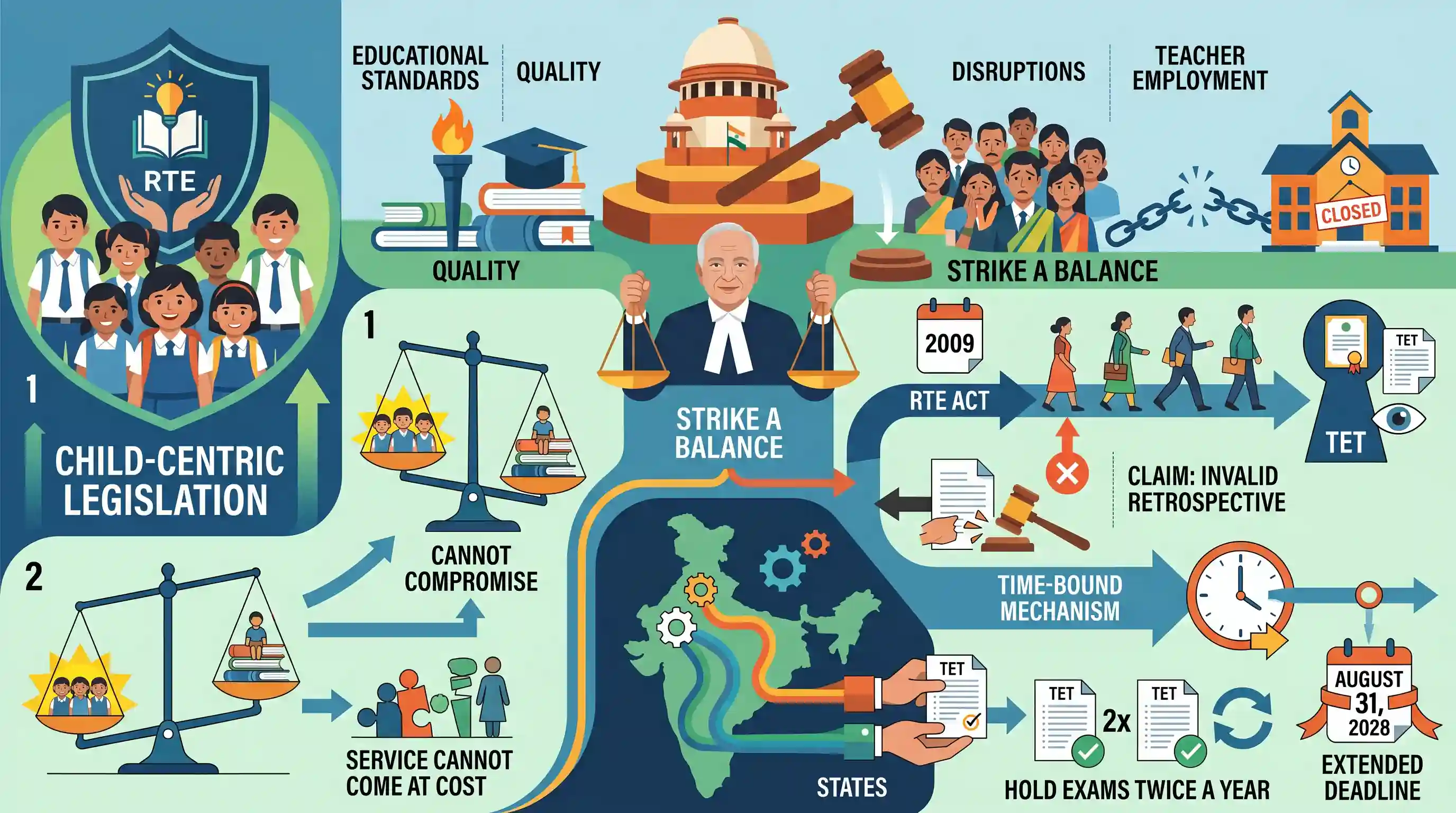
The Supreme Court of India has extended the deadline for in-service teachers to acquire the mandatory Teachers Eligibility Test (TET) qualification until August 31, 2028. Authored by Justice Dipankar Datta, the judgment emphasizes that the Right to Education (RTE) Act is a child-centric legislation, meaning the educational welfare of children cannot be compromised to secure teachers' employment. The court struck a balance between maintaining educational standards and avoiding mass disruptions in school functioning due to potential dismissals of unqualified teachers. It also directed states to hold TET exams twice a year and rejected claims that the TET mandate was an invalid retrospective application of the RTE Act.
Key Points
- The Supreme Court extended the deadline for in-service teachers to pass the Teachers Eligibility Test (TET) to August 31, 2028, while declaring it the final extension.
- The court directed State governments to conduct TET examinations preferably twice a year with a six-month interval.
- Justice Dipankar Datta emphasized that the Right to Education (RTE) Act is fundamentally child-centric, meaning teachers' service cannot compromise students' educational futures.
- The extension seeks to balance avoiding the mass termination of in-service teachers—which would disrupt schools—with upholding the minimum educational qualifications prescribed by the RTE Act over 15 years ago.
- The court dismissed arguments that enforcing the TET mandate constituted a retrospective implementation of the RTE Act, classifying it instead as a time-bound mechanism to secure educational standards.
Important Terms
Right to Education (RTE) Act, 2009

Legislation enacted in 2009 to operationalize Article 21A, ensuring free and compulsory elementary education to children aged 6–14 and setting mandatory standards for teacher qualifications.
UPSC context
GS Paper II: Social Justice/Governance; tests understanding of rights-based legislation and its impact on inclusive education quality.
Teachers Eligibility Test (TET)
A mandatory eligibility exam established to ensure teaching quality for Classes I–VIII; passing it is a non-negotiable prerequisite for recruitment and retention under the RTE Act.
UPSC context
GS Paper II: Issues related to Education; examines the role of standardized testing in maintaining educational professional standards.
Article 21A
A Fundamental Right inserted by the 86th Constitutional Amendment, 2002, requiring the State to provide free and compulsory education to all children aged 6 to 14.
UPSC context
GS Paper II: Indian Polity; critical for questions on fundamental rights, human dignity, and the State's welfare obligations.
National Council for Teacher Education (NCTE)
The statutory body (established under NCTE Act, 1993) responsible for regulating teacher education programs and determining minimum qualifications for school teachers in India.
UPSC context
GS Paper II: Statutory/Regulatory Bodies; relevant for governance questions regarding institutional frameworks in the education sector.
86th Constitutional Amendment Act, 2002
The 2002 amendment that elevated education to a Fundamental Right (Article 21A), amended Article 45 (DPSP), and added a Fundamental Duty under Article 51A(k).
UPSC context
GS Paper II: Constitutional Amendments; tests knowledge of landmark changes that shifted education from DPSP to Fundamental Rights.
Judicial Review (Child-centric Interpretation)
The power of the Judiciary to interpret laws; in this case, interpreting the RTE Act as 'child-centric,' prioritizing children's educational welfare over teachers' employment security.
UPSC context
GS Paper II: Judiciary; examines how courts balance competing rights and interpret legislation to protect vulnerable populations.
Prelims Trap
The RTE Act exempts in-service teachers employed before 2009 from acquiring newly prescribed minimum qualifications like TET.
The Supreme Court explicitly ruled that requiring previously employed teachers to clear TET is a valid, time-bound prospective mandate, not an illegal retrospective application.
Static Concepts Connected
What are the constitutional and statutory anchors of the Right to Education framework?
- Article 21A: Added by the 86th Amendment Act (2002), it guarantees free and compulsory education for children aged 6 to 14 years as a fundamental right.
- NCTE's Role: Under Section 23 of the RTE Act, the National Council for Teacher Education (NCTE) is designated as the academic authority to lay down minimum qualifications.
- Concurrent List: Education is a Concurrent List subject (42nd Amendment), allowing State governments to administer exams like TET while adhering to central statutory standards.
What are the constitutional rules regarding the retrospective application of laws in India?
- Criminal Laws: Article 20(1) of the Constitution strictly prohibits the retrospective application of criminal laws, known as ex-post facto legislation.
- Civil and Tax Laws: Legislatures have the power to enact civil or tax laws retrospectively, provided such laws do not violate other fundamental rights.
- Regulatory Mandates: As the SC clarified, giving existing employees a future deadline to acquire new mandatory qualifications is a prospective regulation, not a retrospective application.
Cross-Topic Patterns
RTE Act & Minority Institutions Exemption
The RTE Act's statutory mandates do not apply to unaided minority schools (Article 30), a constitutional nuance frequently tested by UPSC when discussing state regulation of education.
Teacher Quality & NIPUN Bharat Mission
Enforcing the TET aligns directly with NEP 2020’s NIPUN Bharat mission, which emphasizes rigorous teacher capacity building to achieve universal foundational literacy and numeracy.

A 2026 prelims question is likely to test the interplay of Article 21A, RTE's Section 23 (NCTE powers), and minority school exemptions.
Linked PYQs · 3
Linked PYQs · 3
- 2018PrelimsGS1
Consider the following statements: 1. As per the Right to Education (RTE) Act, to be eligible for appointment as a teacher in a State, a person would be required to possess the minimum qualification laid down by the concerned State Council of Teacher Education. 2. As per the RTE Act, for teaching primary classes, a candidate is required to pass a Teacher Eligibility Test conducted in accordance with the National Council of Teacher Education guidelines. 3. In India, more than 90% of teacher education institutions are directly under the State Governments. Which of the statements given above is/are correct?
- 2022MainsGS2
The Right of Children to Free and Compulsory Education Act, 2009 remains inadequate in promoting incentive-based system for children's education without generating awareness about the importance of schooling. Analyse.
- 2023MainsGS2
Skill development programmes have succeeded in increasing human resources supply to various sectors. In the context of the statement analyse the linkages between education, skill and employment.
