Defense manufacturing land allocation and security infrastructure
Source:The Hindu ↗
Why It Matters
It highlights ongoing infrastructure developments in domestic defence manufacturing capabilities (BrahMos), internal security force expansion (SSB/CAPF), and the growing institutional focus on specialized cyber forensics for law enforcement.
Summary
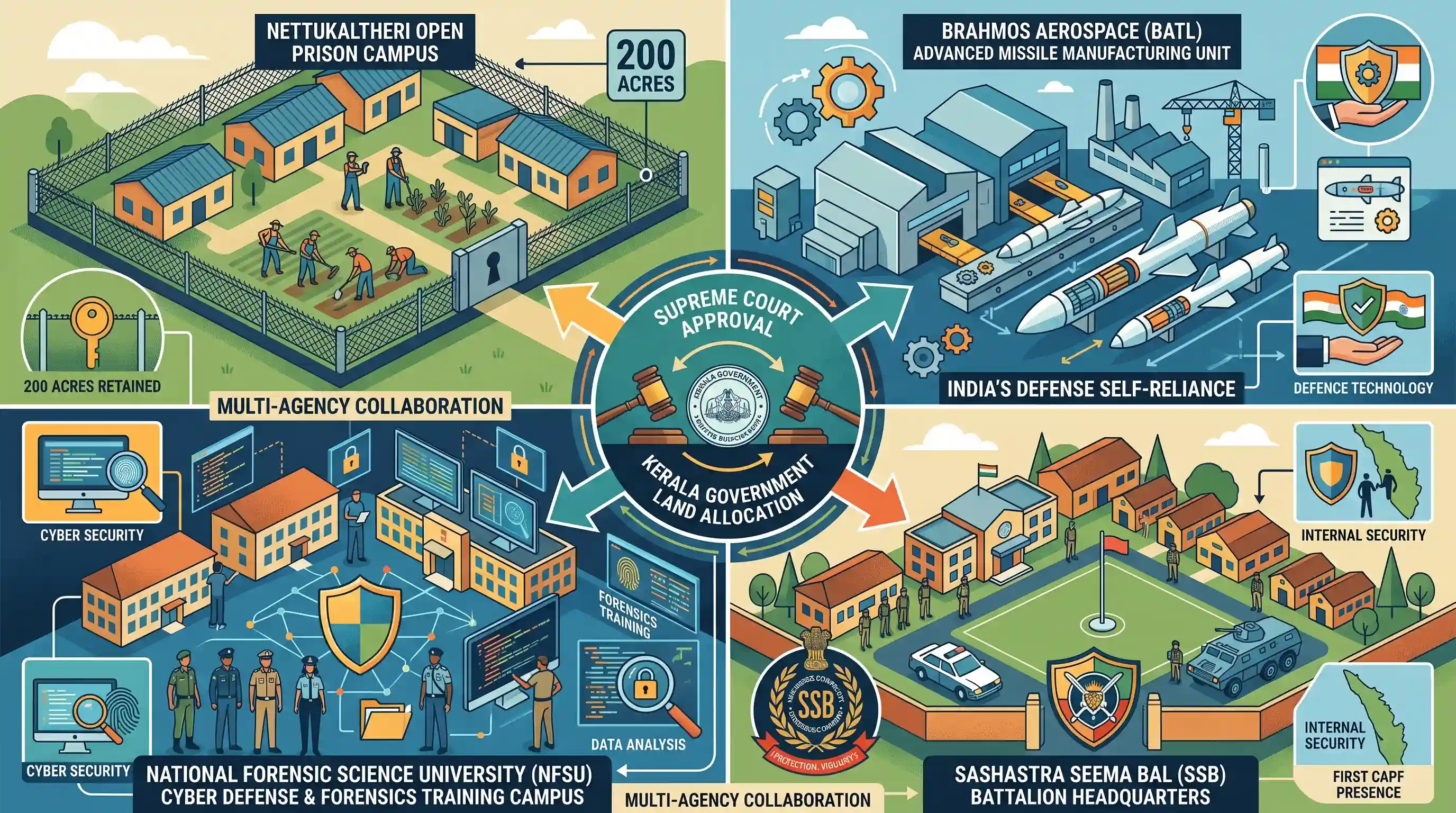
The Supreme Court has approved the Kerala government's allocation of 257 acres of the Nettukaltheri open prison campus to three key national security and defense institutions. BrahMos Aerospace (BATL) will receive land for a second advanced missile manufacturing unit, furthering India's defense self-reliance. The Sashastra Seema Bal (SSB) will establish a battalion headquarters, marking the first permanent Central Armed Police Force (CAPF) presence in Kerala. Finally, the National Forensic Science University will set up a campus focused on cyber defense and forensics training for law enforcement. This multi-agency land allocation emphasizes boosting defense manufacturing, internal security, and cybersecurity capabilities.
Key Points
- The Supreme Court permitted the Kerala government to allot 257 acres of open prison land at Nettukaltheri to three major national institutions.
- BrahMos Aerospace (BATL) will receive 180 acres to establish a second manufacturing unit for advanced missiles and strategic hardware, boosting defense indigenization.
- The Sashastra Seema Bal (SSB) will utilize 45 acres for a battalion headquarters, marking the permanent presence of a CAPF in Kerala.
- The National Forensic Science University will set up a campus with Cyber Defence Centres and Forensic Innovation Centers to train law enforcement.
Important Terms
BrahMos Aerospace Trivandrum Limited (BATL)

A subsidiary of the Indo-Russian BrahMos Aerospace joint venture, specializing in high-precision manufacturing of missile components, aerospace hardware, and strategic defense equipment.
UPSC context
GS-III (Defense Technology); vital for indigenization of defense and 'Aatmanirbhar Bharat' in strategic manufacturing.
Sashastra Seema Bal (SSB)
One of India's seven Central Armed Police Forces, established in 1963; its primary mandate is guarding the borders with Nepal and Bhutan.
UPSC context
GS-III (Internal Security); tests knowledge of security forces' mandates and border management strategies.
National Forensic Science University (NFSU)
An 'Institution of National Importance' under the Ministry of Home Affairs, dedicated to forensic, cyber, and behavioral sciences to strengthen the criminal justice system.
UPSC context
GS-III (Cyber Security/Internal Security); relevant for forensic infrastructure and criminal justice reforms.
Central Armed Police Force (CAPF)
A collective term for seven specialized security forces under the Ministry of Home Affairs, responsible for border guarding, counter-insurgency, and maintaining internal security.
UPSC context
GS-III (Security Forces); core knowledge of India's internal security apparatus and center-state cooperation.
DRDO (Defence Research and Development Organisation)
The R&D wing of the Ministry of Defence, responsible for developing advanced technologies, systems, and platforms for the Indian Armed Forces.
UPSC context
GS-III (Science & Tech/Defense); central to military modernization and technological self-reliance.
Open Prison
A minimum-security correctional facility focused on rehabilitation, allowing inmates to work and live with limited supervision to facilitate reintegration into society.
UPSC context
GS-II (Governance/Social Justice); relevant for prison reforms and the correctional administration system.
Prelims Trap
Prisons and reformatories fall under the Concurrent List, allowing joint Center-State control over administration.
Prisons and their administration fall strictly under Entry 4 of the State List. The State government has primary authority over prison land.
Static Concepts Connected
Which forces implement India's "One Border, One Force" policy?
- Core Principle: Post-Kargil reform ensuring a single specialized force guards a specific border to prevent intelligence and command fragmentation.
- SSB Mandate: The Sashastra Seema Bal (SSB) acts as the designated Border Guarding Force for the open Indo-Nepal and Indo-Bhutan borders.
- Other Borders: The BSF secures the Pakistan and Bangladesh frontiers, while the ITBP is dedicated to the high-altitude Indo-China border.
What defines the BrahMos missile system's technical architecture?
- Propulsion: Operates on a two-stage system: an initial solid propellant booster followed by a liquid ramjet engine.
- Operation: Functions on a 'fire and forget' principle, maintaining supersonic speeds (Mach 2.8) with high precision and a low radar signature.
- Development: An Indo-Russian joint venture (DRDO and NPOM) uniquely capable of being launched from land, air, sea, and sub-sea platforms.
Cross-Topic Patterns
Strategic defense infrastructure & State Lists
Transforming state-controlled prison land (State List, Entry 4) into national security hubs highlights cooperative federalism in addressing advanced defense infrastructure needs.
CAPFs beyond physical borders
A dedicated SSB base in southern India illustrates the shifting role of border-guarding CAPFs (under MHA) toward deep-hinterland security operations and regional disaster response.

Expect a Prelims question matching specific CAPFs to their border mandates alongside tech features of joint-venture missiles like BrahMos.
Linked PYQs · 4
Linked PYQs · 4
- 2021MainsGS3
How is S-400 air defence system technically superior to any other system presently available in the world?
- 2020MainsGS3
Analyze internal security threats and transborder crimes along Myanmar, Bangladesh and Pakistan borders including Line of Control (LoC). Also discuss the role played by various security forces in this regard.
- 2019MainsGS3
What is CyberDome Project? Explain how it can be useful in controlling internet crimes in India.
- 2021MainsGS3
Keeping in view India's internal security, analyse the impact of cross-border cyber attacks. Also discuss defensive measures against these sophisticated attacks.
