Supreme Court seeks Centre response on Jammu and Kashmir statehood
Source:The Hindu ↗
Why It Matters
This ongoing legal and political debate underscores vital UPSC themes regarding the basic structure doctrine, federalism, and the constitutional limits of converting a full-fledged State into a Union Territory. It touches upon executive accountability to institutional promises made before the judiciary.
Summary
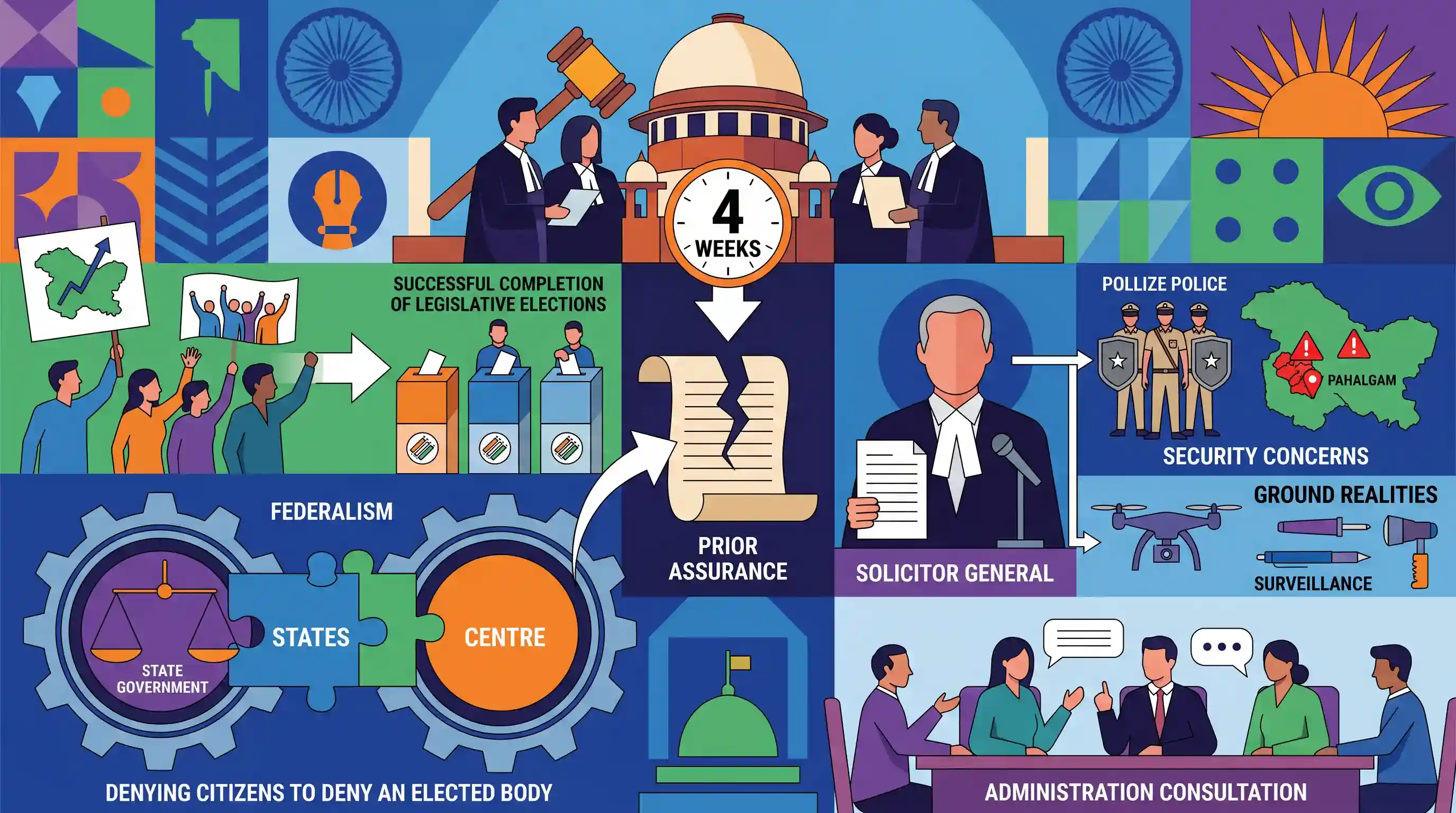
The Supreme Court of India has given the Union Government a four-week deadline to respond to petitions demanding a specific timeframe for the restoration of Jammu and Kashmir's statehood. Petitioners, highlighting the successful conclusion of recent legislative elections, argued that continuing J&K's status as a Union Territory undermines the federal structure of the Constitution and denies citizens an elected state government. They heavily referenced the Centre's prior assurance to restore statehood, which the Supreme Court had relied upon when it refrained from ruling on the state-to-UT conversion in its December 2023 judgment on Article 370. The Centre, represented by Solicitor General Tushar Mehta, countered by citing ongoing security concerns and "ground realities," such as the recent Pahalgam terror attack, requesting more time to consult with the state administration.
Key Points
- The Supreme Court directed the Union Government to file a response within four weeks regarding pleas seeking the restoration of statehood to Jammu and Kashmir.
- Petitioners argued that keeping J&K as a Union Territory violates the basic structure of the Constitution by infringing on Indian federalism, especially since Assembly and Lok Sabha elections were successfully held.
- The petitioners reminded the Court of the Centre's 'solemn promise' to restore statehood, which had persuaded the Court to refrain from deciding on the statehood issue during its December 2023 judgment upholding the abrogation of Article 370.
- Solicitor General Tushar Mehta requested more time, asserting that statehood restoration entails multiple considerations and ground realities, citing recent security challenges like the Pahalgam terror attack.
- Former CJI Sanjiv Khanna's concurring opinion was cited, warning of the 'grave consequences' of converting a State into a Union Territory without strong and cogent grounds.
Important Terms
Article 370

A former "temporary" provision in the Indian Constitution that granted special autonomy to Jammu and Kashmir, including its own constitution and restricted parliamentary legislative reach until 2019.
UPSC context
GS Paper II: Indian Constitution. Tests understanding of special provisions, asymmetrical federalism, and the process of constitutional integration.
Jammu and Kashmir Reorganization Act, 2019
Legislation that bifurcated the State of Jammu and Kashmir into the Union Territories of Jammu & Kashmir and Ladakh, ending the state’s separate constitutional status.
UPSC context
GS Paper II: Reorganization of States. Focuses on Parliament's power to reshape internal boundaries and the administrative transition of sensitive regions.
Federalism
A constitutional principle dividing power between Centre and States; recognized as part of the 'Basic Structure' of the Indian Constitution.
UPSC context
GS Paper II: Federal Structure. Essential for discussing the constitutional limits of converting states into Union Territories.
Article 3
Constitutional provision empowering Parliament to form new states or alter areas, boundaries, and names of existing states; characterizes India as an 'indestructible union of destructible states.'
UPSC context
GS Paper II: Union and Territories. Crucial for understanding the legal mechanism for reorganizing states and executive-legislative powers.
Solicitor General of India
The second-highest law officer in India who assists the Attorney General and represents the Union Government in complex constitutional cases like the J&K statehood pleas.
UPSC context
GS Paper II: Constitutional/Statutory Bodies. Tests knowledge of the executive’s legal representation and the hierarchy of law officers.
Prelims Trap
The Supreme Court has constitutionally validated Parliament's power to downgrade a full-fledged State into a Union Territory.
The SC did NOT rule on this in its 2023 verdict. It deliberately left the constitutional question open, relying on the Centre's promise to restore statehood.
Static Concepts Connected
What are Parliament's powers under Article 3 of the Constitution?
- Territorial Alteration: Parliament can form a new State, or alter the area, boundaries, or name of any existing State by passing a law with a simple majority.
- Presidential Recommendation: No bill altering a State's territory can be introduced in Parliament without the prior recommendation of the President.
- State Legislature Views: The President must refer the bill to the concerned State Legislature for its views, though these views are not binding on Parliament.
How does the J&K UT legislature structurally differ from Delhi's?
- Constitutional Basis: Delhi is governed by Article 239AA (inserted by 69th Amendment), while J&K is administered via Article 239A, originally designed for Puducherry.
- Legislative Exceptions: While both UT legislatures lack power over 'Public Order' and 'Police', the Delhi legislature additionally lacks jurisdiction over 'Land'.
Cross-Topic Patterns
Article 3 vs. Basic Structure Doctrine
The J&K statehood delay highlights the tension between preserving 'Federalism' (a Basic Structure doctrine component) and Parliament's sweeping territorial alteration powers under Article 3.
Internal Security vs. Political Devolution
The Centre’s citing of the Pahalgam attack illustrates the recurring administrative pattern of prioritizing internal security and cross-border terrorism threats over the immediate restoration of devolved democratic statehood.

Expect a 2026 Mains question analyzing if Parliament's power under Article 3 to convert a State into a UT violates the federal basic structure.
Linked PYQs · 3
Linked PYQs · 3
- 2025MainsGS2
Discuss the nature of Jammu and Kashmir Legislative Assembly after the Jammu and Kashmir Reorganization Act, 2019. Briefly describe the powers and functions of the Assembly of the Union Territory of Jammu and Kashmir.
- 2016MainsGS2
To what extent is Article 370 of the Indian Constitution, bearing marginal note "Temporary provision with respect to the State of Jammu and Kashmir", temporary? Discuss the future prospects of this provision in the context of Indian polity.
- 2024MainsGS2
What changes has the Union Government recently introduced in the domain of Centre-State relations ? Suggest measures to be adopted to build the trust between the Centre and the States and for strengthening federalism.
