Supreme Court sets deadline for Centre on Jammu and Kashmir statehood
Source:The Hindu ↗
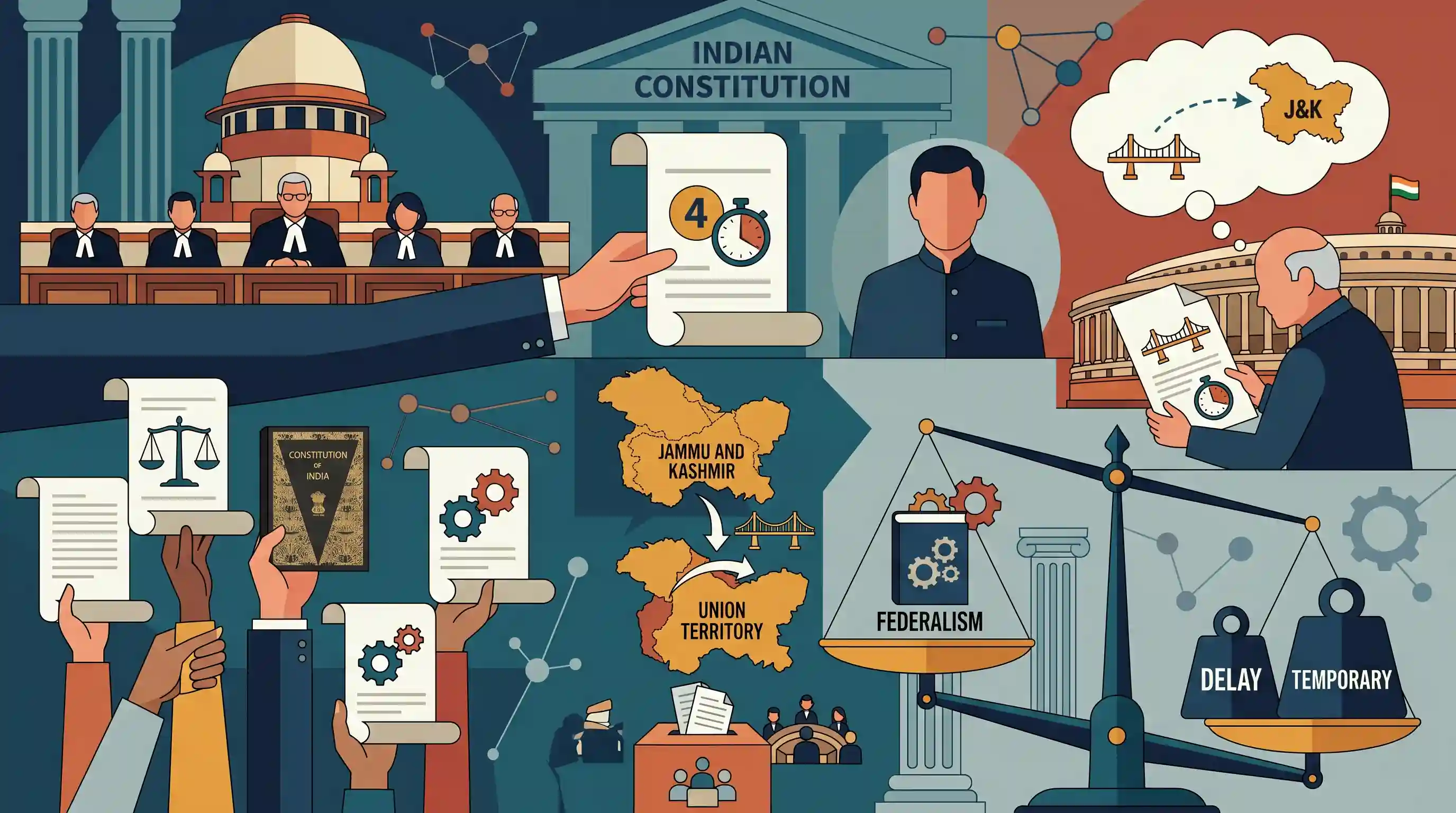
Why It Matters
The downgrading of a State into a Union Territory is an unprecedented constitutional event in India. Understanding the legal arguments around federalism, Article 3, Article 370, and the enforceability of executive assurances given to the Judiciary is critical for GS Paper 2 (Polity and Governance).
Summary
The Supreme Court has given the Centre four weeks to respond to petitions seeking a time-bound restoration of statehood for Jammu and Kashmir. A bench led by CJI Sanjiv Khanna acknowledged the recent formation of an elected government in the UT but deferred passing immediate directions, citing previous assurances from the Solicitor-General that the Union Territory status was temporary. Petitioners have raised concerns about federalism and the constitutional validity of a prolonged delay in restoring the state's status.
Key Points
- The Supreme Court granted the Union government four weeks to formally state its position on the timeline for restoring statehood to Jammu and Kashmir.
- Chief Justice of India Sanjiv Khanna noted that since the assembly elections were recently concluded and an elected government is in place, the court would wait for the Centre's response before issuing binding directions.
- The push for restoration is based on previous assurances given by Solicitor-General Tushar Mehta, who stated that J&K's status as a Union Territory was temporary, unlike Ladakh's.
- Petitioners argued that federalism is part of the basic structure of the Constitution, implying that indefinitely downgrading a state to a UT is constitutionally untenable.
Important Terms
Article 370

A constitutional provision that formerly granted special autonomous status to Jammu and Kashmir; its abrogation in 2019 integrated the region fully into the Indian Union.
UPSC context
GS Paper II: Constitution, Special Provisions, and the legal implications of its abrogation for internal security and federalism.
Jammu and Kashmir Reorganization Act, 2019
The 2019 law that bifurcated the State of Jammu and Kashmir into two Union Territories: Jammu and Kashmir (with a legislature) and Ladakh (without one).
UPSC context
GS Paper II: Reorganization of states and the parliamentary power to alter boundaries under Articles 2 and 3.
Federalism
The constitutional distribution of power between the Union and States; in India, it is a 'quasi-federal' system and part of the Constitution's 'basic structure.'
UPSC context
GS Paper II: Basic structure doctrine, Center-State relations, and the impact of reducing a state to a Union Territory.
Union Territory (UT)
An administrative unit directly governed by the Central Government through a Lieutenant Governor; J&K was converted into a UT from a State in 2019.
UPSC context
GS Paper II: Differences in administrative autonomy between States and UTs under Articles 239 to 241.
Judicial Review
The power of the judiciary to examine the constitutionality of legislative and executive actions, as seen in the Supreme Court’s oversight of J&K's status.
UPSC context
GS Paper II: Functions and responsibilities of the Judiciary and its role in upholding constitutional promises.
Statehood
The status of being a full constituent state of the Indian Union, possessing higher legislative autonomy compared to a Union Territory.
UPSC context
GS Paper II: Federal structure and the Union's obligation to restore democratic and administrative status to constituent units.
Prelims Trap
The Supreme Court explicitly ruled that downgrading a State into a Union Territory under Article 3 violates the Basic Structure of the Constitution.
The SC did not rule on the constitutionality of downgrading a state to a UT in its 2023 verdict. It left the question open, relying on the Union's assurance of restoration.
Static Concepts Connected
What are Parliament's powers under Article 3 regarding State reorganization?
- Formation & Alteration: Parliament can form new states, alter areas, boundaries, or names using a simple majority. This does not count as a constitutional amendment under Article 368.
- Prior Recommendation: Bills under Article 3 require the President's prior recommendation before introduction in either House of Parliament.
- State Assembly Views: The President must refer the bill to the concerned State legislature for its views. However, these views are not binding on Parliament.
How does legislative power in the J&K UT differ from a full State?
- Exempted Subjects: Unlike full States, the J&K UT Assembly cannot legislate on 'Public Order' and 'Police'. These subjects remain under the direct control of the Union via the LG.
- LG's Discretion: The Lieutenant Governor exercises much broader discretionary and administrative control over a Union Territory compared to a State Governor, who acts on ministerial advice.
Cross-Topic Patterns
Federalism and the Basic Structure
The J&K statehood debate directly invokes the S.R. Bommai (1994) ruling, testing whether indefinitely downgrading a State to a UT violates the federal balance of the Constitution.
Asymmetric Federalism and Article 371
The removal of J&K's special status frequently prompts comparative UPSC questions regarding the continuing special constitutional protections for North Eastern and western states under Article 371.

Expect a GS2 Mains question on the constitutionality of Article 3 concerning the downgrade of a State to a UT and impact on federalism.
Linked PYQs · 2
Linked PYQs · 2
- 2025MainsGS2
Discuss the nature of Jammu and Kashmir Legislative Assembly after the Jammu and Kashmir Reorganization Act, 2019. Briefly describe the powers and functions of the Assembly of the Union Territory of Jammu and Kashmir.
- 2016MainsGS2
To what extent is Article 370 of the Indian Constitution, bearing marginal note "Temporary provision with respect to the State of Jammu and Kashmir", temporary? Discuss the future prospects of this provision in the context of Indian polity.
