Supreme Court directive on front of package food labeling
Source:The Hindu ↗
Why It Matters
This development directly relates to GS2 Governance (Issues relating to the development and management of Social Sector/Services relating to Health) and Statutory Bodies (FSSAI). It highlights the intersection of public health policy, consumer rights, and judicial intervention via PILs to enforce Article 21. Understanding food labeling debates (FOPL vs. Star Ratings) is crucial for both Prelims (FSSAI functions) and Mains (Health policy effectiveness).
Summary
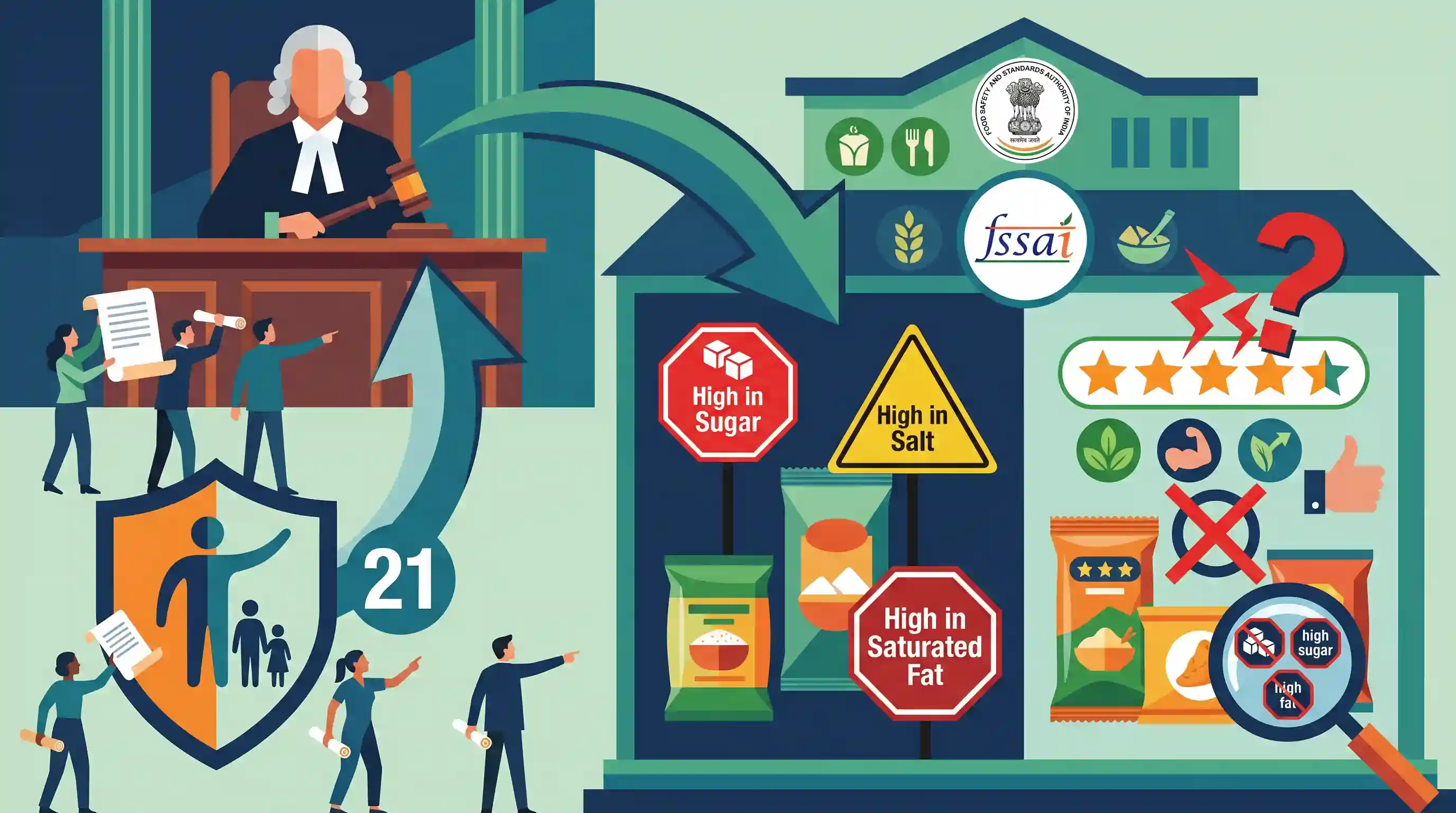
The Supreme Court has asked the Food Safety and Standards Authority of India (FSSAI) to evaluate the implementation of mandatory Front-of-Package Warning Labels (FOPL) on packaged foods that contain high levels of sugar, salt, and saturated fat. Hearing a public interest litigation, the Court emphasized that protecting the fundamental right to health goes beyond offering consumers choices and requires explicit regulatory warnings about harmful ingredients. The petitioners raised concerns that the FSSAI's alternative proposal—the star-based Indian Nutritional Rating (INR) system—could mislead consumers by masking unhealthy ingredients with positive nutrients.
Key Points
- The Supreme Court directed the FSSAI to consider making Front-of-Package Warning Labels (FOPL) mandatory for packaged foods high in sugar, salt, and saturated fat within six months.
- The directive stems from a PIL by an NGO highlighting the alarming rise of non-communicable diseases (NCDs) in India linked to the consumption of ultra-processed foods.
- The Court underscored that ensuring the 'Right to Health' requires proactive regulatory steps, not just consumer choice, emphasizing the need for clear health warnings.
- The petitioners criticized FSSAI's proposed star-based Indian Nutritional Rating (INR), arguing it could be misleading as it allows positive nutrients (like fruit or nuts) to offset the negative score of high sugar or fat.
Important Terms
Food Safety and Standards Authority of India (FSSAI)

A statutory body under the Ministry of Health and Family Welfare, established by the Food Safety and Standards Act, 2006 to regulate food safety and quality.
UPSC context
GS Paper 2: Statutory, Regulatory, and Quasi-judicial bodies; GS Paper 3: Food Processing and related industries.
Right to Health (Article 21)
An implied fundamental right under Article 21 (Right to Life and Personal Liberty), established through judicial interpretations requiring the State to provide medical facilities and clean food.
UPSC context
GS Paper 2: Indian Constitution (Fundamental Rights) and Governance (Issues relating to Health).
Public Interest Litigation (PIL)
Legal action initiated in a court for the enforcement of public interest, characterized by the relaxation of 'locus standi' to allow public-spirited citizens to file petitions.
UPSC context
GS Paper 2: Judiciary (Structure, Organization, and Functioning) and Judicial Activism.
Front-of-Package Labeling (FOPL)
A nutrition labeling policy that places simplified, often symbol-based, health information on the front of food packets to help consumers make informed, quick choices.
UPSC context
GS Paper 2: Health-related issues and government policies; GS Paper 3: Food security and quality.
Indian Nutritional Rating (INR)
FSSAI's proposed star-rating system (0.5 to 5 stars) for packaged foods, which calculates a composite score by weighing unhealthy components against positive nutrients.
UPSC context
GS Paper 2: Government policies and interventions for development in health sectors.
High Fat Sugar and Salt (HFSS) foods
Processed food products containing excessive levels of saturated fats, total sugar, or sodium, which are the primary targets of front-of-package warning regulations.
UPSC context
GS Paper 3: Food processing, standards, and health impacts of modern diets.
Prelims Trap
"FSSAI is a statutory body operating under the Ministry of Consumer Affairs, Food and Public Distribution."
FSSAI falls under the Ministry of Health and Family Welfare. UPSC frequently swaps this with Consumer Affairs due to the 'food' and 'consumer' overlap.
Static Concepts Connected
What is the statutory basis and mandate of FSSAI?
- Statutory Origin: Established under the Food Safety and Standards Act, 2006, consolidating various older laws like the Prevention of Food Adulteration Act, 1954.
- Nodal Ministry: Functions under the administrative control of the Ministry of Health and Family Welfare.
- Core Mandate: Laying down science-based standards for food items and regulating their manufacture, storage, distribution, and import.
How is the Right to Health constitutionally protected in India?
- Article 21 Implication: Read into the 'Right to Life' under Article 21 through judicial pronouncements, expanding it beyond mere survival to a life of dignity and well-being.
- DPSP Directive: Supported by Article 47, which directs the State to raise the level of nutrition and the standard of living, and improve public health.
Cross-Topic Patterns
Food labeling & NCD burden
India's shift toward ultra-processed foods accelerates the non-communicable disease crisis. FOPL regulation ties directly to the National Programme for Prevention and Control of NCDs (NP-NCD) objectives.
Judicial push on statutory bodies
Similar to SC directives to CPCB on pollution or SEBI on markets, the Court is increasingly linking technical regulatory frameworks (like food standards) to Article 21 fundamental rights.

Expect a prelims statement contrasting FOPL warnings with the star-based INR system, paired with FSSAI's statutory mandate under MoHFW.
Linked PYQs · 4
Linked PYQs · 4
- 2016PrelimsGS1
With reference to pre-packaged items in India, it is mandatory to the manufacturer to put which of the following information on the main label, as per the Food Safety and Standards (Packaging and Labelling) Regulations, 2011? 1. List of ingredients including additives 2. Nutrition information 3. Recommendations, if any, made by the medical profession about the possibility of any allergic reactions 4. Vegetarian/non-vegetarian Select the correct answer using the code given below.
- 2018PrelimsGS1
Consider the following statements: 1. The Food Safety and Standards Act, 2006 replaced the Prevention of Food Adulteration Act, 1954. 2. The Food Safety and Standards Authority of India (FSSAI) is under the charge of Director General of Health Services in the Union Ministry of Health and Family Welfare. Which of the statements given above is/are correct?
- 2020MainsGS2
Judicial Legislation is antithetical to the doctrine of separation of powers as envisaged in the Indian Constitution. In this context justify the filing of large number of public interest petitions praying for issuing guidelines to executive authorities.
- 2021MainsGS2
“Besides being a moral imperative of a Welfare State, primary health structure is a necessary precondition for sustainable development.” Analyze.
