Supreme Court Directs FSSAI on Food Warning Labels
Source:The Hindu ↗
Why It Matters
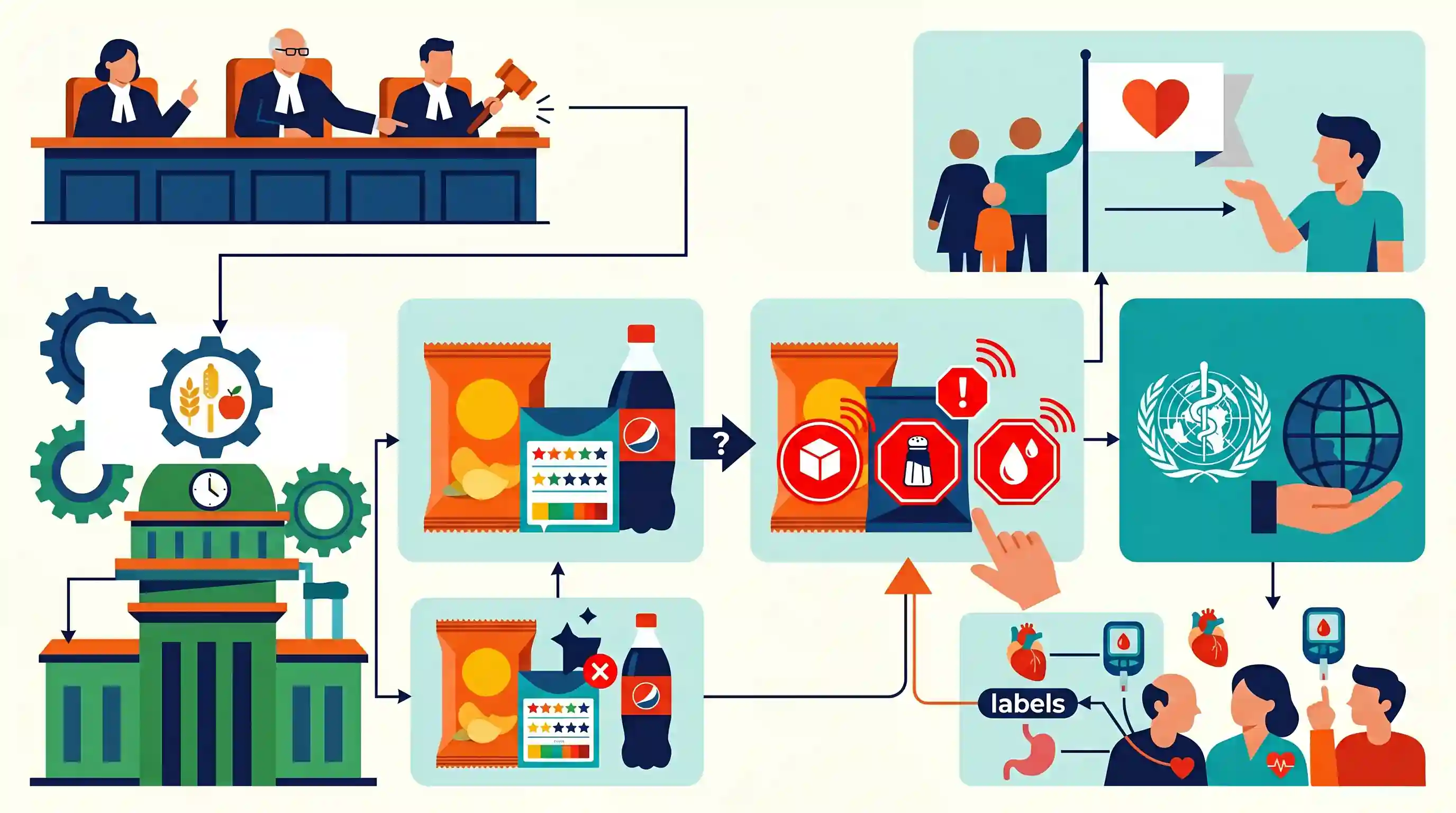
Front-of-package labelling (FOPL) is a critical intersection of public health governance, consumer rights, and food regulation. It reflects the proactive role of the judiciary in interpreting Article 21 to include informed dietary choices, and tests the regulatory effectiveness of statutory bodies like FSSAI in mitigating the epidemic of non-communicable diseases.
Summary
The Supreme Court of India has instructed the Food Safety and Standards Authority of India (FSSAI) to evaluate the implementation of mandatory front-of-package warning labels on packaged foods that are high in sugar, salt, and saturated fat. Acting on a public interest litigation, the Court underscored that the right to health includes consumers' right to be informed about harmful food ingredients. The ruling questions the efficacy of FSSAI's current composite nutritional rating system, which can potentially obscure unhealthy components, and aligns with WHO recommendations to use clear warning labels to tackle the growing burden of non-communicable diseases in the country.
Key Points
- The Supreme Court directed FSSAI to consider mandating clear front-of-package warning labels (FOPL) for packaged foods high in sugar, salt, and saturated fats (HFSS).
- The direction was in response to a PIL by an NGO arguing that the fundamental right to health (under Article 21) includes the right to make informed food choices.
- Currently, FSSAI uses the 'Indian Nutritional Rating (INR)' system, a composite score that the petitioners claim allows companies to mask high levels of harmful ingredients by adding positive nutrients.
- The WHO strongly advocates for simple warning labels to combat the rising incidence of diet-related non-communicable diseases (NCDs) like diabetes and cardiovascular disorders.
- The Court granted FSSAI a six-month window to constitute a committee, engage with stakeholders, and arrive at a decision regarding the implementation of the warning labels.
Important Terms
Food Safety and Standards Authority of India (FSSAI)

Autonomous statutory body under the Ministry of Health & Family Welfare responsible for protecting public health through the regulation and supervision of food safety across India.
UPSC context
GS II/III: Statutory bodies and food processing. Crucial for questions on regulatory governance and public health management.
Indian Nutrition Rating (INR) system
A proposed labeling system assigning 0.5 to 5 stars to packaged foods based on nutritional quality; currently scrutinized for potentially masking high sugar/salt content with positive nutrients.
UPSC context
GS II: Government policies. Evaluates the efficacy of health interventions and the 'Right to Know' for consumers.
Front-of-Package Labeling (FOPL)
Simplified nutritional information (like warning symbols or star ratings) placed on the front of food packets to help consumers quickly identify unhealthy levels of nutrients.
UPSC context
GS II: Social Sector/Health. Tests understanding of preventive healthcare measures and global best practices in food regulation.
Food Safety and Standards Act, 2006
The primary legislation in India that consolidated various old food laws into a unified framework to ensure the availability of safe and wholesome food.
UPSC context
GS II: Important Acts. Central to governance topics related to consumer safety and legislative consolidation.
Right to Health (Article 21)
A fundamental right under Article 21, interpreted by the Supreme Court to include the consumer's right to be informed about harmful ingredients in food.
UPSC context
GS II: Polity. Demonstrates judicial activism and the expansion of fundamental rights through case law.
Non-Communicable Diseases (NCDs)
Chronic conditions like diabetes and heart disease; their rising prevalence in India is a key driver for stricter front-of-package food labeling regulations.
UPSC context
GS II: Health issues. Relevant for discussing India's dual burden of disease and public health policy.
3S and Our Health Society
The charitable non-profit organization that filed the Public Interest Litigation (PIL) leading the Supreme Court to demand clearer food warning labels.
UPSC context
GS II: Role of Civil Society. Example of NGO-led judicial intervention for public welfare.
Prelims Trap
"FSSAI is a statutory body under the Ministry of Consumer Affairs or Ministry of Food Processing Industries."
FSSAI actually functions under the Ministry of Health and Family Welfare (MoHFW). Aspirants often confuse it due to its regulatory role over consumer goods and food processing.
Static Concepts Connected
What is the statutory framework and mandate of FSSAI?
- Nodal Ministry: It functions administratively under the Ministry of Health and Family Welfare (MoHFW).
- Genesis: Established under the Food Safety and Standards Act, 2006, replacing older fragmented laws like the Prevention of Food Adulteration Act, 1954.
- Core Mandate: Lays down science-based standards to regulate the manufacture, storage, distribution, sale, and import of food items in India.
How is the Right to Health protected in the Indian Constitution?
- Fundamental Right: Not explicitly written, but judicially interpreted by the Supreme Court as an integral part of the Right to Life under Article 21.
- DPSP: Article 47 explicitly directs the State to raise nutrition levels, standard of living, and improve overall public health.
Cross-Topic Patterns
Food labelling & Consumer Protection Act
Misleading nutritional claims on packaging attract regulatory scrutiny and penalties under both the Food Safety and Standards Act and the Central Consumer Protection Authority (CCPA) guidelines on misleading advertisements.
NCDs and India's Demographic Dividend
Rising non-communicable diseases (like diabetes and cardiovascular issues) linked to ultra-processed foods directly threaten India's demographic dividend and escalate out-of-pocket healthcare expenditures.

FSSAI’s Indian Nutritional Rating, WHO's FOPL, and the Right to Health (Art 21) connection is a prime multi-statement target for 2026.
Linked PYQs · 4
Linked PYQs · 4
- 2018PrelimsGS1
Consider the following statements: 1. The Food Safety and Standards Act, 2006 replaced the Prevention of Food Adulteration Act, 1954. 2. The Food Safety and Standards Authority of India (FSSAI) is under the charge of Director General of Health Services in the Union Ministry of Health and Family Welfare. Which of the statements given above is/are correct?
- 2011PrelimsGS1
A company marketing food products advertises that its items do not contain trans-fats. What does this campaign signify to the customers? 1. The food products are not made out of hydrogenated oils. 2. The food products are not made out of animal fats/oils. 3. The oils used are not likely to damage the cardiovascular health of the consumers. Which of the statements given above is/are correct?
- 2024MainsGS2
In a crucial domain like the public healthcare system the Indian State should play a vital role to contain the adverse impact of marketisation of the system. Suggest some measures through which the State can enhance the reach of public healthcare at the grassroots level.
- 2020MainsGS2
In order to enhance the prospects of social development, sound and adequate health care policies are needed particularly in the fields of geriatric and maternal health care. Discuss.
