Supreme Court forms panel to re-examine Aravalli range definition
Source:The Hindu ↗
Why It Matters
The exact definition and geographical delineation of the Aravallis determines the extent of legal protection from mining and real estate development. The Supreme Court's intervention highlights the ongoing tension between environmental conservation and economic extraction, a recurring theme in UPSC GS3 and GS2 papers.
Summary
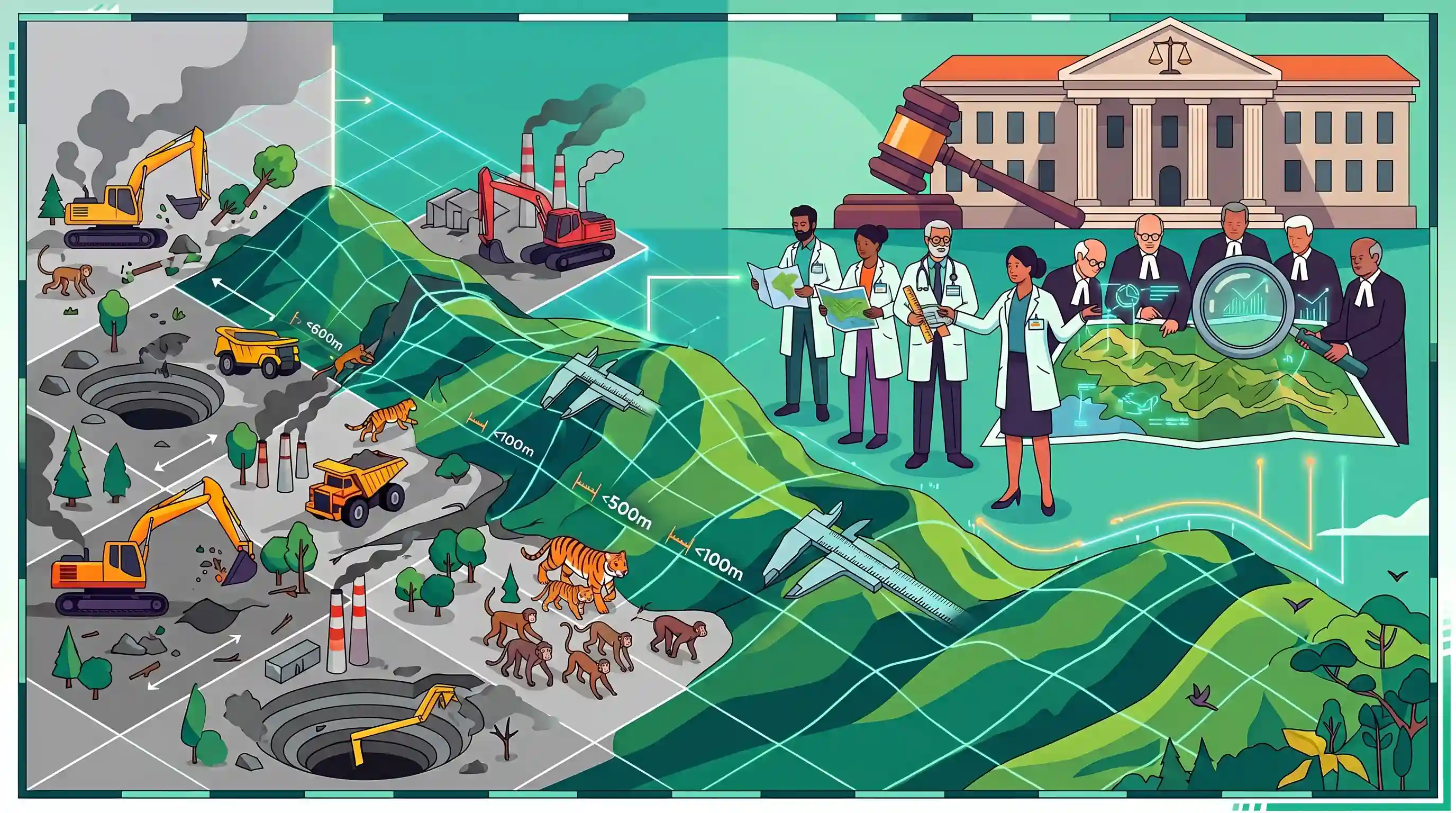
The Supreme Court of India has constituted a high-powered expert committee to independently re-examine the definition and delineation of the Aravalli hill range, following concerns over a recent Ministry of Environment, Forest and Climate Change (MoEFCC) report. The committee, chaired by ICFRE Director General Kanchan Devi, will investigate if narrowing the definition of the Aravallis—such as limiting it to hills with gaps of less than 500 metres—would expose ecologically sensitive, continuous ecological formations to mining and other disruptive activities. The panel will also verify the claim that a vast majority of Rajasthan's hills fall short of the 100-metre elevation criterion, determining whether such classifications leave critical ecosystems unprotected.
Key Points
- The Supreme Court formed a High-Powered Committee (HPC) chaired by ICFRE Director General Kanchan Devi to re-examine the definition and delineation of the Aravalli hill range.
- The HPC will independently review an October 2025 MoEFCC report whose implementation was stayed by the apex court due to "critical ambiguities".
- The committee will assess whether defining the Aravalli range based on a maximum 500-metre gap between hills unjustifiably narrows the protected territory and opens up ecologically sensitive land to mining.
- Another key contention to be examined is whether hills over 100 metres high form a continuous ecological formation despite wider gaps, and if mining should be prohibited in those intervening spaces.
- The panel will also investigate the scientific accuracy of the Centre's assertion that only 1,048 of Rajasthan's 12,081 hills meet the 100-metre elevation criterion.
Important Terms
Supreme Court of India

The highest judicial forum and final court of appeal under the Constitution. It plays a critical role in environmental governance through Public Interest Litigation and judicial activism.
UPSC context
GS II (Judiciary) and GS III (Environment); tests judicial interventions, Constitutional provisions, and environmental jurisprudence.
Ministry of Environment, Forest and Climate Change (MoEFCC)
The nodal central ministry responsible for India's environmental policies, biodiversity conservation, forest management, and international climate change negotiations. It oversees bodies like the CPCB and NTCA.
UPSC context
GS III (Environment); tests policy frameworks, environmental legislations, and institutional roles in climate action.
Indian Council of Forestry Research and Education (ICFRE)
An autonomous council under the MoEFCC, headquartered in Dehradun. It is India's apex institution for forestry research, education, and the transfer of scientific technologies to state forest departments.
UPSC context
GS III (Environment and Biodiversity); tests institutional frameworks for sustainable forest management and ecological rehabilitation.
Central Empowered Committee (CEC)
A body established by the Supreme Court in 2002 to monitor environmental compliance. It received statutory status in 2023 and assists the judiciary in matters concerning forest conservation.
UPSC context
GS II (Polity) and GS III (Environment); tests judicial oversight and the functioning of statutory bodies in environmental protection.
Forest Survey of India (FSI)
A premier national organization under MoEFCC responsible for assessing forest and tree cover. It is best known for publishing the biennial India State of Forest Report (ISFR).
UPSC context
GS III (Environment); tests monitoring of natural resources and data-driven policy formulation for forest protection.
Geological Survey of India (GSI)
A scientific agency under the Ministry of Mines, founded in 1851. It conducts geological surveys, mineral prospecting, and provides earth science information for national development and resource management.
UPSC context
GS I (Physical Geography) and GS III (Mining); tests knowledge of geological formations and the distribution of natural resources.
Prelims Trap
"The 100-metre elevation criterion for defining the Aravalli hills is a statutory standard under the EPA, 1986."
This is a contested parameter proposed in an MoEFCC report, which the Supreme Court has explicitly stayed. It is not a settled statutory standard.
Static Concepts Connected
What are the primary geographical and ecological characteristics of the Aravalli Range?
- Formation: One of the world's oldest fold mountain systems, highly denuded over millions of years and existing today as relict or residual mountains.
- Geographical Extent: Runs approximately 670 km southwest to northeast, from Palanpur in Gujarat through Rajasthan and Haryana, ending in Delhi.
- Ecological Role: Acts as a critical physical and climatic barrier that prevents the eastward expansion of the Thar Desert into the fertile Indo-Gangetic plains.
What is the Indian Council of Forestry Research and Education (ICFRE)?
- Institutional Status: It is not a statutory body; it is an autonomous apex organization registered as a society, functioning under the Ministry of Environment, Forest and Climate Change.
- Primary Mandate: Headquartered in Dehradun, it is responsible for formulating, organizing, directing, and coordinating national forestry research and education.
Cross-Topic Patterns
Aravalli degradation and UNCCD targets
Narrowing the Aravalli definition threatens continuous natural corridors, undermining India's UNCCD commitment to restore 26 million hectares of degraded land by 2030 by accelerating eastward desertification.
Judicial definition of ecosystems
The SC intervening to define a mountain range parallels the historic Godavarman case, where the judiciary expanded the definition of 'forest' beyond statutory classifications to protect fragile ecologies.

Expect a 2026 Prelims question fusing the Aravallis' geomorphological traits with ICFRE's mandate and India's desertification targets.
Linked PYQs · 3
Linked PYQs · 3
- 2001PrelimsGS1
The approximate age of the Aravalli’s range is
- 2025MainsGS3
Mineral resources are fundamental to the country's economy and these are exploited by mining. Why is mining considered an environmental hazard? Explain the remedial measures required to reduce the environmental hazard due to mining.
- 2022MainsGS2
“The most significant achievement of modern law in India is the constitutionalization of environmental problems by the Supreme Court.” Discuss this statement with the help of relevant case laws.
