Supreme Court Appoints Committee to Probe NEET Protest Police Action
Source:The Hindu ↗
Why It Matters
This issue highlights the persistent conflict between state mechanisms for maintaining public order and citizens' fundamental rights to protest and privacy. It raises critical questions regarding police reforms, the proportional use of force, and accountability within security forces—core areas for UPSC GS-2 (Polity & Governance) and GS-3 (Internal Security). The judicial intervention via the HPEC underscores the Supreme Court's role in checking executive overreach and protecting vulnerable sections, especially women.
Summary
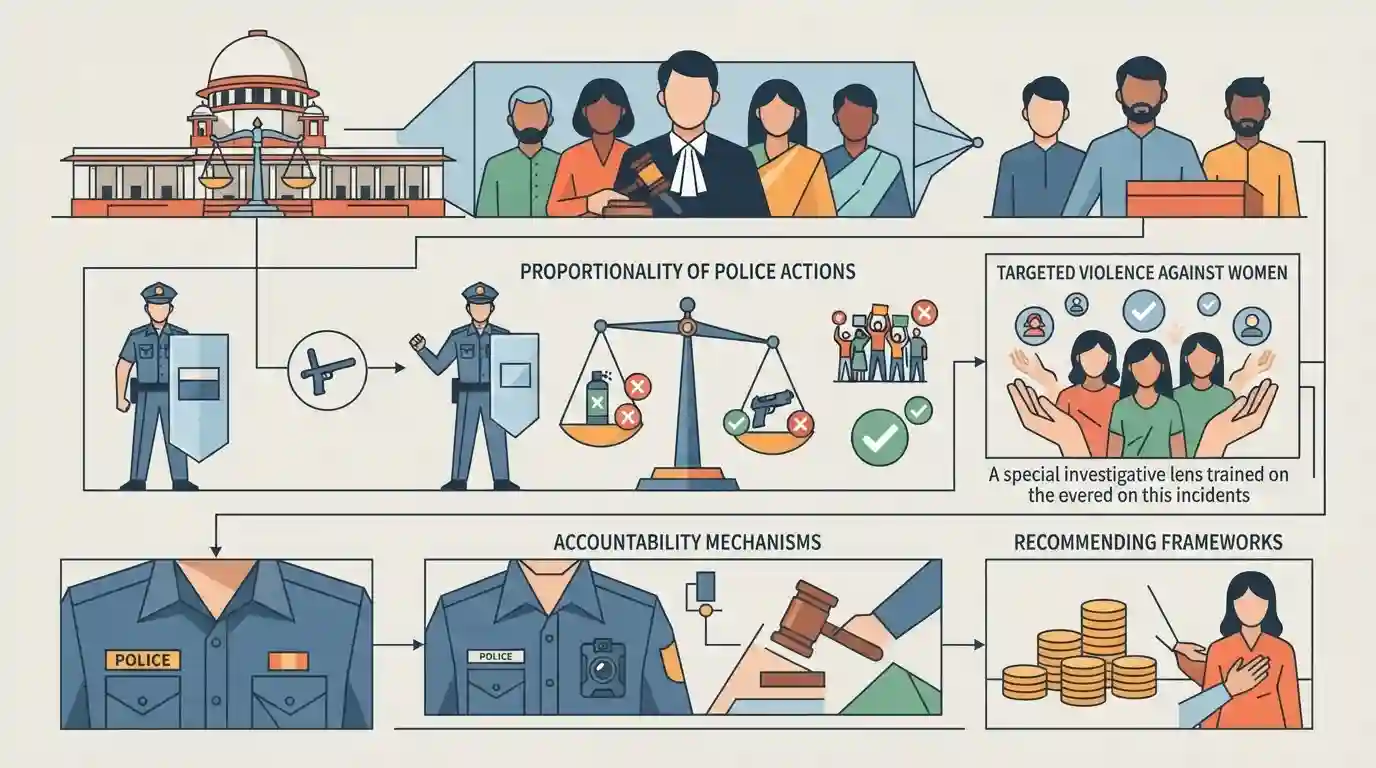
The Supreme Court of India has formed a five-member high-powered enquiry committee (HPEC), led by former SC Judge Justice R. Subhash Reddy, to investigate allegations of excessive force and police brutality during nationwide protests against NEET-UG paper leaks. The committee is mandated to examine the proportionality of police actions—including the use of pellet guns, tear gas, and electric batons—and ensure that measures for crowd control do not violate the fundamental rights to peaceful assembly and privacy. Special priority is given to probing incidents of targeted violence and harassment against female protesters. Additionally, the panel will look into establishing accountability mechanisms, such as mandatory visible nameplates for police, and recommend frameworks for compensating victims of abuse, thereby seeking a constitutional balance between public order and the right to dissent.
Key Points
- The Supreme Court constituted a five-member high-powered enquiry committee (HPEC) headed by former SC judge Justice R. Subhash Reddy to probe violence and police excesses during the NEET-UG protests.
- The panel will assess whether the police response was proportionate and measured, scrutinizing the use of pellet guns, electric batons, tear gas, and lathi charges.
- It will prioritize investigating allegations of targeted violence, harassment, and molestation of female protesters.
- The committee is tasked with examining if surveillance and monitoring of protesters breached constitutional rights to privacy and free assembly.
- Recommendations will be sought to enhance police accountability, such as enforcing uniform and visible nameplates during crowd control operations.
- The mechanism for providing medical support and compensation to victims of police abuse, alongside probing violence by protesters against public property, falls under the mandate.
Important Terms
Right to Peaceful Assembly

A fundamental right guaranteed under Article 19(1)(b) of the Constitution, allowing citizens to gather peaceably and without arms, subject to reasonable restrictions like public order and national integrity under Article 19(3).
UPSC context
GS Paper II (Polity): Explores fundamental rights, reasonable restrictions, and the balance between democratic dissent and public order.
Doctrine of Proportionality
A constitutional principle of judicial review mandating that state restrictions on fundamental rights must be reasonable, necessary, and the least intrusive means to achieve a legitimate objective.
UPSC context
GS Paper II (Judiciary): Evaluates state overreach, judicial review standards, and balancing fundamental rights against public interest.
Police Accountability
The legal and institutional mechanisms ensuring law enforcement personnel are answerable for their actions, particularly concerning the use of force, preventing abuses, and upholding civil rights.
UPSC context
GS Papers II & III: Explores police reforms, governance, law and order, and state compliance with human rights.
Supreme Court of India
The highest judicial authority in India under Article 124 of the Constitution, serving as the final interpreter of laws and the ultimate custodian of fundamental rights.
UPSC context
GS Paper II (Polity): Tests the judiciary's structure, powers, judicial review, and its role in protecting citizen rights.
NEET-UG
The National Eligibility cum Entrance Test (Undergraduate), a single centralized nationwide examination conducted in India for admissions to undergraduate medical and dental courses.
UPSC context
GS Paper II (Education): Covers government policies, centralisation of examinations, and governance challenges in the social sector.
Prelims Trap
The Right to Protest is explicitly listed as an absolute Fundamental Right under Article 19 of the Constitution.
The "Right to Protest" is not explicitly written in the Constitution. It is a judicially derived right flowing implicitly from the combination of Article 19(1)(a) and Article 19(1)(b), and is never absolute.
Static Concepts Connected
What are the constitutional limits on the Right to Assembly under Article 19(1)(b)?
- Constitutional Grounds: Article 19(3) allows the State to impose reasonable restrictions only in the interests of the sovereignty and integrity of India, or public order.
- Peaceful & Unarmed: The assembly must be strictly peaceful and unarmed; violent assemblies lose constitutional immunity immediately.
- Statutory Restrictions: Section 144 of the CrPC/BNSS and regulatory traffic laws are valid statutory restrictions, provided they meet the test of reasonableness.
What is the Doctrine of Proportionality in Indian jurisprudence?
- Puttaswamy Mandate: Affirmed in the K.S. Puttaswamy judgment, requiring any state restriction on rights to have a legitimate aim and a rational, necessary connection.
- Least Intrusive Means: The state must employ the least intrusive/restrictive means available to achieve its objective (e.g., in crowd control).
- Proportionality stricto sensu: The social/public benefit of the restriction must outweigh the level of infringement on the individual's fundamental rights.
Cross-Topic Patterns
Judicial Oversight vs Executive Domain
SC-appointed panels investigating policing (State List II) highlight the evolving boundaries of Article 142 and judicial oversight in administrative and law-enforcement domains.
Federal Exams + Local Policing Friction
Centralized competitive examinations (like NEET) create nationwide administrative failure points, forcing state police forces to handle localized public order crises.

Expect questions testing the doctrine of proportionality and reasonable restrictions when balancing Article 19 with 7th Schedule powers.
Linked PYQs · 3
Linked PYQs · 3
- 2017MainsGS3
Mob violence is emerging as a serious law and order problem in India. By giving suitable examples, analyze the causes and consequences of such violence.
- 2021MainsGS2
Though the Human Rights Commissions have contributed immensely to the protection of human rights in India, yet they have failed to assert themselves against the mighty and powerful. Analyzing their structural and practical limitations, suggest remedial measures.
- 2024MainsGS2
Right to privacy is intrinsic to life and personal liberty and is inherently protected under Article 21 of the constitution. Explain. In this reference discuss the law relating to D.N.A. testing of child in the womb to establish its paternity.
