Supreme Court Warns Against Risks of AI in Legal Drafting
Source:The Hindu ↗
Why It Matters
The intersection of Artificial Intelligence and judicial processes highlights emerging challenges in governance and ethics. For UPSC aspirants, understanding the limitations of AI (like hallucinations and bias) is crucial for topics related to Science and Technology (GS3), Governance (GS2), and Ethics in decision-making (GS4).
Summary
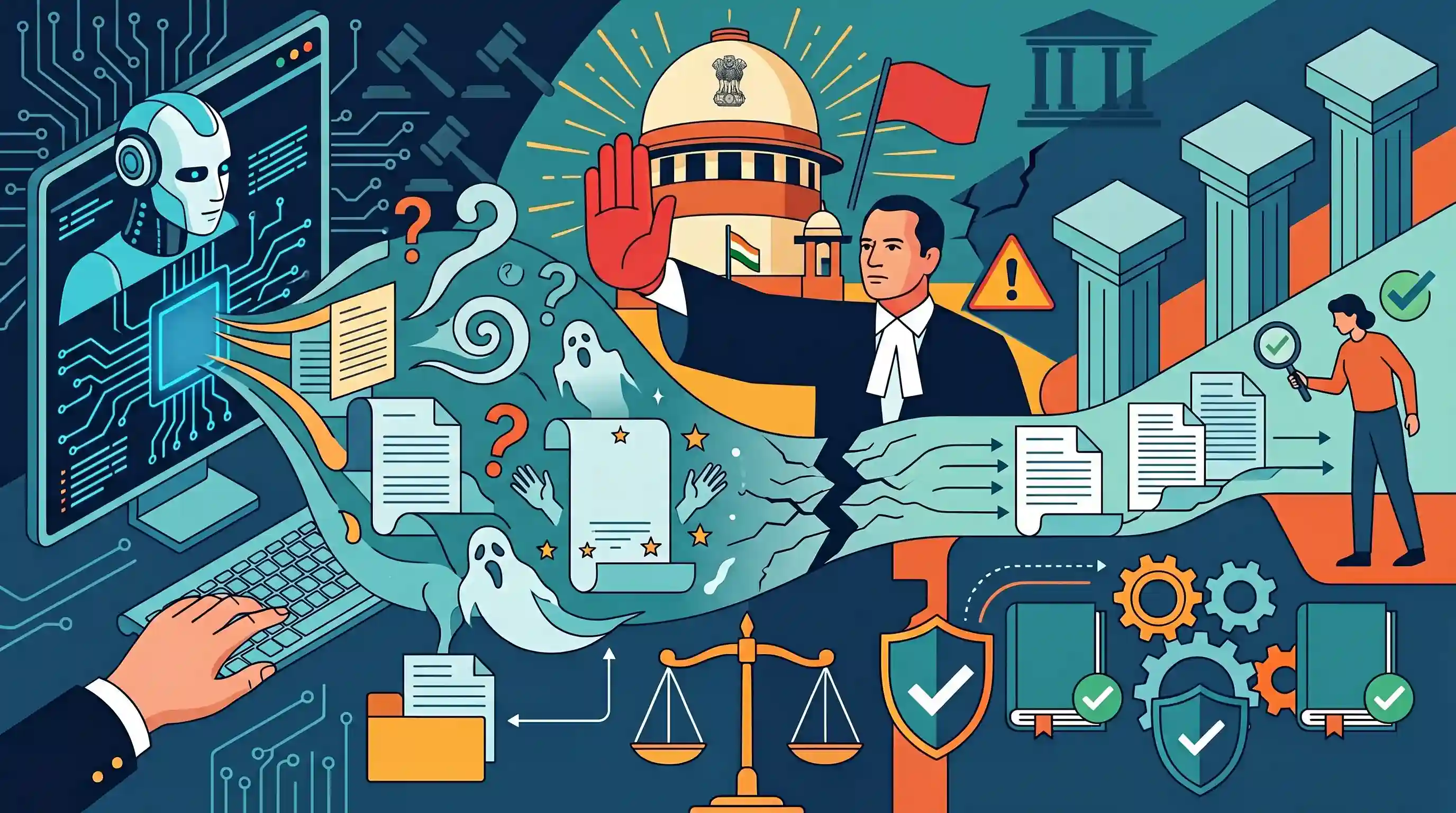
The Supreme Court of India has flagged serious risks associated with the use of Generative AI in drafting legal petitions, warning against the phenomenon of "AI hallucinations" that produce fictitious case laws and judgments. Noting instances where lawyers cited non-existent precedents like 'Mercy vs Mankind', the Bench cautioned that while AI offers convenience in legal research, it must not undermine truth, accuracy, or the integrity of the justice administration process. The observations underscore the need for ethical guidelines and human oversight in integrating AI into the legal sector.
Key Points
- The Supreme Court of India expressed alarm over the increasing use of Generative AI in drafting legal petitions, citing the risk of compromising judicial integrity.
- A key issue highlighted was "AI hallucinations," where AI tools fabricate non-existent case laws, rules, or judgments.
- The Bench cited a real-world example where a lawyer submitted a fictitious case, 'Mercy vs Mankind', generated by an AI platform.
- The judiciary emphasized that the convenience of AI-assisted legal research should never come at the expense of factual accuracy and truth in the justice administration process.
Important Terms
Supreme Court of India

The highest judicial authority in India and the final court of appeal under the Constitution. It possesses the power of judicial review and protects fundamental rights.
UPSC context
GS Paper II (Polity); essential for understanding judicial structure, powers, and constitutional protection.
AI Hallucination
A phenomenon where generative AI models produce factually incorrect or entirely fabricated information—such as non-existent legal cases—while appearing plausible and authoritative.
UPSC context
GS Paper III (Science & Technology); tests awareness of technology's limitations and ethical risks in governance.
Generative AI (GenAI)
A type of artificial intelligence capable of creating new content—including text, images, and code—by learning patterns and structures from massive existing datasets.
UPSC context
GS Paper III (Science & Technology); focuses on emerging technologies and their regulatory challenges.
SUPACE
An AI-driven portal (Supreme Court Portal for Assistance in Court’s Efficiency) designed to assist judges with legal research, case file processing, and data management.
UPSC context
GS Paper II (Governance); highlights technology-led reforms to improve judicial efficiency and reduce pendency.
SUVAS
An AI-based translation tool (Supreme Court Vidhik Anuvaad Software) used to translate Supreme Court judgments and legal documents into various regional Indian languages.
UPSC context
GS Paper II (Governance); relates to improving accessibility and inclusivity within the justice system.
e-Courts Project
A mission-mode project aimed at transforming the Indian judiciary through Information and Communication Technology (ICT) enablement of district and subordinate courts across the country.
UPSC context
GS Paper II (Governance); critical for questions on judicial reforms, transparency, and digital governance.
Professional Misconduct
Unethical or illegal behavior by a professional. The Supreme Court has noted that citing AI-generated fake judgments can constitute misconduct rather than a simple error.
UPSC context
GS Paper IV (Ethics); tests understanding of professional accountability and integrity in the legal system.
Prelims Trap
"SUPACE is an AI tool developed by the Supreme Court to autonomously draft judgments and decide minor cases."
SUPACE and SUVAS are administrative and research aids for efficiency. The Supreme Court strictly mandates a "Human-in-the-Loop" approach; AI is never used for autonomous decision-making or drafting judgments.
Static Concepts Connected
What are the primary AI and digital portals used by the Indian Judiciary?
- SUVAS: Supreme Court Vidhik Anuvaad Software. An AI-trained machine learning tool used to translate judicial documents from English to vernacular languages and vice versa.
- SUPACE: Supreme Court Portal for Assistance in Court's Efficiency. An AI-driven research tool that extracts relevant facts and laws to assist judges, without decision-making powers.
- FASTER: Fast and Secured Transmission of Electronic Records. A system to ensure secure, rapid transmission of SC interim orders, stay orders, and bail orders to authorities.
What are "AI Hallucinations" in the context of Generative AI?
- Definition: Instances where a Large Language Model (LLM) confidently generates false, illogical, or fabricated information presented as absolute fact.
- Underlying Mechanism: Generative AI predicts the next statistically probable word rather than retrieving verified facts, lacking actual cognitive understanding or factual reasoning capabilities.
- Impact in Governance: In legal and medical fields, this leads to citing non-existent precedents (like fabricated case laws) or proposing incorrect treatments, requiring strict human oversight.
Cross-Topic Patterns
Algorithmic Bias vs Fundamental Rights
AI trained on historically skewed legal data can perpetuate systemic discrimination, threatening Article 14 (Equality before Law) and raising questions about automated bias in the justice system.
Data Privacy and Cloud AI
Feeding sensitive case facts into public generative AI platforms risks breaching litigant confidentiality, intersecting with the Right to Privacy (Puttaswamy) and the Digital Personal Data Protection (DPDP) Act.

AI tools in judiciary (SUVAS, SUPACE) matched with their functions, alongside 'AI hallucinations' as a tech concept, is a prime 2026 bet.
Linked PYQs · 2
Linked PYQs · 2
- 2024MainsGS4
The application of Artificial Intelligence as a dependable source of input for administrative rational decision-making is a debatable issue. Critically examine the statement from the ethical point of view.
- 2023MainsGS3
Introduce the concept of Artificial Intelligence (AI). How does Al help clinical diagnosis? Do you perceive any threat to privacy of the individual in the use of Al in healthcare?
