Supreme Court warns against artificial intelligence in legal drafting
Source:The Hindu ↗
Why It Matters
The integration of Generative AI in critical governance and judicial functions presents unprecedented challenges, particularly regarding AI hallucinations, bias, and legal accuracy. Understanding these risks is vital for evaluating technology adoption policies within India's justice administration.
Summary
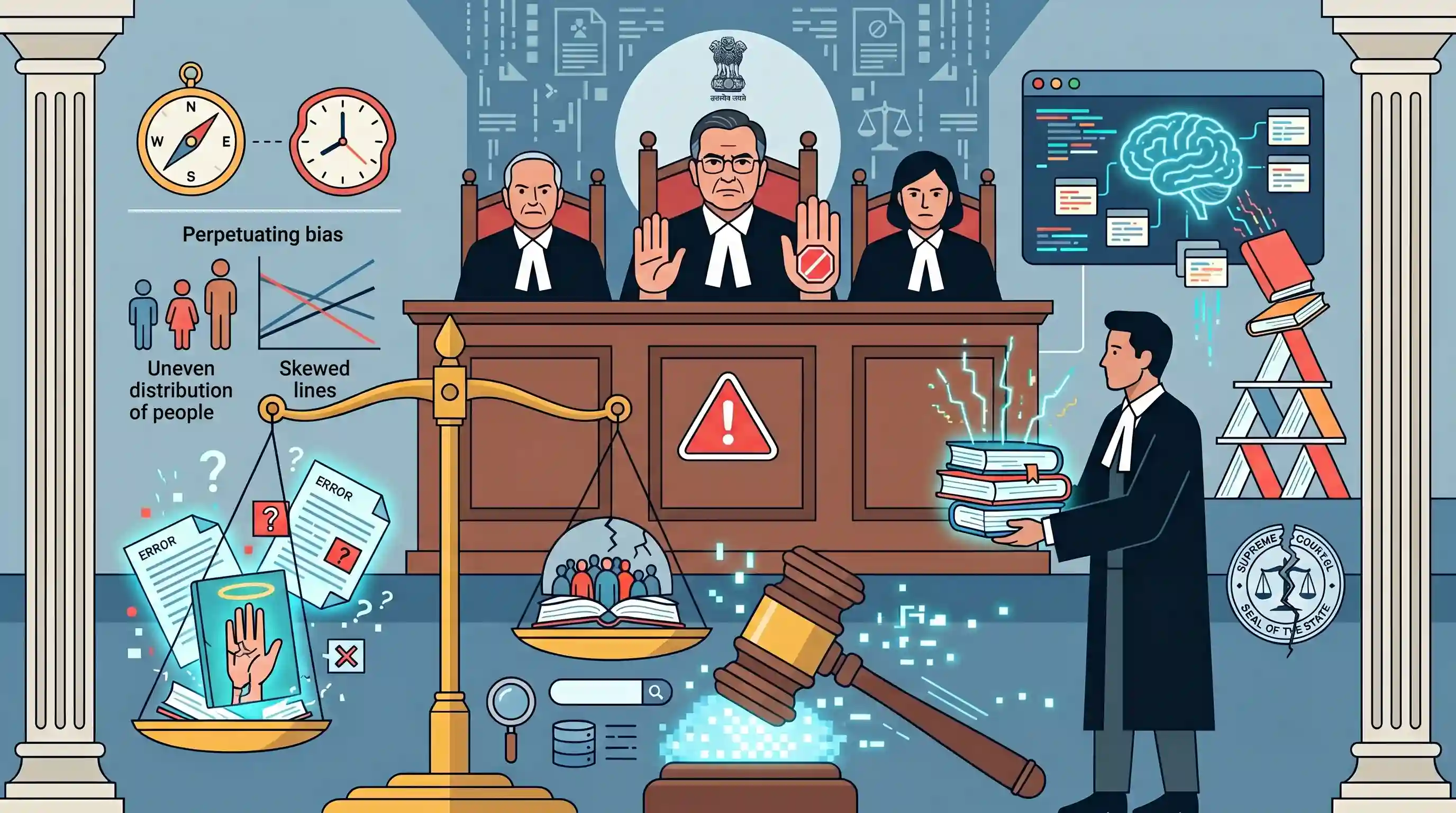
The Supreme Court of India has raised serious concerns regarding the growing reliance on Generative Artificial Intelligence (GenAI) for drafting legal petitions. A Bench headed by the Chief Justice of India warned of AI "hallucinations" after noting instances where lawyers cited entirely fictitious, AI-generated case laws (such as 'Mercy vs Mankind'). The court cautioned that the indiscriminate use of AI in legal work risks compromising truth and accuracy, producing fictitious judgments, and perpetuating bias. The justices emphasized that while technological tools are useful for research, they must not overpower or undermine the integrity of the justice administration process.
Key Points
- The Supreme Court of India flagged the alarming trend of using Artificial Intelligence (AI) to draft legal petitions, which has led to citing non-existent or fictitious case laws.
- A Supreme Court Bench highlighted instances of AI 'hallucinations', such as a fabricated judicial precedent titled 'Mercy vs Mankind', compromising accuracy and truth in courts.
- The Chief Justice of India warned against the indiscriminate use of Generative AI (GenAI), citing risks like hallucinations, fictitious judgments, and the potential to perpetuate bias.
- The apex court emphasized that while AI can assist in legal research, it must not overpower the justice administration process or be used at the cost of legal accuracy.
Important Terms
Generative Artificial Intelligence (GenAI)

AI models capable of creating original content—such as text, images, or code—by learning patterns from existing data rather than just classifying it.
UPSC context
GS Paper III (Science & Tech); essential for understanding emerging technology risks and ethical governance.
AI Hallucination
A phenomenon where AI generates factually incorrect, non-existent, or fabricated information (like fake case citations) while presenting it as a coherent and confident fact.
UPSC context
GS Paper II/III; highlights the reliability and ethical challenges of integrating AI into governance and the judiciary.
Judicial Misconduct
Behavior that violates professional standards or ethical codes; the Supreme Court recently declared reliance on AI-fabricated judgments as misconduct rather than a simple error.
UPSC context
GS Paper II (Judiciary) and Paper IV (Ethics); focuses on accountability and the integrity of the adjudicatory process.
Supreme Court of India
The apex court of India and the final interpreter of the Constitution, established under Article 124 to safeguard fundamental rights and resolve legal disputes.
UPSC context
GS Paper II (Polity/Judiciary); central to the structure and functioning of the Indian state.
Administration of Justice
The overarching process and legal framework through which the state interprets and applies laws to resolve disputes and maintain the rule of law.
UPSC context
GS Paper II (Governance); pertains to the efficiency, transparency, and integrity of the justice delivery system.
Prelims Trap
SUPACE is an AI tool utilized by the Supreme Court to draft and deliver final judgments.
SUPACE assists judges with extracting facts and organizing documents. It is purely assistive; all adjudicatory decisions and judgment drafting remain strictly human-led.
Static Concepts Connected
What are the key AI portals deployed by the Indian Supreme Court?
- SUVAS: Supreme Court Vidhik Anuvaad Software (SUVAS) translates judicial documents and judgments from English into multiple regional languages to improve access to justice.
- SUPACE: Supreme Court Portal for Assistance in Court's Efficiency (SUPACE) assists judges by extracting facts and analyzing precedents, but does not make decisions.
- e-Courts Phase III: Explicitly integrates AI and Machine Learning for advanced digital case management, smart scheduling, and automated defect identification.
What is Generative AI 'hallucination' and why does it occur?
- Definition: A phenomenon where GenAI models confidently invent and present false, fictitious, or fabricated information as verified fact (e.g., fake case laws).
- Cause: Occurs because Large Language Models probabilistically predict the next logical word sequence based on patterns in training data, without actual reasoning or factual verification capabilities.
Cross-Topic Patterns
Algorithmic bias & constitutional equity
GenAI's latent biases in training data pose direct threats to Article 14 rights. Relying on it for substantive legal arguments risks compromising equitable justice delivery.
e-Courts Phase III vs AI risks
While e-Courts Phase III relies on NLP to clear judicial backlogs, the Supreme Court clearly isolates administrative AI assistance from substantive, human-led legal drafting.

Expect a GS-2/GS-3 Prelims question distinguishing the administrative roles of SUPACE/SUVAS from GenAI risks like 'hallucinations'.
Linked PYQs · 2
Linked PYQs · 2
- 2023MainsGS3
Introduce the concept of Artificial Intelligence (AI). How does Al help clinical diagnosis? Do you perceive any threat to privacy of the individual in the use of Al in healthcare?
- 2025MainsGS2
e-governance projects have a built-in bias towards technology and back-end integration than user-centric designs. Examine.
