Supreme Court Directs States to Formulate Road Safety Rules
Source:The Hindu ↗
Why It Matters
Road safety is a critical governance and public health issue in India. This article showcases the use of Public Interest Litigation (PIL) and judicial intervention to compel executive authorities to act on statutory duties, highlighting the accountability of infrastructure contractors and the practical implementation of the Motor Vehicles Act.
Summary
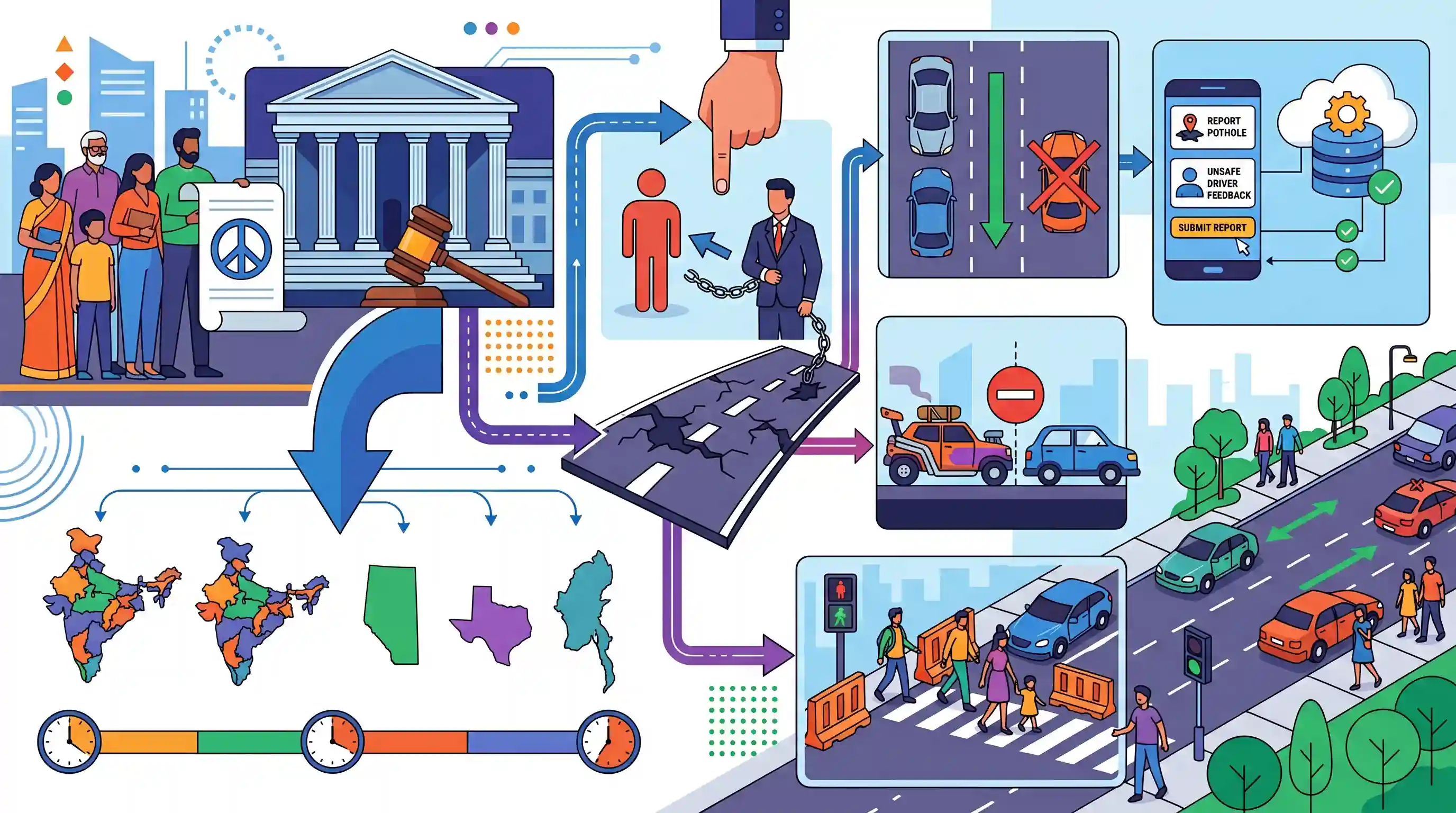
The Supreme Court has ordered all State governments and Union Territories to draft comprehensive road safety rules within six months to address the high rate of fatal traffic accidents. Acting on a Public Interest Litigation (PIL), the Court highlighted the necessity of protecting pedestrians and warned that government officials and contractors face personal liability for faulty road designs under Section 198A of the Motor Vehicles Act. The mandated rules will tackle issues like wrong-lane driving, unauthorized vehicle modifications, and require the establishment of an online grievance portal to improve public safety and governance.
Key Points
- The Supreme Court directed States and Union Territories to formulate comprehensive road safety rules within six months under the Motor Vehicles (MV) Act, 1988.
- The Court emphasized the urgent need to protect pedestrians and hold officials and contractors personally liable for infrastructural or design failures causing fatal accidents under Section 198A of the MV Act.
- The rules must address offenses such as wrong-lane driving, non-compliance with helmet laws, unsafe overtaking, dazzling LED headlights, and the unauthorized use/sale of red-blue strobe lights and hooters.
- States are required to create a simple, effective online public grievance redressal mechanism to report road safety violations.
- The court acted on a Public Interest Litigation (PIL) and emphasized adherence to Indian Roads Congress (IRC) standards for better road design and safety.
Important Terms
Motor Vehicles (MV) Act, 1988

A comprehensive central legislation regulating road transport, vehicle registration, and traffic safety. The 2019 Amendment significantly increased penalties and introduced provisions for vehicle recalls and a National Road Safety Board.
UPSC context
GS Paper 2 & 3; essential for questions on infrastructure regulation, governance, and road safety frameworks in India.
Indian Roads Congress (IRC)
The premier technical body of highway engineers in India, established in 1934. it formulates standard codes and guidelines for the design, construction, and maintenance of roads and bridges.
UPSC context
GS Paper 3; relevant for infrastructure standards and the role of statutory/semi-official bodies in national development.
Section 198A (MV Act)
A specific provision in the Motor Vehicles Act that holds designated authorities, contractors, or consultants personally liable (with fines) for failing to comply with road design and safety standards.
UPSC context
GS Paper 2; highlights executive accountability and legal mechanisms to prevent administrative lethargy in public safety.
Article 21 (Right to Safe Passage)
A judicial interpretation of the fundamental 'Right to Life,' whereby the Supreme Court has declared that safe passage on roads and highways is an essential facet of living with dignity.
UPSC context
GS Paper 2; vital for Constitutional Law questions regarding the expansion of fundamental rights through judicial interpretation.
Public Interest Litigation (PIL)
A legal mechanism allowing individuals or groups to file petitions in the Supreme Court or High Courts for the protection of public interest, rather than personal grievance.
UPSC context
GS Paper 2; a core topic in Indian Polity regarding judicial remedies and social justice.
Judicial Activism
A proactive role played by the judiciary in enforcing the rights of citizens and directing the executive or legislature to perform their duties, often seen in road safety mandates.
UPSC context
GS Paper 2; tests understanding of the Separation of Powers and the evolving role of the Supreme Court.
Prelims Trap
"The Motor Vehicles Act holds only drivers and owners liable, exempting road contractors from personal liability."
False. Section 198A of the Motor Vehicles (Amendment) Act, 2019 explicitly holds road contractors, consultants, and civic authorities personally liable for faulty road design causing death.
Static Concepts Connected
What is the Brasilia Declaration on Road Safety?
- UN Framework: Adopted at the 2nd Global High-Level Conference in 2015, co-sponsored by WHO. India is a key signatory.
- SDG 3.6 Link: Directly aligns with Sustainable Development Goal (SDG) target 3.6, which aims to halve global road traffic deaths and injuries by 2030.
How is legislative jurisdiction over 'Motor Vehicles' shared constitutionally?
- Concurrent List: 'Mechanically propelled vehicles' fall under Entry 35 of the Concurrent List (Seventh Schedule) of the Indian Constitution.
- Rule-making Power: This shared jurisdiction allows Parliament to enact the overarching Motor Vehicles Act while empowering States to frame specific operational rules.
Cross-Topic Patterns
Judicial Activism & Article 21
The SC's directive to frame executive rules highlights the ongoing expansion of the Right to Life (Article 21) to include protection from preventable public infrastructure hazards and executive inaction.
Urbanization & Pedestrian Rights
Links heavily to GS1/GS3 urbanization themes, where auto-centric infrastructure planning routinely neglects the safety and rights of pedestrians and non-motorized transport users.

Expect a Prelims question linking the Brasilia Declaration, SDG 3.6, and contractor liability under the MV Act.
Linked PYQs · 2
Linked PYQs · 2
- 2020MainsGS2
Judicial Legislation is antithetical to the doctrine of separation of powers as envisaged in the Indian Constitution. In this context justify the filing of large number of public interest petitions praying for issuing guidelines to executive authorities.
- 2024MainsGS2
Explain the reasons for the growth of public interest litigation in India. As a result of it, has the Indian Supreme Court emerged as the world's most powerful judiciary ?
