Supreme Court on Civic Connivance in Building Bye Law Violations
Source:The Hindu ↗
Why It Matters
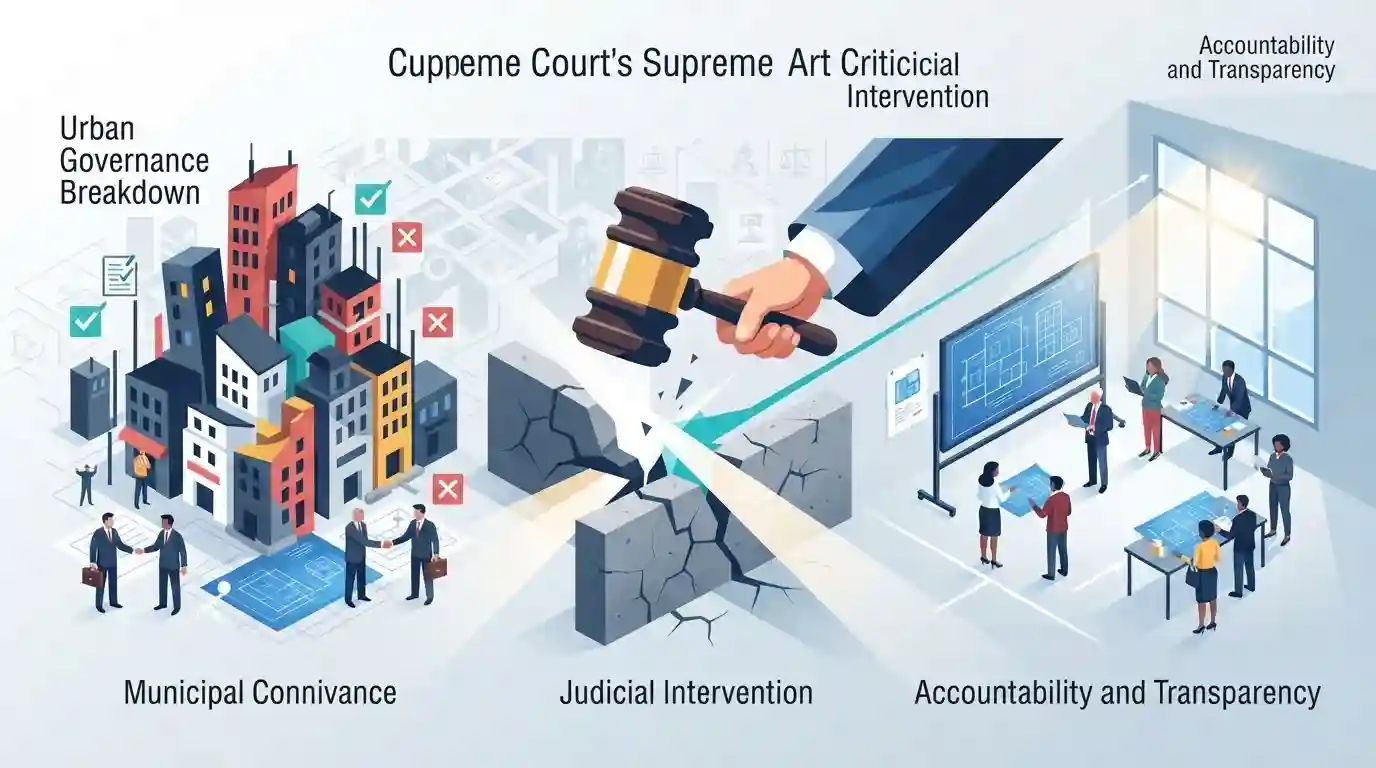
It highlights systemic failures in urban local bodies and municipal governance, showcasing how corruption and connivance among officials undermine urban planning and the rule of law.
Summary
The Supreme Court has strongly criticized municipal and civic authorities for active connivance in widespread building bye-law violations and unauthorized constructions, highlighting the breakdown of urban governance and accountability.
Key Points
- The Supreme Court criticized the active connivance of civic authorities in flagrant violations of building bye-laws and unauthorized constructions.
- The court highlighted how unchecked illegal constructions compromise urban safety, planning, and environmental standards.
- Emphasized the accountability of municipal officials and urban local bodies in curbing illegal real estate growth.
Important Terms
Building Bye-Laws

Locally formulated rules and regulations established by municipal authorities to govern building construction, structural safety, land use, and architectural standards within an urban area.
UPSC context
GS Paper II (Governance, Urbanization) and GS Paper IV (Ethics, Integrity in Public Administration); tests accountability in local urban bodies.
Urban Governance
The institutional framework, administrative machinery, and participatory processes involved in managing urban areas, providing civic amenities, and enforcing local municipal laws.
UPSC context
GS Paper II (Governance and Polity); evaluates challenges, institutional bottlenecks, and reforms needed in municipal administration and local bodies.
Accountability and Transparency
The constitutional duty and moral obligation of public officials and local authorities to answer for decisions, discharge duties transparently, and prevent administrative corruption or dereliction.
UPSC context
GS Paper II (Polity/Governance) and GS Paper IV (Ethics); focuses on corruption, integrity, and administrative ethics in public service delivery.
Prelims Trap
Municipal bye-laws and urban planning are purely executive domains exempt from judicial scrutiny or constitutional oversight.
Aspirants often assume urban local bodies fall exclusively under state executive control without any constitutional avenues for direct judicial or central intervention on safety standards.
Static Concepts Connected
What are the constitutional provisions and 74th Amendment features governing Urban Local Bodies in India?
- Constitutional Status: Constitutional Status: Added by the 74th Constitutional Amendment Act of 1992, inserting Part IX-A and the Twelfth Schedule into the Constitution.
- Devolution of Powers: Devolution of Powers: Empowers State Legislatures to endow municipalities with powers, authority, and responsibilities necessary to function as institutions of self-government.
- Twelfth Schedule: Twelfth Schedule: Lists 18 functional items including urban planning, regulation of land use, construction of buildings, and fire services.
Cross-Topic Patterns
Urban Flooding & Municipal Governance Failures
Unregulated urban growth directly strains civic infrastructure, exacerbating urban flooding and environmental degradation during extreme weather events.
Ethics and Bureaucratic Integrity in Local Bodies
Bureaucratic corruption in local bodies directly undermines foundational civil service integrity and probity required under public administration norms.

Expect a GS Paper 2/4 question linking municipal corruption, judicial activism, and the systemic breakdown of urban local bodies.
Linked PYQs · 2
Linked PYQs · 2
- 2023MainsGS2
“The states in India seem reluctant to empower urban local bodies both functionally as well as financially.” Comment.
- 2024MainsGS2
The Doctrine of Democratic Governance makes it necessary that the public perception of the integrity and commitment of civil servants becomes absolutely positive. Discuss.
