Supreme Court Review of Passive Euthanasia Legal Frameworks
Source:The Hindu ↗
Why It Matters
This article is highly relevant for UPSC aspirants as it details the evolving constitutional jurisprudence surrounding Article 21. It provides a real-world case study distinguishing active from passive euthanasia, explaining the legal procedural mechanisms (medical boards, living wills) required to uphold the right to life with dignity, and touching upon the intersections of law, medical ethics, and human rights.
Summary
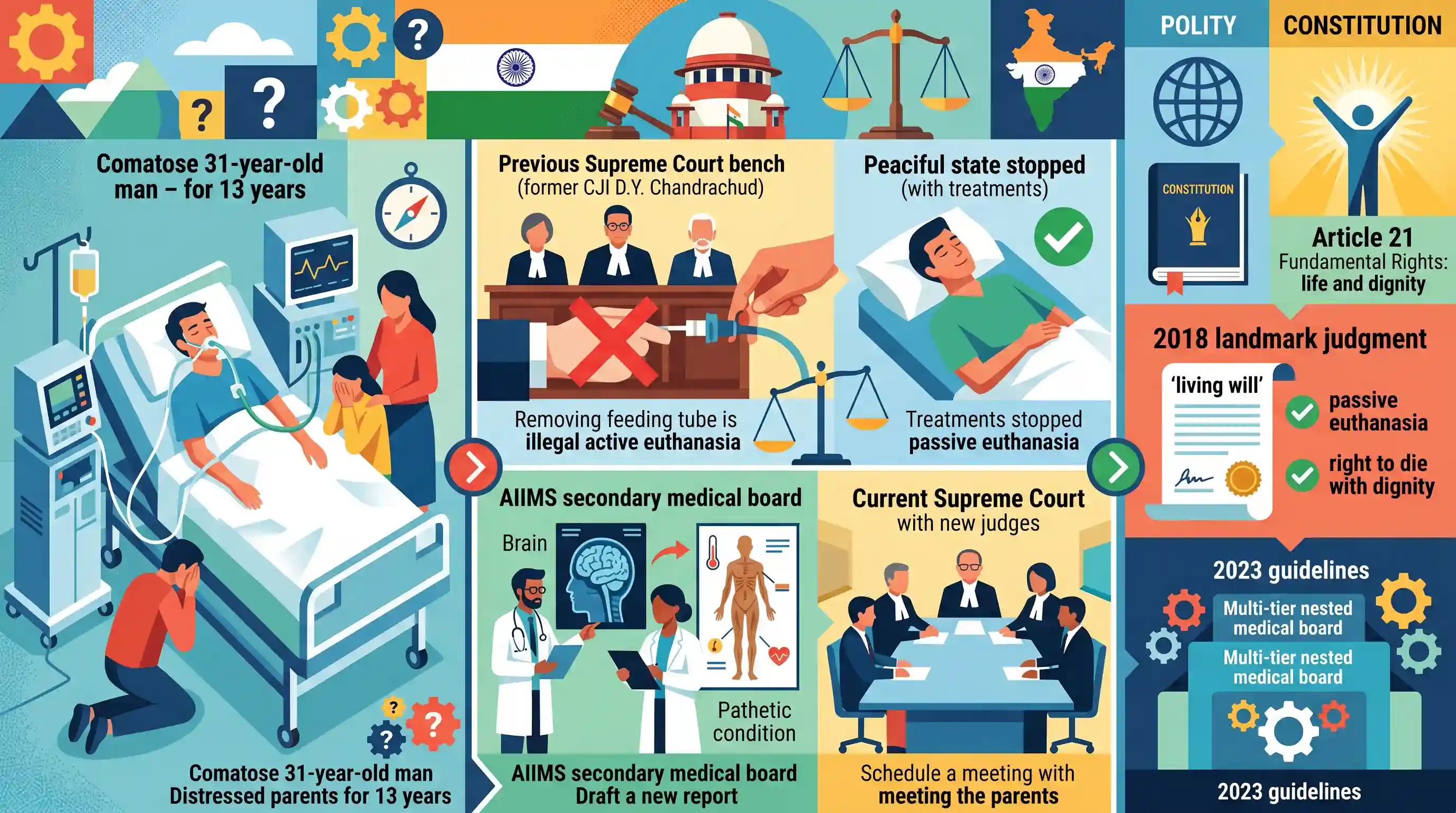
The Supreme Court is reviewing a plea for passive euthanasia by the parents of a 31-year-old man who has been comatose and quadriplegic for 13 years. A previous Supreme Court Bench led by former CJI D.Y. Chandrachud had rejected the plea on the grounds that removing his feeding tube—his only life support—would amount to illegal active euthanasia. However, after examining a new report from an AIIMS secondary medical board detailing the patient's 'pathetic condition', the Court has scheduled a meeting with the parents. The case revives critical debates around the 2018 landmark Supreme Court judgment that legalized passive euthanasia and 'living wills' under the right to die with dignity (Article 21), and the subsequent 2023 guidelines that established multi-tier medical boards to oversee such end-of-life decisions.
Key Points
- Active vs. Passive Euthanasia: The Supreme Court noted that withdrawing only a feeding tube (when no ventilator is used) constitutes illegal active euthanasia, whereas withdrawing artificial life support is legally permissible passive euthanasia.
- Right to Die with Dignity: In 2018, a Constitution Bench ruled that Article 21 (Right to Life) inherently includes the right to a dignified death for terminally ill or permanently vegetative patients.
- Advance Medical Directives: The 2018 landmark judgment legally recognized 'living wills', allowing individuals to pre-determine their refusal of life-prolonging medical interventions.
- Procedural Safeguards: In 2023, the SC simplified euthanasia procedures, mandating primary and secondary medical boards to assess end-of-life withdrawal of support.
- Ethical and Governance Dilemmas: The case highlights the severe emotional and financial toll on families, balancing the sanctity of life against the quality of life and the prevention of euthanasia misuse.
Important Terms
Article 21 of the Constitution

Guarantees protection of life and personal liberty. The Supreme Court interprets this to include the 'right to die with dignity' as an essential component of a meaningful life.
UPSC context
GS II (Polity/Fundamental Rights) and GS IV (Ethics). Tests knowledge of judicial expansion of rights and bioethical legal frameworks.
Passive Euthanasia
Withdrawing or withholding life-sustaining treatment (like ventilators or feeding tubes) to allow a terminally ill or permanently vegetative patient to die naturally. It is legal in India under strict safeguards.
UPSC context
GS II (Judiciary) and GS IV (Medical Ethics). Distinguishes legal natural death from prohibited acts under Indian law.
Advance Medical Directives (Living Wills)
Written legal instructions specifying a person's medical treatment preferences if they become incapacitated. Legalized in 2018 and simplified in 2023 to ensure patient autonomy in end-of-life decisions.
UPSC context
GS II (Governance/Social Justice). Relates to self-determination, legal healthcare reforms, and the implementation of Supreme Court procedural guidelines.
Active Euthanasia
The intentional act of causing a patient's death through direct intervention, such as a lethal injection. Unlike passive euthanasia, it remains strictly illegal and a criminal offense in India.
UPSC context
GS IV (Ethics/Moral Philosophy). Tests ability to distinguish between acts of omission versus commission in legal and ethical settings.
Common Cause v. Union of India (2018)
The landmark 2018 Supreme Court judgment that legalized passive euthanasia and 'living wills,' ruling that the 'right to die with dignity' is a fundamental right under Article 21.
UPSC context
GS II (Landmark Judgments). Essential for tracing the legal evolution of personal liberty and bodily autonomy in Indian jurisprudence.
Secondary Medical Board
A 2023-mandated committee of three expert doctors (minimum 5 years' experience) that reviews a primary board's decision on withdrawing life support, ideally within 48 hours.
UPSC context
GS II (Governance/Health Policy). Part of the procedural safeguards to prevent misuse while streamlining end-of-life care processes.
Prelims Trap
"Active euthanasia is legally permitted in India for permanently vegetative patients under medical board supervision."
The Supreme Court (2018/2023) legalized only passive euthanasia. Active euthanasia (deliberately causing death, e.g., via lethal injection) remains strictly illegal in India regardless of the medical board's opinion.
Static Concepts Connected
Active vs. Passive Euthanasia: What is the legal distinction?
- Active Euthanasia: Involves a deliberate intervention or action to end life (e.g., administering a lethal substance). It is strictly illegal in India.
- Passive Euthanasia: Involves withdrawing or withholding life-sustaining medical treatment (e.g., turning off ventilators). Legally permitted in India under strict Supreme Court guidelines.
What is an Advance Medical Directive (Living Will)?
- Definition: A legal document allowing a mentally competent adult to specify their refusal of life-prolonging treatments if they later fall into an irreversible vegetative state.
- Constitutional Basis: Recognized as a facet of Article 21 (Right to die with dignity) by the Supreme Court in the landmark 2018 Common Cause judgment.
- Procedural Safeguards: Execution and implementation require stringent oversight by Primary and Secondary Medical Boards to prevent misuse, as simplified by the SC's 2023 modified guidelines.
Cross-Topic Patterns
Bioethics vs. Constitutional Law (GS4)
The euthanasia debate links directly to GS4 (Bioethics), pitting the ethical principle of patient 'autonomy' against the 'sanctity of life' and the state's paternalistic duty to prevent suicide.
Judicial Lawmaking in vacuums (GS2)
In the absence of a parliamentary statute on end-of-life care, the SC used its powers to frame binding medical guidelines (2018, 2023), mirroring its approach in the Vishaka guidelines.

Expect a multi-statement prelims question on Article 21 integrating living wills, the 2018 Common Cause ruling, and passive euthanasia.
Linked PYQs · 3
Linked PYQs · 3
- 2023MainsGS2
“The Constitution of India is a living instrument with capabilities of enormous dynamism. It is a constitution made for a progressive society.” Illustrate with special reference to the expanding horizons of the right to life and personal liberty.
- 2024PrelimsGS1
Under which of the following Articles of the Constitution of India, has the Supreme Court of India placed the Right to Privacy ?
- 2021PrelimsGS1
'Right to Privacy' is protected under which Article of the Constitution of India?
