Supreme Court Stay on Lok Sabha Privileges Committee Summons
Source:The Hindu ↗
কেন এটি গুরুত্বপূর্ণ
This case is highly relevant for GS-2 Polity, particularly for understanding the scope of Article 105 (Powers, Privileges, and Immunities of Parliament and its Members). It sets a legal precedent on whether parliamentary privileges can be invoked for political protests outside the Parliament, and it involves the friction between a Central legislative committee and State executive officials.
সারসংক্ষেপ
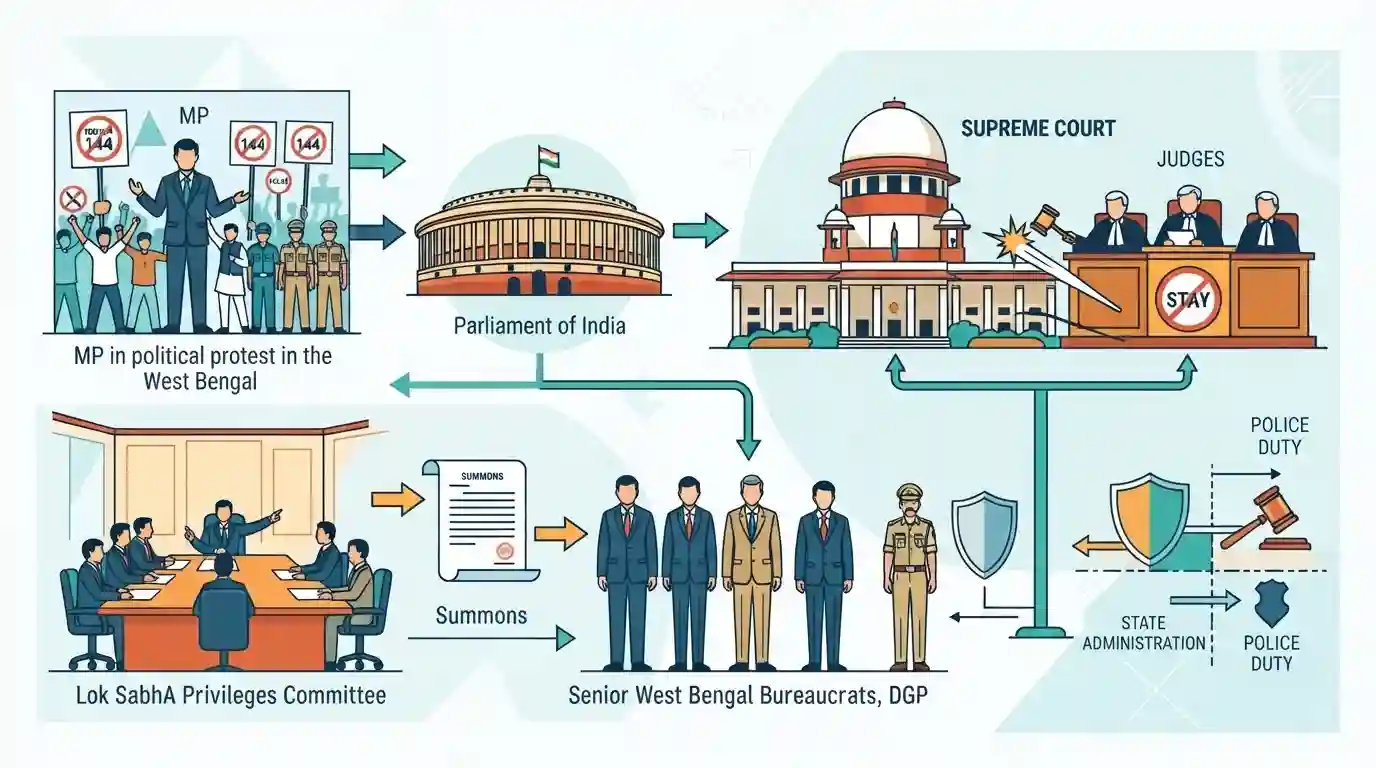
The Supreme Court extended the stay on proceedings by the Lok Sabha Privileges Committee against senior West Bengal bureaucrats. The bureaucrats were summoned based on a complaint by BJP MP Sukanta Majumdar regarding police action during his visit to Sandeshkhali. The legal defense for the officials argued that parliamentary privileges, under Article 105, are designed to protect MPs in their legislative duties, not during political activities or protests that violate prohibitory orders like Section 144. The case highlights the jurisdictional limits of parliamentary committees and the exact scope of parliamentary privileges.
মূল বিষয়
- The Supreme Court has extended its stay on the Lok Sabha Privileges Committee proceedings against senior West Bengal bureaucrats, including the Chief Secretary and DGP.
- The Committee had summoned the officials following a complaint by BJP MP Sukanta Majumdar, who alleged misconduct and injuries during a clash with police while traveling to Sandeshkhali.
- Legal counsels for the bureaucrats argued that parliamentary privileges do not extend to an MP's political activities or protests involving violations of prohibitory orders (Section 144).
- The counsels contended that parliamentary privileges are strictly meant to protect an MP's official duties within the legislature, and the Privileges Committee lacks jurisdiction in this political clash.
গুরুত্বপূর্ণ শব্দ
Article 105 of the Constitution

A constitutional provision granting privileges and immunities to Members of Parliament, including freedom of speech within the House and protection from legal proceedings for any statements made or votes cast during parliamentary duties.
UPSC context
Crucial for GS Paper 2 (Polity) to understand parliamentary functioning, legislative independence, and the balance between privileges and fundamental rights.
Section 144 of CrPC
A legal provision empowering executive magistrates to issue orders prohibiting assemblies of four or more people in specific areas to prevent imminent nuisance, unrest, or threats to human life and public property.
UPSC context
Relevant for GS Paper 2 and 3, highlighting the state's power in maintaining public order and potential conflicts with citizens' civil liberties.
Lok Sabha Privileges Committee
A 15-member standing committee nominated by the Speaker. It examines alleged breaches of the special rights and immunities enjoyed by the House and its members, and recommends appropriate disciplinary actions or resolutions.
UPSC context
Important for GS Paper 2 (Polity), testing knowledge of parliamentary committees, their composition, and their quasi-judicial role in upholding legislative dignity.
Separation of Powers
A foundational constitutional doctrine dividing government authority into distinct legislative, executive, and judicial branches. In India, it operates with functional overlap, creating a system of checks and balances to prevent power concentration.
UPSC context
A core GS Paper 2 concept, critical for analyzing the functional boundaries between government organs and debates over judicial overreach.
Parliamentary Privileges
Special rights, immunities, and exemptions enjoyed by Parliament, its committees, and individual members. These uncodified privileges ensure legislators can perform their duties freely without fear of intimidation or external legal interference.
UPSC context
Vital for GS Paper 2, often tested regarding the need for their codification, potential misuse against critics, and clashes with fundamental rights.
প্রিলিমস ফাঁদ
"MPs enjoy absolute immunity from arrest in both civil and criminal cases during an active parliamentary session."
MPs enjoy freedom from arrest ONLY in civil cases during a session, and 40 days before/after. They have no immunity from criminal charges or preventive detention.
সংযুক্ত স্থির ধারণা
What is the composition and function of the Privileges Committee?
- Lok Sabha: Consists of 15 members who are nominated by the Speaker.
- Rajya Sabha: Consists of 10 members who are nominated by the Chairman.
- Core Function: Investigates cases of breach of privilege or contempt of the House and recommends appropriate action.
What are the core individual and collective privileges under Article 105?
- Freedom of Speech: Absolute immunity in courts for anything said or any vote given by an MP in the Parliament.
- Freedom from Arrest: Protection from arrest in civil cases during the session and 40 days before and after it.
- Uncodified Privileges: Most privileges remain uncodified by Parliament, conventionally drawing from the practices of the UK House of Commons.
আন্তঃবিষয় প্যাটার্ন
Judicial Review vs Article 122
While Article 122 protects Parliament from judicial scrutiny over procedural irregularities, the Supreme Court retains the power to review committee actions for fundamental rights violations or gross illegality.
Federalism via Bureaucratic Summons
Summoning state DGPs and Chief Secretaries by parliamentary committees parallels recent Centre-State frictions involving CBI general consent and ED jurisdictional overreach.

Expect a 2026 Prelims question testing the boundaries of Article 105, specifically contrasting civil immunity with criminal liability.
সংযুক্ত PYQ · 1
সংযুক্ত PYQ · 1
- 2014MainsGS2
The 'Powers, Privileges and Immunities of Parliament and its Members' as envisaged in Article 105 of the Constitution leave room for a large number of un-codified and un-enumerated privileges to continue. Assess the reasons for the absence of legal codification of the 'parliamentary privileges'. How can this problem be addressed ?
