Supreme Court Expresses Concern Over Rising Digital Arrest Scams
Source:The Hindu ↗
Why It Matters
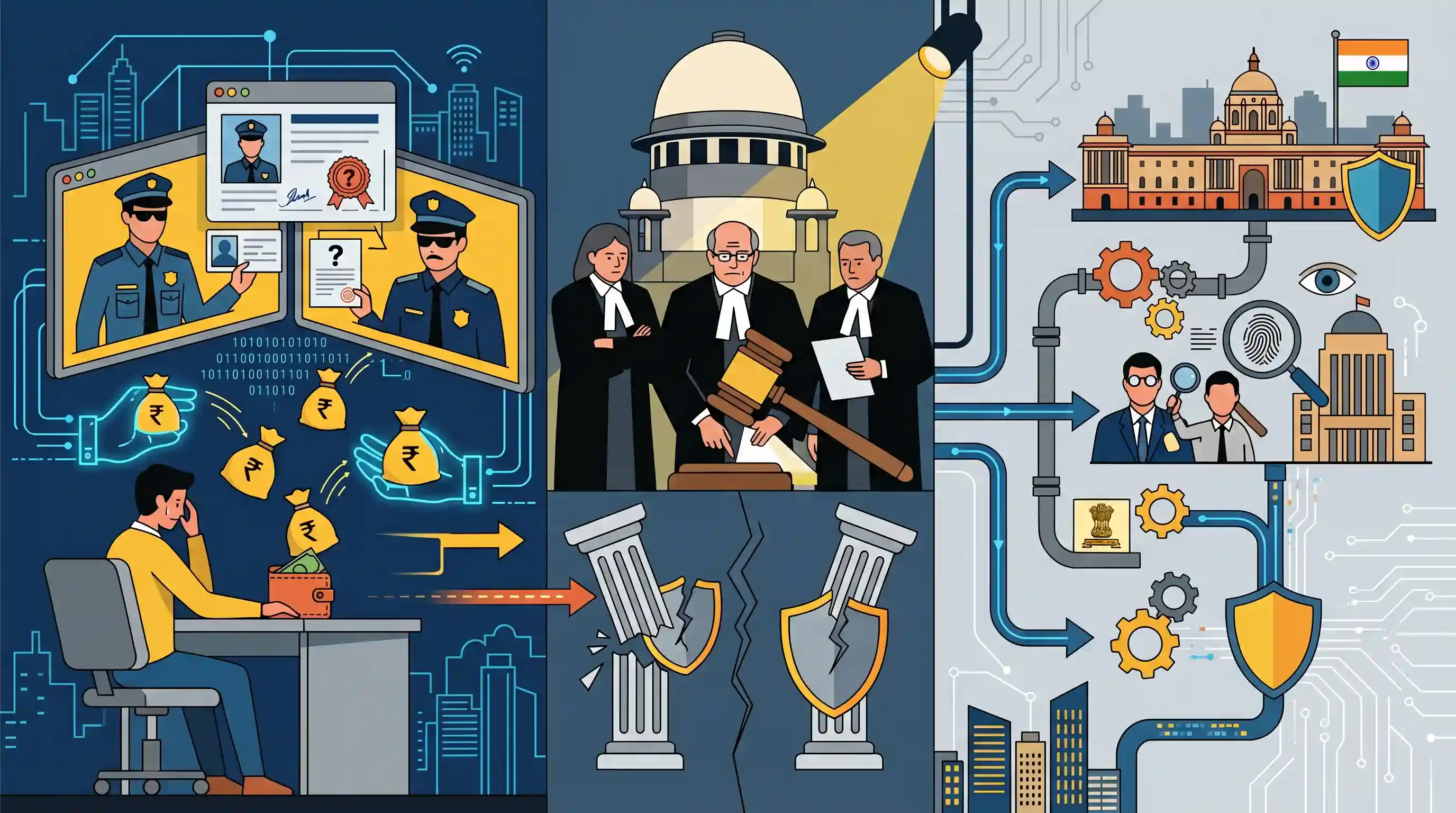
"Digital arrests" represent an emerging internal security threat where cybercriminals weaponise the fear of law enforcement and the judiciary against citizens. The issue highlights the urgent need for robust cybersecurity frameworks, digital literacy, and coordinated inter-agency responses (CBI, MHA, state police) to tackle organised cyber extortion.
Summary
The Supreme Court has expressed "grave concern" over the rising menace of "digital arrest" scams, taking suo motu cognisance of the issue. Scammers are increasingly impersonating law enforcement officers from agencies like the CBI and ED, and forging judicial documents to extort large sums of money from citizens. Emphasising that fabricating court orders undermines public trust and the rule of law, the Court has sought responses from the Ministry of Home Affairs, the CBI, and the Haryana government to formulate a pan-India institutional mechanism to combat these sophisticated cybercrimes.
Key Points
- The Supreme Court took suo motu cognisance of rising "digital arrest" scams, where conmen impersonate law enforcement to extort money.
- Perpetrators routinely fabricate Supreme Court or High Court orders and forge judicial signatures to convince victims they are under investigation.
- The Court noted that such forgeries strike at the foundation of public trust in the judicial system and the rule of law.
- Notices were issued to the Centre, CBI, and Haryana government to devise a comprehensive, pan-India institutional response to cyber extortion.
- The court appointed Attorney General R. Venkataramani to assist in examining the modus operandi of these scams.
Important Terms
Digital Arrest

A cyber-extortion tactic where scammers impersonate law enforcement via video calls, creating "virtual custody" to falsely accuse and extort victims using forged documents.
UPSC context
GS III (Internal Security): Cybersecurity challenges and the role of digital literacy in preventing sophisticated cyber-enabled extortion and fraud.
Suo Motu Cognisance
The power of the judiciary to initiate legal proceedings on its own initiative, without a formal petition from an aggrieved party.
UPSC context
GS II (Judiciary): Powers of the Supreme Court; judicial activism and protection of public interest through self-initiated legal intervention.
Central Bureau of Investigation (CBI)
India’s premier investigating agency under the Ministry of Personnel, tasked with probing high-profile corruption, multi-state organized crime, and complex cyber-fraud cases.
UPSC context
GS II (Statutory/Non-statutory bodies): Role and jurisdiction of investigating agencies in handling cross-border organized crime and federal issues.
Enforcement Directorate (ED)
A specialized financial investigation agency under the Ministry of Finance that enforces economic laws like the PMLA and FEMA to combat money laundering.
UPSC context
GS III (Internal Security): Money laundering and its links to organized crime; mandates of specialized agencies in enforcing financial transparency.
Indian Cyber Crime Coordination Centre (I4C)
An initiative under the Ministry of Home Affairs providing a comprehensive framework for law enforcement agencies to coordinate and combat cybercrime effectively.
UPSC context
GS III (Internal Security): Institutional frameworks for cybersecurity; inter-agency coordination and technological mechanisms to track and block cybercriminals.
Prevention of Money Laundering Act (PMLA)
Legislation enacted to prevent money laundering and provide for the confiscation of property derived from, or involved in, money laundering activities.
UPSC context
GS III (Internal Security): Legal measures to counter economic offenses; powers of the ED in seizing assets and conducting financial investigations.
Ministry of Home Affairs (MHA)
The nodal central ministry responsible for internal security, border management, and coordinating national responses to cyber-enabled threats and scams.
UPSC context
GS III (Internal Security): Government’s role in formulating national security policies and coordinating between central and state agencies.
Prelims Trap
Digital arrest is a newly introduced preventive detention provision under the Information Technology Rules.
"Digital arrest" is not a legal provision or statutory power; it is entirely a cyber-fraud tactic. Indian law does not authorize virtual confinement.
Static Concepts Connected
What is the mandate of the Indian Cyber Crime Coordination Centre (I4C)?
- Nodal Agency: Operates under the Ministry of Home Affairs to tackle cybercrime in a coordinated and comprehensive manner across the country.
- Core Functions: Manages the National Cyber Crime Reporting Portal (NCRP) and operates the national toll-free cyber helpline 1930.
- Structural Units: Houses the Threat Analytics Unit, Joint Cyber Crime Investigation Team, and a Cybercrime Ecosystem Management Unit to track sophisticated threats.
How does the Supreme Court exercise suo motu cognisance?
- Constitutional Basis: Derived largely from its status as a Court of Record (Article 129) and its expansive power to do complete justice (Article 142).
- Trigger Conditions: Invoked to address issues of grave public interest, fundamental rights violations, or threats to institutional integrity without waiting for a formal petition.
Cross-Topic Patterns
Cyber-extortion meets Money Laundering
The use of rented "mule accounts" to layer and disperse extorted funds turns digital fraud into organized money laundering, triggering PMLA provisions and expanding ED's jurisdiction.
Federalism vs Borderless Cybercrime
Because "Police" is a State subject under the 7th Schedule, borderless digital scams necessitate central intervention via CBI and MHA's I4C to bridge massive jurisdictional gaps.

A 2026 GS3 question will likely link borderless cyber-frauds like 'digital arrests' to money laundering and the limits of State policing.
Linked PYQs · 3
Linked PYQs · 3
- 2020MainsGS3
Discuss different types of cyber crimes and measures required to be taken to fight the menace.
- 2023MainsGS3
What are the internal security challenges being faced by India? Give out the role of Central Intelligence and Investigative Agencies tasked to counter such threats.
- 2017MainsGS3
Discuss the potential threats of Cyber attack and the security framework to prevent it.
