Supreme Court examines constitutional validity of unelected ministers
Source:Indian Express ↗
Why It Matters
This issue directly tests the boundaries of Article 164(4) and the principles of the parliamentary system. It addresses a critical loophole in the Constitution where the executive might try to bypass the requirement of legislative accountability. A Supreme Court decision here would set a vital precedent regarding the interpretation of consecutive non-legislator appointments, an important concept for UPSC GS2 polity.
Summary
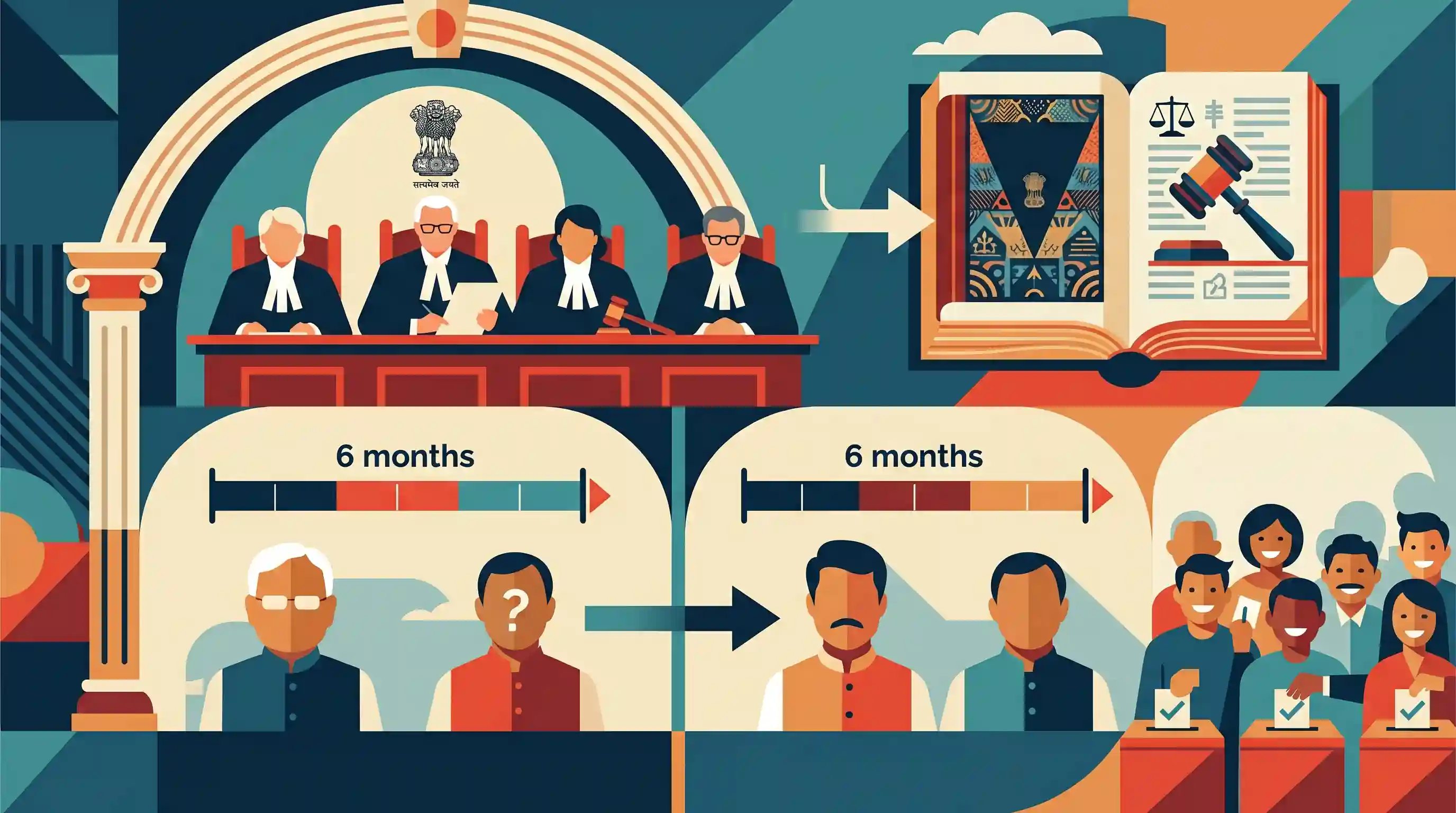
The Supreme Court of India is examining a plea challenging the consecutive appointment of Deepak Prakash as a minister in Bihar without his election to the state legislature. Appointed first under Chief Minister Nitish Kumar and again under his successor Samrat Choudhary, Prakash's tenure invokes scrutiny of Article 164(4) of the Constitution, which restricts unelected ministers to a strict six-month term limit. Petitioners argue that this provision is a one-time exception, and restarting the clock by reconstituting the government circumvents constitutional safeguards and subverts the foundational principles of representative democracy.
Key Points
- The Supreme Court has issued notices on a plea challenging the re-appointment of Deepak Prakash as Bihar’s Panchayati Raj minister without being an elected legislator.
- Article 164(4) of the Indian Constitution allows a non-member to hold a ministerial position for a maximum of six consecutive months, after which they must vacate the office if unelected.
- Prakash was appointed first in November 2025 under the Nitish Kumar government and subsequently re-appointed in May 2026 when Samrat Choudhary formed a new Council of Ministers.
- The petitioner argued that the six-month grace period is a one-time opportunity that cannot be reset through government changes or reconstitutions of the cabinet.
- The case raises critical questions about representative democracy, parliamentary accountability, and whether repeated executive appointments can bypass strict constitutional limitations.
Important Terms
Article 164(4)

Mandates that a Minister who is not a member of the State Legislature for six consecutive months must vacate office; prevents indefinite unelected tenure.
UPSC context
GS Paper II (Polity). Tests accountability of the State Executive and constitutional limits on executive discretion.
Representative Democracy
A system where citizens elect officials to represent them. Petitioners argue reappointing unelected ministers repeatedly subverts this "basic structure" principle by bypassing electoral accountability.
UPSC context
GS Paper II (Governance). Core conceptual topic regarding India’s democratic framework and the "Basic Structure" doctrine.
Judicial Review
The power of courts to examine the constitutionality of executive and legislative actions, ensuring the government remains within constitutional boundaries.
UPSC context
GS Paper II (Judiciary). Essential for understanding separation of powers and judicial checks on authority.
Writ of Quo Warranto
A prerogative writ meaning "by what authority," requiring a person to prove their legal right to hold a public office; used to challenge unauthorized appointments.
UPSC context
GS Paper II (Judiciary). Tests knowledge of constitutional remedies under Articles 32 and 226.
Bihar Vidhan Parishad
The upper house (Legislative Council) of Bihar’s bicameral legislature, where unelected ministers often seek membership to fulfill constitutional requirements.
UPSC context
GS Paper II (State Legislature). Relevant for state-level bicameralism and alternate ministerial qualification routes.
State Executive
The branch of state government consisting of the Governor and the Council of Ministers, whose functions are regulated by Articles 153-167.
UPSC context
GS Paper II (Polity). Core syllabus topic covering appointment, powers, and functions of state-level authorities.
Prelims Trap
"The six-month limit for an unelected minister resets if a new Council of Ministers is formed under a different Chief Minister."
The SC (S.R. Chaudhuri case, 2001) ruled this grace period is a strictly non-renewable, one-time privilege during a single Assembly's term, regardless of cabinet reconstitutions.
Static Concepts Connected
What are the constitutional rules for unelected Ministers?
- Six-month limit: Under Art 164(4) for States and Art 75(5) for the Union, a non-member can be a Minister for a maximum of 6 consecutive months.
- S.R. Chaudhuri Case: In S.R. Chaudhuri v. State of Punjab (2001), the SC ruled this is a one-time privilege per Assembly term and cannot be renewed by reappointment.
- Collective Responsibility: Enforcing this limit ensures the executive remains accountable to the elected legislature, a bedrock of representative democracy (Article 164(2)).
Can an unelected person become the Chief Minister or Prime Minister?
- Valid for PM/CM: Yes, the Constitution allows the appointment of an unelected person as CM or PM, subject to the same six-month limitation to secure a seat.
- Either House: They are not restricted to the lower house; they can become a member of either House (Legislative Assembly/Council, or Lok Sabha/Rajya Sabha).
Cross-Topic Patterns
Unelected Ministers + Anti-Defection Law
MLAs often resign to topple governments, are appointed as unelected ministers in the new cabinet, and seek re-election within 6 months, linking Art 164(4) directly to Anti-Defection controversies.
Constitutional Morality vs. Letter of the Law
Bypassing the 6-month rule via technical cabinet reconstitution highlights the ongoing tension between strict textual interpretation of the Constitution and the broader unwritten doctrine of Constitutional Morality.

A multi-statement Prelims question on Art 164(4)/75(5) combining the 6-month rule with the S.R. Chaudhuri judgment is highly likely.
Linked PYQs · 3
Linked PYQs · 3
- 2020PrelimsGS1
Consider the following statements: 1. According to the Constitution of India, a person who is eligible to vote can be made a minister in a State for six months even if he/she is not a member of the Legislature of that State. 2. According to the Representation of People Act, 1951, a person convicted of a criminal offence and sentenced to imprisonment for five years is permanently disqualified from contesting an election even after his release from prison. Which of the statements given above is/are correct?
- 2021PrelimsGS1
Constitutional government means
- 2020PrelimsGS1
A Parliamentary System of Government is one in which
