Supreme Court Review of ECI Voter Deletion and Electoral Rolls
Source:Indian Express ↗
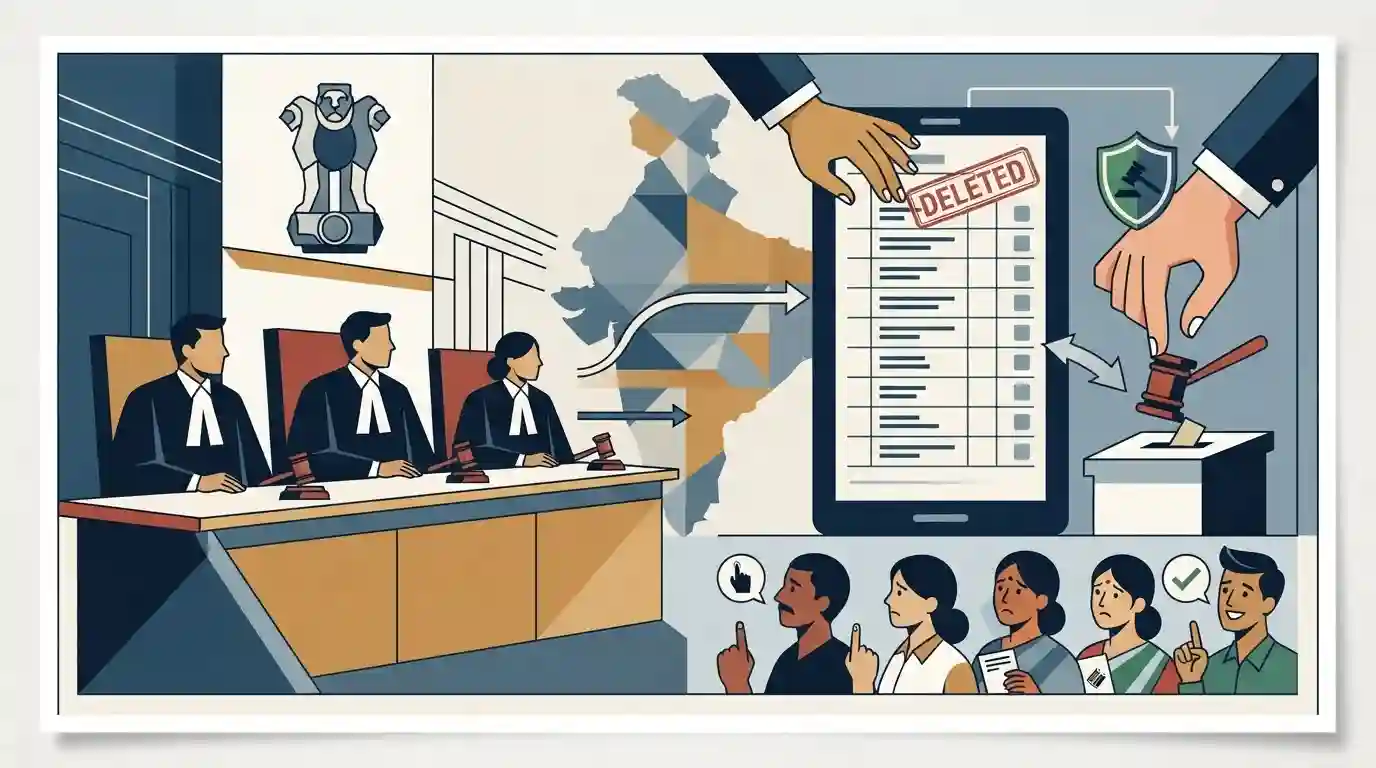
Why It Matters
It highlights the crucial balance between administrative efficiency of the ECI in maintaining clean electoral rolls and the protection of citizens' democratic right to vote against arbitrary deletions.
Summary
The Supreme Court heard a matter concerning the Election Commission of India (ECI) regarding voter deletion and electoral roll management, reinforcing the legal and constitutional safeguards required for protecting citizens' voting rights.
Key Points
- The Supreme Court examined issues related to voter deletions and electoral roll integrity involving the Election Commission of India (ECI).
- The case touches upon administrative accountability, transparency, and the fundamental right to vote in Indian democracy.
- Judicial scrutiny emphasizes procedural safeguards to prevent arbitrary deletion of eligible voters from electoral rolls.
Important Terms
Election Commission of India (ECI)

An independent constitutional body established under Article 324 of the Constitution, responsible for administering all electoral processes in India including elections to Parliament, State Legislatures, and the offices of the President and Vice-President.
UPSC context
UPSC GS Paper II (Polity & Governance) - Constitutional Bodies, their powers, functions, and role in conducting free and fair elections.
Representation of the People Act
Key Indian statutes enacted by Parliament that regulate the conduct of elections, qualifications and disqualifications for membership, administrative machinery for conducting elections, and the preparation and revision of electoral rolls.
UPSC context
UPSC GS Paper II (Polity & Governance) - Statutory provisions, electoral reforms, and representation mechanisms in Indian democracy.
Supreme Court
The apex judicial tribunal of the country under Article 124, possessing powers of judicial review to interpret constitutional provisions, safeguard fundamental rights, and adjudicate disputes involving constitutional authorities like the ECI.
UPSC context
UPSC GS Paper II (Polity & Governance) - Structure, organization, and functioning of the judiciary and judicial review.
Prelims Trap
exclusion from a voter list strips an individual of citizenship or can be done without prior notice.
Aspirants often assume that exclusion of a name from the electoral roll during revisions automatically strips a person of Indian citizenship or requires no legal recourse.
Static Concepts Connected
What are the statutory provisions governing the preparation and revision of electoral rolls in India?
- RP Act, 1950: Statutory backing under Section 21 of the Representation of the People Act, 1950, empowers authorities to revise electoral rolls.
- Natural Justice: Mandatory adherence to natural justice principles requires prior notice, opportunity of hearing, and recorded reasons before any deletion.
- Citizenship Limit: Citizenship verification during rolls revision does not confer finality on citizenship status, which falls under the Citizenship Act, 1955.
Cross-Topic Patterns
Electoral Rolls vs. Administrative Natural Justice
The Supreme Court's mandate on prior notice for voter deletions intersects with administrative law principles under Article 21, balancing executive electoral cleansing with natural justice.
Voter Deletion vs. Citizenship Determination
Distinguishing electoral roll inclusion from citizenship determination links election law directly to the Citizenship Act and constitutional provisions on nationality.

Expect a statement-based prelims question on whether ECI electoral roll deletion can independently determine a person's citizenship status.
Linked PYQs · 2
Linked PYQs · 2
- 2022MainsGS2
Discuss the role of the Election Commission of India in the light of the evolution of the Model Code of Conduct.
- 2017PrelimsGS1
For election to the Lok Sabha, a nomination paper can be filed by
