Stray Dog Bite Compensation Examined by Supreme Court
Source:The Hindu ↗
Why It Matters
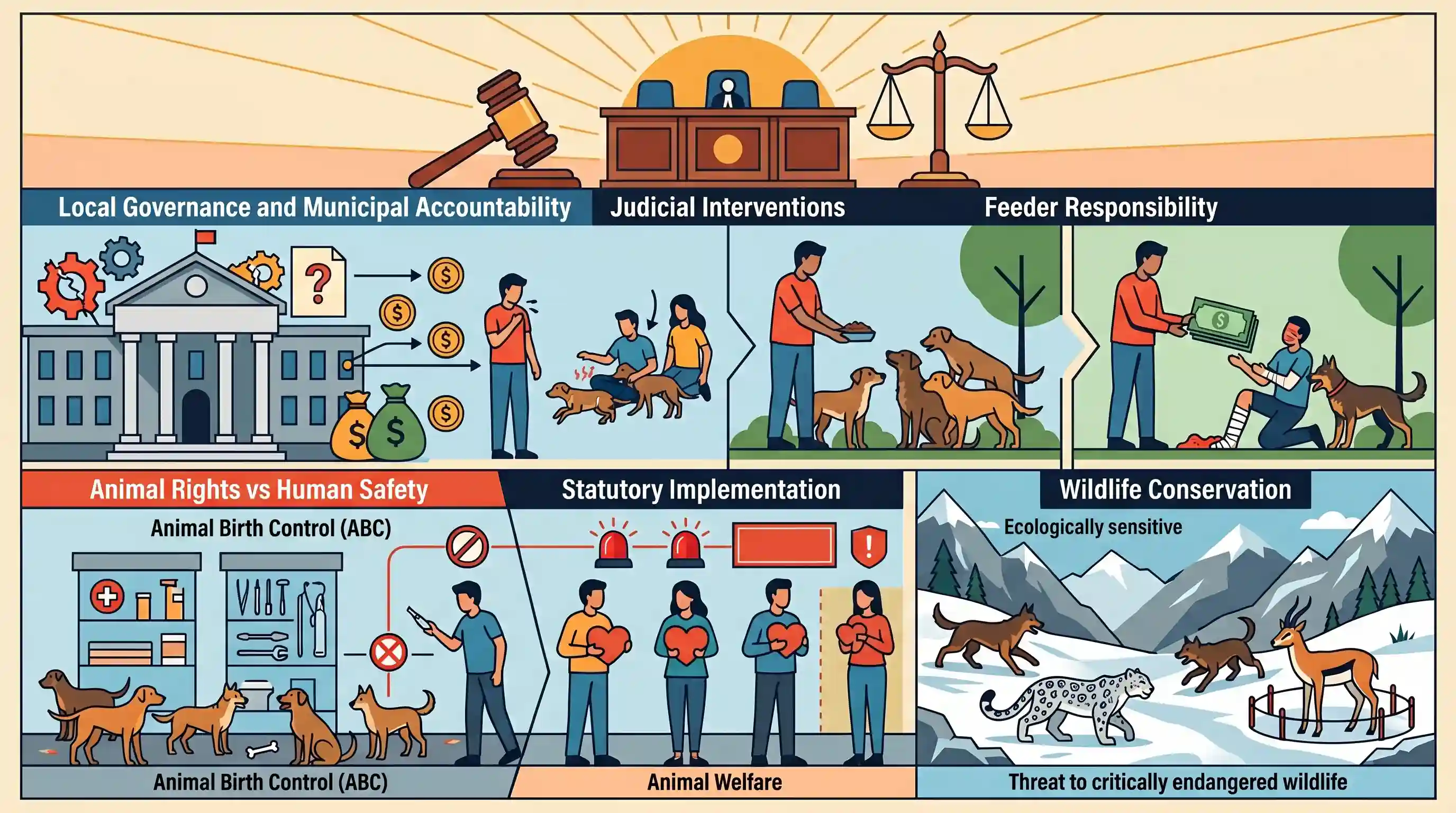
This issue lies at the intersection of urban governance, constitutional rights, and environmental ethics. It highlights the systemic failure of local bodies to implement statutory frameworks like the ABC Rules. It also addresses the ethical and legal dilemma between animal welfare (compassion towards strays) and the fundamental right to human safety, as well as the growing ecological threat of feral dogs to endangered wildlife.
Summary
The Supreme Court of India has indicated that state governments and municipal authorities could be held financially liable for injuries caused by stray dog bites and road accidents involving stray animals. The Court also proposed that individuals who regularly feed stray dogs must take responsibility for them, including paying compensation if those dogs attack people. Emphasizing municipal accountability, the Court criticized the widespread failure to implement the Animal Birth Control (ABC) Rules, 2023, and the Catch-Neuter-Vaccinate-Release (CNVR) mechanism under the Prevention of Cruelty to Animals Act. Furthermore, the bench raised environmental concerns regarding feral dogs threatening critically endangered wildlife in ecologically sensitive areas such as Ladakh, bringing into focus the complex conflict between animal welfare, human safety, and wildlife conservation.
Key Points
- The Supreme Court suggested that state governments and municipal bodies must be held accountable and pay compensation for injuries caused by stray dog bites and accidents triggered by stray animals.
- The Court indicated that individuals who feed stray dogs should bear responsibility and face financial liability if the animals they feed attack people.
- Local authorities were criticized for failing to implement the Animal Birth Control (ABC) Rules, 2023, which mandate the establishment of functional ABC units for sterilization and vaccination.
- The Court highlighted the ecological threat posed by feral dogs hunting critically endangered wildlife in sensitive regions like Ladakh.
- The management of stray populations through the humane Catch-Neuter-Vaccinate-Release (CNVR) mechanism under the Prevention of Cruelty to Animals Act was emphasized as a statutory mandate.
Important Terms
Animal Birth Control (ABC) Rules, 2023

Statutory regulations under the PCA Act mandating local bodies to manage stray dog populations via sterilization and vaccination, prohibiting their random relocation to maintain territorial balance.
UPSC context
GS Paper 2 (Local Governance) and GS Paper 3 (Animal Welfare); tests statutory implementation and municipal accountability.
Prevention of Cruelty to Animals (PCA) Act, 1960
The principal Indian legislation enacted to prevent unnecessary pain or suffering to animals, which established the Animal Welfare Board of India (AWBI).
UPSC context
GS Paper 2 and 3; links to Article 51A(g) regarding fundamental duties and legal protection of animals.
Capture-Neuter-Vaccinate-Release (CNVR)
A humane population management strategy where stray animals are caught, sterilized, vaccinated against rabies, and returned to their original territory to prevent a population vacuum.
UPSC context
GS Paper 3 (Environment); focuses on scientific and ethical solutions to human-animal conflict.
State Tortious Liability
A legal principle holding the State financially liable for damages caused to citizens due to the failure of authorities to discharge their statutory or public duties.
UPSC context
GS Paper 2 (Governance/Judiciary); critical for topics concerning administrative accountability and judicial interventions in public safety.
Feral Dogs
Domestic dogs that live and reproduce in the wild without human reliance, often forming packs that threaten biodiversity and endangered species in sensitive ecosystems.
UPSC context
GS Paper 3 (Environment/Biodiversity); relevant to human-wildlife conflict and threats to critically endangered species.
Strict Liability
A legal standard where a party is held responsible for the consequences of an activity regardless of fault or intent, often applied by courts to public safety hazards.
UPSC context
GS Paper 2 (Judiciary); tests understanding of evolving legal doctrines used by the Supreme Court to protect citizen rights.
Prelims Trap
"The Animal Birth Control (ABC) Rules, 2023 were notified under the Wildlife Protection Act, 1972 to manage feral animals."
The ABC Rules are actually notified under the Prevention of Cruelty to Animals (PCA) Act, 1960. Do not confuse their ecological impact with their statutory origin.
Static Concepts Connected
Which constitutional provisions govern local government liability and animal welfare?
- 12th Schedule: Grants urban local bodies the functional responsibility for public health, sanitation, and the prevention of cruelty to animals under Article 243W.
- Directive Principles: Article 48 directs the state to organize animal husbandry, while Article 48A focuses on protecting forests and wildlife.
- Fundamental Duties: Article 51A(g) explicitly mandates every citizen to protect the natural environment and have compassion for living creatures.
What is the statutory framework of the Prevention of Cruelty to Animals (PCA) Act, 1960?
- AWBI Creation: Establishes the Animal Welfare Board of India (AWBI), a statutory advisory body for animal welfare laws and the promotion of animal welfare.
- Rule-making power: Provides the legal basis for the Animal Birth Control (ABC) Rules, prohibiting permanent relocation or culling of street dogs.
- Nodal Ministry: The Act and the AWBI fall under the Ministry of Fisheries, Animal Husbandry and Dairying, not the Ministry of Environment.
Cross-Topic Patterns
Feral dogs + Trans-Himalayan ecology
Urban waste mismanagement at military and tourist camps in Ladakh directly fuels feral dog populations, threatening endangered native species like the Snow Leopard and Black-necked crane.
One Health + Rabies Elimination
Dog bite management is central to the National Action Plan for Rabies Elimination (NAPRE), integrating animal birth control with zoonotic disease prevention under a One Health approach.
State Tort Liability + 12th Schedule
The Supreme Court holding states financially liable for local administrative failures bridges constitutional tort law with municipal governance under the 12th Schedule.

Expect a multi-statement Prelims question linking ABC Rules 2023 under the PCA Act with 12th Schedule municipal duties on public health.
Linked PYQs · 3
Linked PYQs · 3
- 2024MainsGS2
Analyse the role of local bodies in providing good governance at local level and bring out the pros and cons merging the rural local bodies with the urban local bodies.
- 2022PrelimsGS1
With reference to Indian laws about wildlife protection, consider the following statements : 1. Wild animals are the sole property of the government. 2. When a wild animal is declared protected, such animal is entitled for equal protection whether it is found in protected areas or outside. 3. Apprehension of a protected wild animal becoming a danger to human life is sufficient ground for its capture or killing. Which of the statements given above is/are correct?
- 2025MainsGS4
In line with the Directive Principles of State Policy enshrined in the Indian Constitution, the government has a constitutional obligation to ensure basic needs "Roti, Kapda aur Makan (Food, Clothes and Shelter)" - for the under-privileged. Pursuing this mandate, the district administration proposed clearing a portion of forest land to develop housing for the homeless and economically weaker sections of the society. The proposed land, however, is an ecologically sensitive zone densely populated with age-old trees, medicinal plants and vital biodiversity. Besides, these forests help to regulate micro-climate and rainfalls; provide habitat for wildlife, support soil fertility and prevent land/soil erosion and sustain livelihoods of tribal and nomadic communities. Inspite of the ecological and social costs, the administration argues in favour of the said proposal by highlighting that this very initiative addresses fundamental human rights as a critical welfare priority. Besides, it fulfils the government's duty to uplift and empower the poor through inclusive housing development. Further, these forest areas have become unsafe due to wild-animal threats and recurring human-wild life conflicts. Lastly, clearing forest-zones may help to curb anti-social elements allegedly using these areas as hideouts, thereby enhancing law and order. (a) Can deforestation be ethically justified in the pursuit of social welfare objectives like, housing for the homeless ? (b) What are the socio-economic, administrative and ethical challenges in balancing environmental conservation with human development ? (c) What substantial alternatives or policy interventions can be proposed to ensure that both environmental integrity and human dignity are protected ?
