Medical Negligence Cases Survive Doctor Death via Legal Heirs
Source:Indian Express ↗
Why It Matters
It sets a critical judicial precedent clarifying the boundaries of tortious liability, directly impacting consumer rights, healthcare accountability, and the legal frameworks governing compensation after the death of a tortfeasor.
Summary
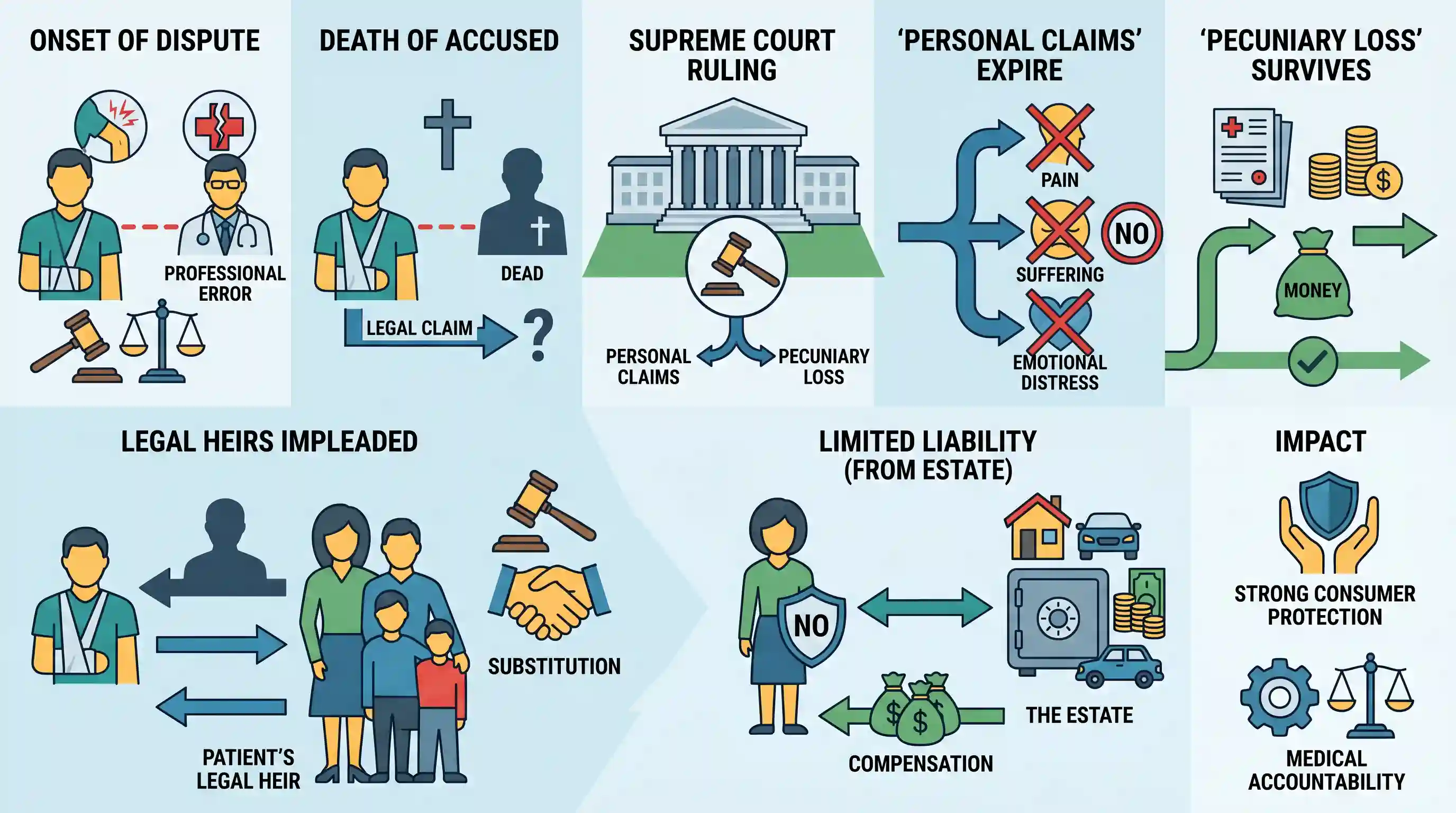
The Supreme Court has issued a landmark ruling establishing that medical negligence cases do not automatically collapse upon the death of the accused doctor. Clarifying the interplay between the Consumer Protection Act and Section 306 of the Indian Succession Act, 1925, the Court held that while pure personal injury claims expire with the wrongdoer, claims involving pecuniary loss (such as medical expenses) survive. Consequently, a deceased doctor's legal heirs can be impleaded in ongoing consumer disputes. However, the heirs are not personally liable; any compensation awarded can only be recovered from the estate inherited from the deceased doctor. This significant judgment clarifies tort law principles regarding the "right to sue" and expands the scope of accountability and consumer protection across civil wrongs.
Key Points
- The Supreme Court ruled that a medical negligence claim causing pecuniary loss survives the death of the accused doctor.
- Legal heirs can be impleaded in ongoing proceedings under the Consumer Protection Act, but their liability is restricted to the estate inherited from the deceased.
- The Court distinguished pure personal injury claims (which die with the wrongdoer) from claims involving financial loss to the estate (like medical expenses), relying on Section 306 of the Indian Succession Act.
- Compensation, if awarded, can only be recovered from the deceased doctor\'s estate, not from the personal assets of the legal heirs.
- The ruling establishes a precedent applicable to all tort claims, not just medical negligence, clarifying the limits of the maxim \'actio personalis moritur cum persona\'.
Important Terms
Indian Succession Act, 1925

1925 Act regulating testamentary and intestate succession in India. Section 306 determines which legal actions survive or abate upon a party's death, distinguishing between personal and proprietary (estate) claims.
UPSC context
GS Paper 2 (Statutory Laws); tests understanding of civil rights and legal continuity in judicial processes.
Actio Personalis Moritur Cum Persona
Common law maxim stating "a personal action dies with the person." The Supreme Court clarified its limits, holding it does not apply to claims involving financial loss to an estate.
UPSC context
GS Paper 2 (Judiciary/Legal Maxims); relevant for jurisprudence and evolution of common law in India.
Consumer Protection Act, 2019
The statutory framework for consumer rights. It allows victims of service deficiency, including medical malpractice, to seek compensation through a three-tier quasi-judicial system at district, state, and national levels.
UPSC context
GS Paper 2 (Governance/Statutory Bodies); key for questions on citizen-centric administration and consumer protection.
National Consumer Disputes Redressal Commission (NCDRC)
The highest forum in India's consumer dispute redressal hierarchy. It adjudicates high-value complaints and appeals, ensuring accountability for services like healthcare under the Consumer Protection Act.
UPSC context
GS Paper 2 (Quasi-judicial bodies); tests knowledge of alternative dispute resolution and consumer justice architecture.
Impleadment
A legal procedure where a third party is joined to an existing lawsuit. The Supreme Court allowed impleading legal heirs to ensure claims against a deceased doctor's estate continue.
UPSC context
GS Paper 2 (Judiciary); relates to legal procedures, natural justice, and judicial efficiency.
Medical Negligence
A civil wrong where a healthcare provider breaches the duty of care, causing harm. The Supreme Court's ruling ensures accountability survives even if the accused practitioner passes away.
UPSC context
GS Paper 4 (Ethics) and Paper 2 (Health); tests concepts of professional accountability and patient rights.
Prelims Trap
Legal heirs of a deceased doctor become fully liable to pay compensation for their medical negligence.
Liability does not extend to the legal heirs' personal assets; it is strictly capped at the value of the estate inherited from the deceased doctor.
Static Concepts Connected
How does Indian civil law treat liability upon the death of an accused?
- Inherited Estate limit: Heirs are only liable up to the value of the estate they inherited; their personal, independent assets cannot be attached for the deceased's wrongs.
- Actio personalis maxim: Pure personal injury claims die with the wrongdoer (actio personalis moritur cum persona), but claims involving financial/pecuniary loss survive against the estate.
Are medical professionals covered under the Consumer Protection Act?
- IMA vs. V.P. Shantha: Yes. The landmark 1995 IMA vs. V.P. Shantha judgment brought medical practitioners under the CPA, treating paying patients as consumers.
- Free services exemption: Doctors and hospitals providing services entirely free of charge to all users are generally exempted from the CPA's jurisdiction.
Cross-Topic Patterns
Tort Law + Statutory Consumer Rights
The Supreme Court is bridging uncodified tort principles with statutory bodies (like the Consumer Protection Act) to ensure victims of medical negligence are not left without a remedy.
Healthcare accountability in GS4
Medical ethics often clashes with legal loopholes. This ruling ensures financial accountability (pecuniary loss) outlives the practitioner, providing a strong case study for GS4.

Expect a Prelims statement blending CPA jurisdiction over doctors with the limit on legal heirs' liability (estate vs. personal assets).
Linked PYQs · 4
Linked PYQs · 4
- 2020PrelimsGS1
In India, under cyber insurance for individuals, which of the following benefits are generally covered, in addition to payment for the loss of funds and other benefits? 1. Cost of restoration of the computer system in case of malware disrupting access to one's computer 2. Cost of a new computer if some miscreant wilfully damages it, if proved so 3. Cost of hiring a specialized consultant to minimize the loss in case of cyber extortion 4. Cost of defence in the Court of Law if any third party files a suit Select the correct answer using the code given below:
- 2024MainsGS4
“Ethics encompasses several key dimensions that are crucial in guiding individuals and organizations towards morally responsible behaviour.” Explain the key dimensions of ethics that influence human actions. Discuss how these dimensions shape ethical decision-making in the professional context.
- 2021MainsGS4
Besides domain knowledge, a public official needs innovativeness and creativity of a high order as well, while resolving ethical dilemmas. Discuss with suitable example.
- 2024MainsGS2
Explain the reasons for the growth of public interest litigation in India. As a result of it, has the Indian Supreme Court emerged as the world's most powerful judiciary ?
