Child Welfare Precedes Parental Agreements in Custody
Source:Indian Express ↗
Why It Matters
Highlights the Supreme Court\'s proactive intervention in mutual consent agreements to protect child welfare and gender equity, setting a precedent on the limitations of private family settlements when they violate fundamental principles of justice.
Summary
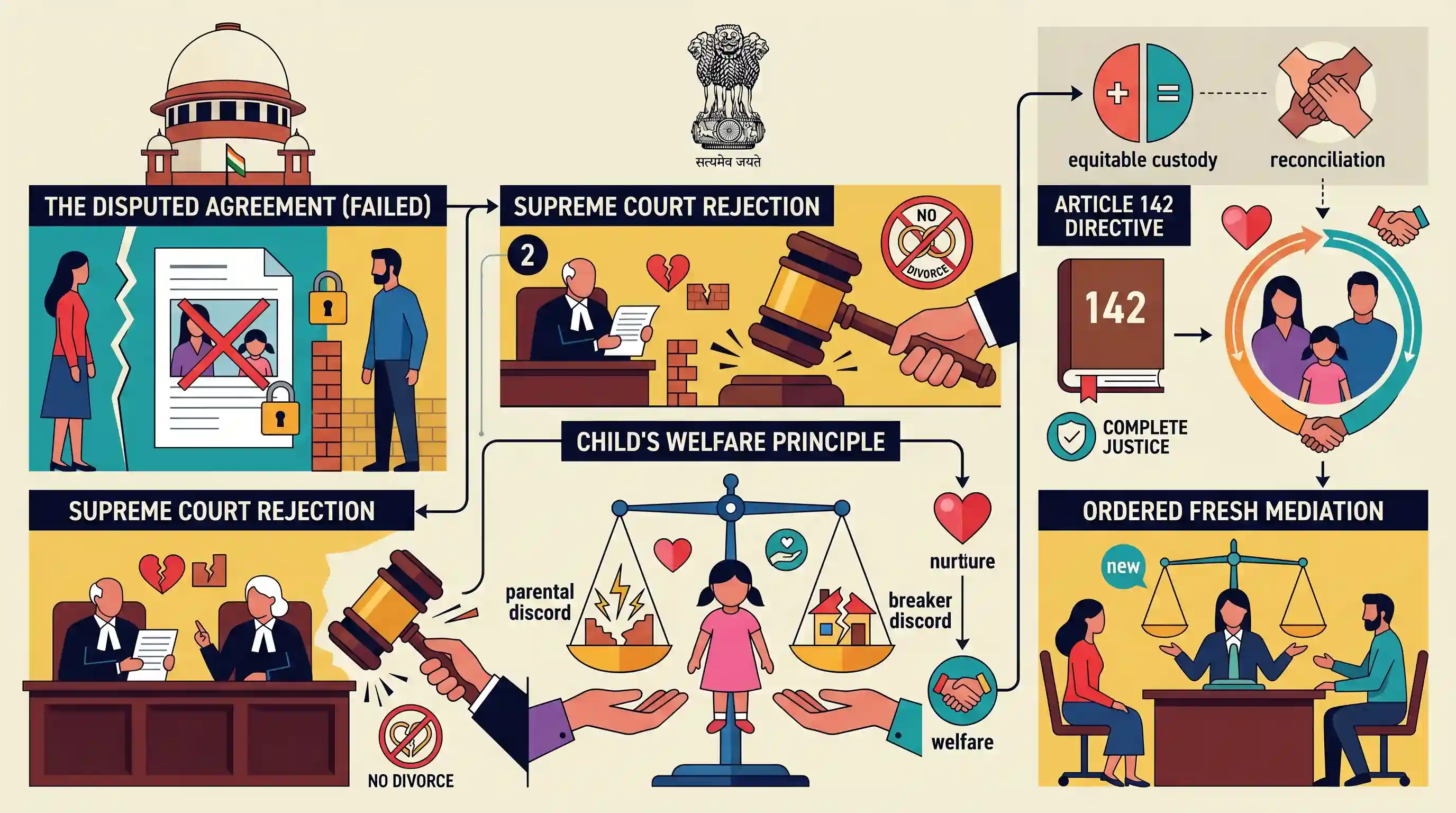
The Supreme Court of India rejected a mutual consent divorce agreement that completely barred a mother from visiting her three-year-old daughter. Emphasizing that the child\'s welfare supersedes parental discord, a bench comprising Justices J B Pardiwala and K V Viswanathan termed the restrictive clause "disturbing." Refusing to dissolve the marriage under Article 142 and the Hindu Marriage Act, the court noted that the relationship had not irretrievably broken down and directed the couple to undergo fresh mediation to either reconcile or negotiate an equitable custody arrangement.
Key Points
- The Supreme Court rejected a mutual consent divorce settlement because a clause entirely denied a mother visitation rights to her three-year-old daughter.
- The bench affirmed that the \'welfare of the child\' is the paramount consideration in custody matters, overriding mutual agreements between estranged parents.
- Observing that the marriage had not irretrievably broken down, the court declined to exercise its extraordinary powers under Article 142 to dissolve the marriage.
- Fresh mediation was ordered via video conferencing to explore reconciliation or establish an equitable arrangement that ensures the mother\'s visitation rights.
Important Terms
Article 142 of the Constitution

Grants the Supreme Court discretionary power to pass any order necessary to achieve "complete justice," bypassing procedural requirements when statutory law provides no adequate remedy for unique situations.
UPSC context
GS II (Polity); tests the scope of judicial discretion and its role in ensuring justice where statutes are silent or rigid.
Section 13B of the Hindu Marriage Act
A statutory provision governing divorce by mutual consent, requiring couples to live separately for one year and undergo a "cooling-off" period before final dissolution.
UPSC context
GS II (Social Justice); concerns the legal framework of personal laws and statutory procedures for matrimonial relief.
Parens Patriae Jurisdiction
A legal doctrine authorizing the judiciary to act as the legal guardian for individuals unable to care for themselves, prioritizing the "paramount welfare" of children in custody disputes.
UPSC context
GS II (Social Justice/Judiciary); relates to the court's protective role over vulnerable sections, particularly children and the mentally ill.
Irretrievable Breakdown of Marriage
A judicial ground for divorce where a marriage is considered emotionally dead and beyond repair, often invoked by the Supreme Court when reconciliation is impossible.
UPSC context
GS II (Social Justice); involves the evolution of family law through judicial precedents and the "fault" vs. "no-fault" divorce debate.
Mediation
An Alternative Dispute Resolution (ADR) mechanism where a neutral third party facilitates negotiations between parties to reach a voluntary settlement, often mandatory in matrimonial cases.
UPSC context
GS II (Judiciary); focuses on reforming justice delivery through non-adversarial methods to reduce pendency and promote social harmony.
Prelims Trap
Irretrievable breakdown of marriage is a codified statutory ground for divorce under the Hindu Marriage Act.
Aspirants confuse the Supreme Court's frequent use of Article 142 to dissolve marriages for 'irretrievable breakdown' as a sign that it is a codified legislative ground. It is not.
Static Concepts Connected
What is the scope of Article 142 of the Constitution?
- Complete Justice: Empowers the Supreme Court to pass any decree necessary for doing "complete justice" in any pending cause or matter.
- Procedural Override: It can bypass procedural laws (like the HMA's mandatory cooling-off period) but generally cannot override fundamental substantive statutory rights.
- Divorce Application: In the 2023 Shilpa Sailesh case, a Constitution Bench affirmed SC can directly dissolve marriages under Art 142 for irretrievable breakdown.
How does the 'Parens Patriae' doctrine apply in child custody?
- State as Guardian: Translating to 'parent of the nation', it designates the State (via Courts) as the ultimate guardian for minors unable to protect themselves.
- Paramount Welfare: Custody decisions must prioritize the child's best interests, which overrides parental rights, mutual agreements, or personal religious laws.
Cross-Topic Patterns
Mediation Act 2023 vs. Child Rights
The Mediation Act 2023 institutionalizes ADR but specifically excludes claims involving minors. This limits pure private mediation in child custody, demanding overarching judicial scrutiny under the 'Parens Patriae' doctrine.
Article 142 as a legislative bridge
SC's use of Article 142 bridges legislative gaps (like uncodified 'irretrievable breakdown'), parallel to how it expanded Article 21 to cover environmental rights and privacy before specific legislations.

Article 142's power to bypass statutory cooling-off periods vs. the Parens Patriae doctrine will likely form a complex Prelims statement.
Linked PYQs · 3
Linked PYQs · 3
- 2020MainsGS2
Judicial Legislation is antithetical to the doctrine of separation of powers as envisaged in the Indian Constitution. In this context justify the filing of large number of public interest petitions praying for issuing guidelines to executive authorities.
- 2023MainsGS2
Explain the constitutional perspectives of Gender Justice with the help of relevant Constitutional Provisions and case laws.
- 2025MainsGS2
The National Commission for Protection of Child Rights has to address the challenges faced by children in the digital era. Examine the existing policies and suggest measures the Commission can initiate to tackle the issue.
