Supreme Court Dismisses Plea for Time-Bound Case Disposal Guidelines
Source:The Hindu ↗
Why It Matters
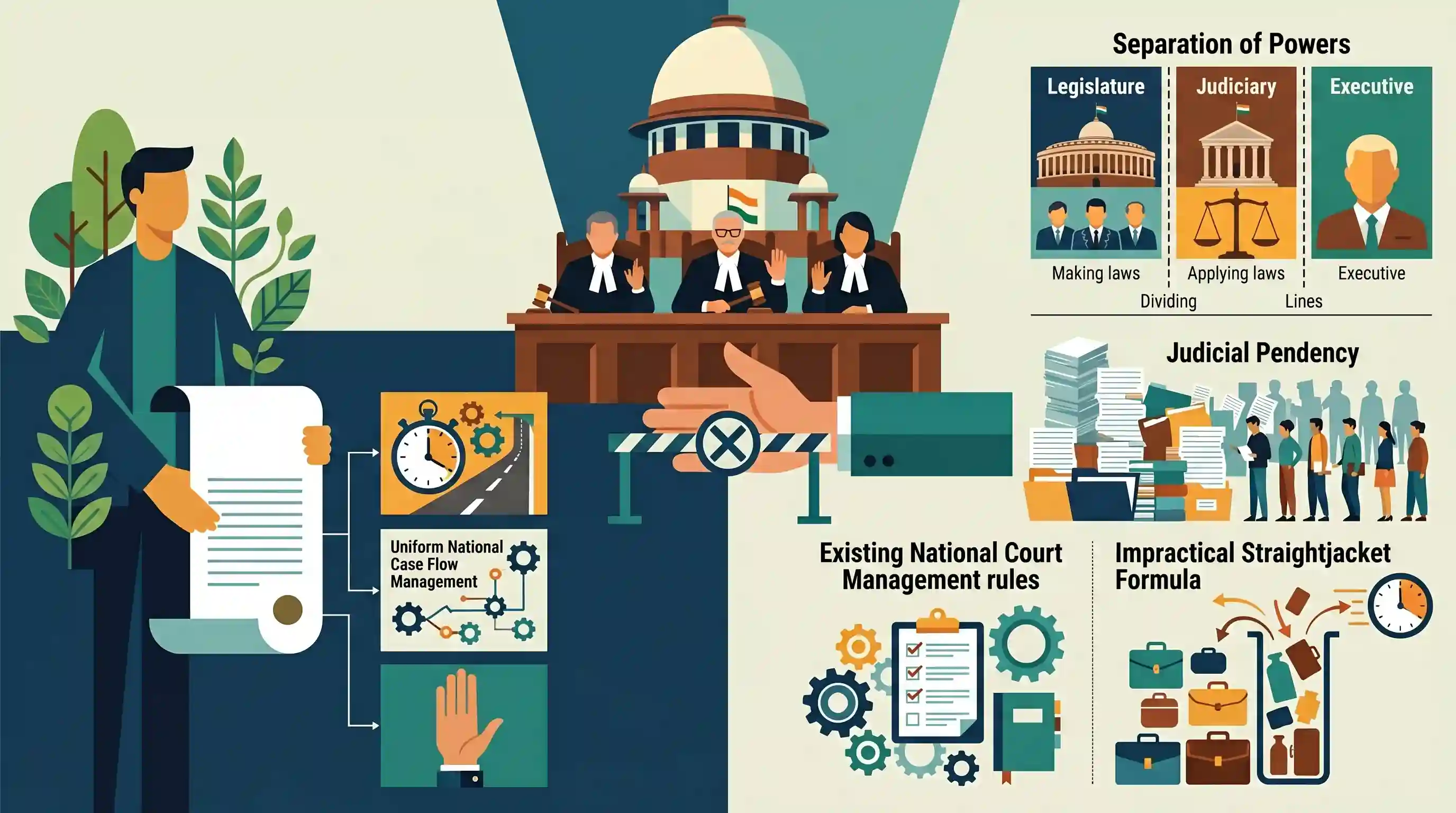
Illustrates the practical boundaries of Judicial Activism versus Judicial Legislation. It highlights the separation of powers by showcasing an instance where the apex court declined to issue guidelines that fall into the domain of legislative law-making, directly addressing ongoing concerns about judicial overreach and court pendency management.
Summary
The Supreme Court of India dismissed a Public Interest Litigation (PIL) filed by the NGO 'Social Action for Forest and Environment' that sought the formulation of guidelines for the time-bound disposal of cases across all courts and the implementation of a Uniform National Case Flow Management system. The petition also aimed to restrict the granting of adjournments only to 'unavoidable' or 'exceptional' circumstances. Rejecting the plea, a bench of Justices Bela M. Trivedi and Pankaj Mithal reiterated the principle of separation of powers, stating that framing laws and setting statutory timelines for case disposal is the domain of Parliament. The bench noted that courts already operate under existing National Court Management rules and observed that it is impractical to establish a straightjacket formula mandating a specific number of case disposals by judges in a rigid, time-bound manner.
Key Points
- The Supreme Court dismissed a PIL seeking guidelines for the time-bound disposal of cases and a regulatory framework for granting adjournments.
- The petitioner NGO argued for implementing a Uniform National Case Flow Management system to curb judicial delays.
- The bench highlighted that making laws regarding the time frame for case disposal falls under the jurisdiction of Parliament, reinforcing the doctrine of separation of powers.
- The Supreme Court observed that a straightjacket formula cannot be applied to dictate how many cases a judge must clear within a specific timeframe, as existing court management rules already guide the process.
Important Terms
Separation of Powers

A constitutional doctrine that divides government authority into Legislative, Executive, and Judicial branches to prevent power concentration and ensure mutual checks and balances.
UPSC context
GS Paper 2 (Indian Constitution). Tested as a 'Basic Structure' element regarding boundaries between state organs and judicial overreach.
Judicial Pendency
The accumulation of unresolved cases across various levels of the judiciary. In India, this currently exceeds 5 crore cases, impacting the 'Right to Speedy Trial'.
UPSC context
GS Paper 2 (Judiciary). A critical topic for Mains regarding efficiency, infrastructure, and the judge-to-population ratio in India.
Public Interest Litigation (PIL)
A legal mechanism allowing individuals or NGOs to seek justice on behalf of the public or marginalized groups, bypassing strict 'locus standi' requirements.
UPSC context
GS Paper 2 (Judiciary/Judicial Activism). Tests understanding of the judiciary's role in social change and legal accountability.
Case Flow Management (CFM) Rules
Procedural guidelines that classify cases into 'tracks' with fixed timelines to ensure court-led control over the pace of litigation and reduce delays.
UPSC context
GS Paper 2 (Judicial Reforms). Specifically linked to the Salem Advocate Bar Association case and efforts to streamline court processes.
National Court Management Systems (NCMS)
A scheme established by the Supreme Court in 2012 to develop policy frameworks, performance standards, and a national system of judicial statistics.
UPSC context
GS Paper 2 (Judicial Reforms). Relevant for questions on modernization, data-driven management, and enhancing timeliness in the Indian courts.
Prelims Trap
The Supreme Court can issue a writ of mandamus directing Parliament to formulate a law for time-bound judicial disposal.
This violates the doctrine of separation of powers. The Supreme Court cannot issue a writ of mandamus directing the legislature to enact any specific legislation.
Static Concepts Connected
Against whom can a writ of Mandamus NOT be issued?
- The Legislature: Courts cannot issue a writ of mandamus directing Parliament or State Assemblies to enact a specific law.
- President and Governors: Mandamus cannot compel the President or State Governors to perform their constitutional or discretionary public duties.
- Private entities: It cannot be issued against a private individual or body unless they are explicitly entrusted with a public duty.
What existing procedural and institutional mechanisms curb judicial delays in India?
- NCMS: Established in 2012, the National Court Management Systems institutionalizes measurable performance standards and internal data tracking for the judiciary.
- CPC Adjournment Limits: Order XVII Rule 1 of the Civil Procedure Code explicitly restricts civil courts from granting more than three adjournments to a party.
- NJDG: The National Judicial Data Grid acts as a monitoring tool, providing real-time transparency on case pendency across the country.
Cross-Topic Patterns
Separation of powers vs Judicial Activism
UPSC frequently tests the boundary where PILs cross into executive/legislative domains. Here, the SC exercised judicial restraint, highlighting that setting statutory timelines is strictly Parliament's domain.
Digital infrastructure over statutory timelines
Rather than rigid statutory case-disposal deadlines, India tackles judicial pendency through infrastructure, leveraging Phase III of the e-Courts project and the National Judicial Data Grid (NJDG).

Expect a 2026 Prelims statement testing limits of Mandamus, specifically whether the SC can direct Parliament to enact case disposal laws.
Linked PYQs · 2
Linked PYQs · 2
- 2020MainsGS2
Judicial Legislation is antithetical to the doctrine of separation of powers as envisaged in the Indian Constitution. In this context justify the filing of large number of public interest petitions praying for issuing guidelines to executive authorities.
- 2014MainsGS2
Instances of President's delay in commuting death sentences has come under public debate as denial of justice. Should there be a time limit specified for the President to accept/reject such petitions ? Analyse.
