Supreme Court Ruling on Amaravati Land Pooling Scheme Legal Case
Source:The Hindu ↗
Why It Matters
The case highlights the judicial scrutiny of politically motivated litigation and the use of the Supreme Court's appellate jurisdiction to uphold High Court decisions quashing FIRs. It also underscores the governance model of land pooling as an alternative to compulsory land acquisition for large-scale infrastructure projects like capital city development.
Summary
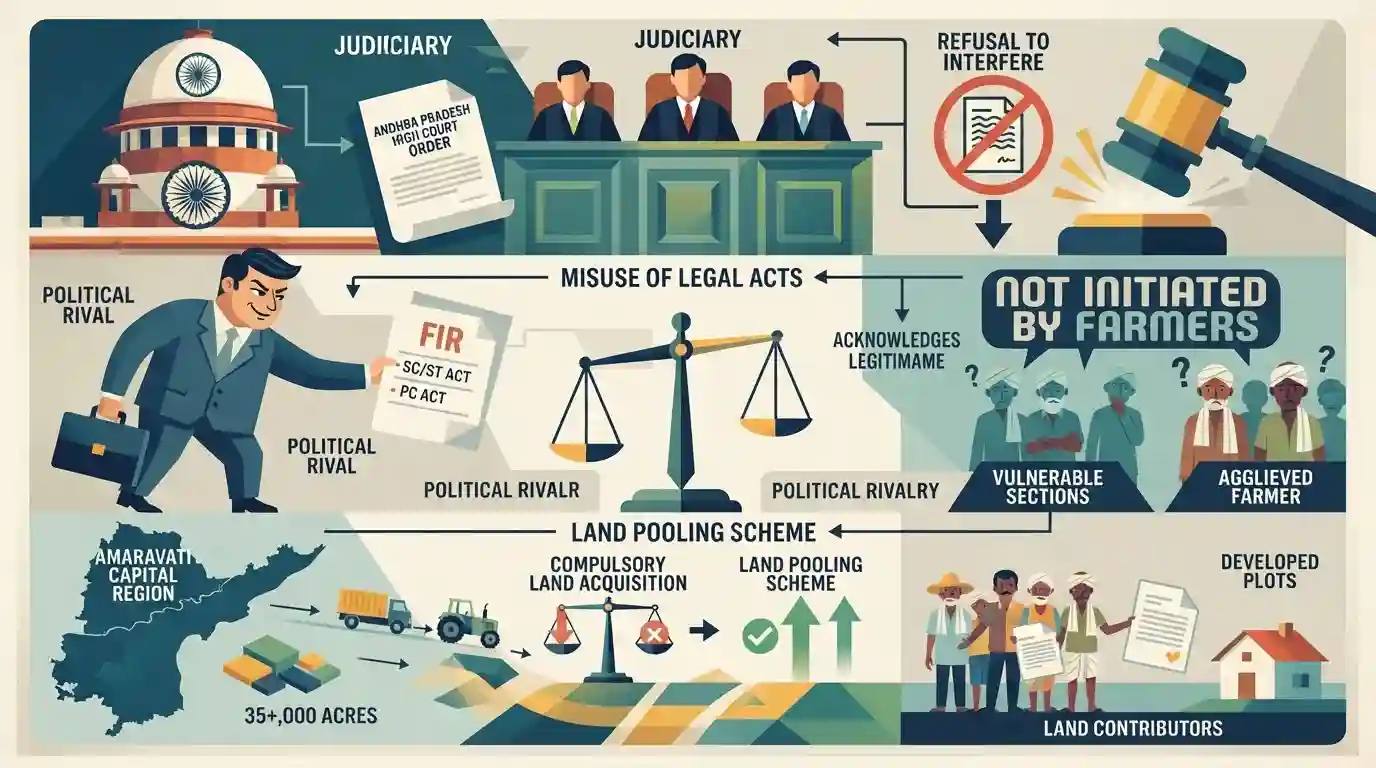
The Supreme Court has refused to interfere with an Andhra Pradesh High Court order quashing a criminal case against Chief Minister N. Chandrababu Naidu and Minister P. Narayana over alleged irregularities in the Amaravati land pooling scheme. The apex court noted that the FIR, which invoked the SC/ST Act and Prevention of Corruption Act, was filed by a political rival rather than any aggrieved farmer. The bench emphasized that courts should not be used for political battles. The land pooling scheme, which gathered over 35,000 acres for the capital city, provided land contributors with developed plots as an alternative to compulsory land acquisition.
Key Points
- The Supreme Court dismissed a plea challenging an Andhra Pradesh High Court order that quashed an FIR against Chief Minister N. Chandrababu Naidu and Minister P. Narayana regarding the Amaravati land pooling scheme.
- The FIR alleged irregularities in the acquisition of assigned lands belonging to Scheduled Castes, booking the leaders under the IPC, SC/ST Act, AP Assigned Lands Act, and Prevention of Corruption Act.
- The Supreme Court bench, led by CJI Surya Kant, observed that political battles should not be fought in courts, noting the case was initiated by a political rival and no affected farmers had come forward to complain.
- The Amaravati Land Pooling Scheme was implemented as a voluntary alternative to compulsory land acquisition, under which 28,181 landowners from 25 villages surrendered 35,215 acres in exchange for developed residential and commercial plots.
Important Terms
Land Pooling Scheme

A voluntary, market-based mechanism for urban development where farmers surrender their land to a government agency and receive developed residential or commercial plots in return, avoiding coercive acquisition.
UPSC context
Highly relevant for GS-3 (Urbanization, Land Reforms) as an alternative model to traditional compulsory land acquisition.
Prevention of Corruption Act, 1988
A comprehensive Indian law that defines various forms of corruption and penalizes public servants for bribery, illicit enrichment, and abuse of official position to ensure accountability in public service.
UPSC context
Crucial for GS-2 (Governance, Transparency) and GS-4 (Probity in Governance) regarding legal frameworks against corruption.
Scheduled Castes and Scheduled Tribes (Prevention of Atrocities) Act, 1989
A specialized legislation establishing stringent protections, new offenses, and Special Courts to prevent crimes, discrimination, and atrocities against members of Scheduled Castes and Scheduled Tribes.
UPSC context
Essential for GS-2 (Social Justice) testing statutory mechanisms and constitutional protections for marginalized communities.
Supreme Court of India
The highest judicial court and final court of appeal under the Constitution of India, responsible for upholding constitutional values, protecting fundamental rights, and settling disputes between political entities.
UPSC context
Core GS-2 topic (Judiciary); routinely tested on its original, appellate, and advisory jurisdictions and judicial review.
Prelims Trap
Land pooling schemes are mandatory state acquisitions governed uniformly under the RFCTLARR Act, 2013.
Land pooling is a voluntary, alternative model where owners surrender land for reconstituted plots. It operates distinctly from the mandatory compulsory acquisition framework of the RFCTLARR Act, 2013.
Static Concepts Connected
How does Land Pooling fundamentally differ from traditional Land Acquisition?
- Nature of Consent: Land pooling is voluntary, relying on landowner agreement. Traditional land acquisition is often compulsory, utilizing the state's sovereign power of eminent domain.
- Mode of Compensation: Pooling compensates landowners with reconstituted, developed plots of higher value. Traditional acquisition typically provides statutory monetary compensation and rehabilitation.
- Stakeholder Status: Under pooling, the original landowner remains an active stakeholder in the urban development process, sharing directly in the project's long-term value appreciation.
What is the High Court's inherent power to quash an FIR?
- Statutory Basis: It is exercised under Section 528 of the BNSS, 2023 (formerly Section 482 of the CrPC) to prevent abuse of the judicial process.
- Application Grounds: Courts invoke this to secure the ends of justice, often when an FIR is absurd, legally baseless, or maliciously instituted for political vendetta.
- Jurisdictional Exclusivity: Unlike lower courts, the High Court holds these broad inherent powers to intervene early and halt frivolous criminal proceedings before trial.
Cross-Topic Patterns
Assigned Lands & SC/ST Act
Dispossession of vulnerable groups from government-assigned lands isn't just a revenue issue; it constitutes an atrocity under the SC/ST Act, intertwining land reform with strict criminal law.
Locus Standi: PILs vs Criminal FIRs
While locus standi is relaxed in PILs to help the marginalized, the Supreme Court restricts unaffected third parties from initiating criminal cases merely to settle proxy political scores.

Expect a 2026 prelims statement comparing Land Pooling with the RFCTLARR Act 2013, focusing specifically on consent and compensation modes.
Linked PYQs · 3
Linked PYQs · 3
- 2019APPSC_PRELIMSGS1
Choose the correct answer relating to the Supreme Court of India :
- 2023APPSC_PRELIMSGS1
Which of the following are not included in the original jurisdiction of the Supreme Court ? I. A dispute between two or more States. II. A dispute regarding elections to either House of the Parliament or that of Legislature of a State. III. A dispute between the Government of India and a Union Territory. IV. A dispute between the Government of India and one or more States. Choose the correct answer using the codes given below :
- 2023APPSC_PRELIMSGS1
The National Commission for Scheduled Castes, while investigating any matter or inquiring into any complaint, has the powers on the following matters : I. It can receive evidences on affidavits. II. It can requisition any public record from any court or office. III. It can issue summons for the examination of witnesses and documents. Choose the correct answer using the codes given below :
