Supreme Court Dismissal of E20 Petrol Policy PIL
Source:Indian Express ↗
Why It Matters
This development sits at the intersection of GS3 (energy security, biofuels, farmer incomes via agricultural feedstocks) and GS2 (the scope of judicial review over executive policy). It serves as a practical example of how environmental transition policies can face consumer pushback and how the judiciary navigates such public interest litigations.
Summary
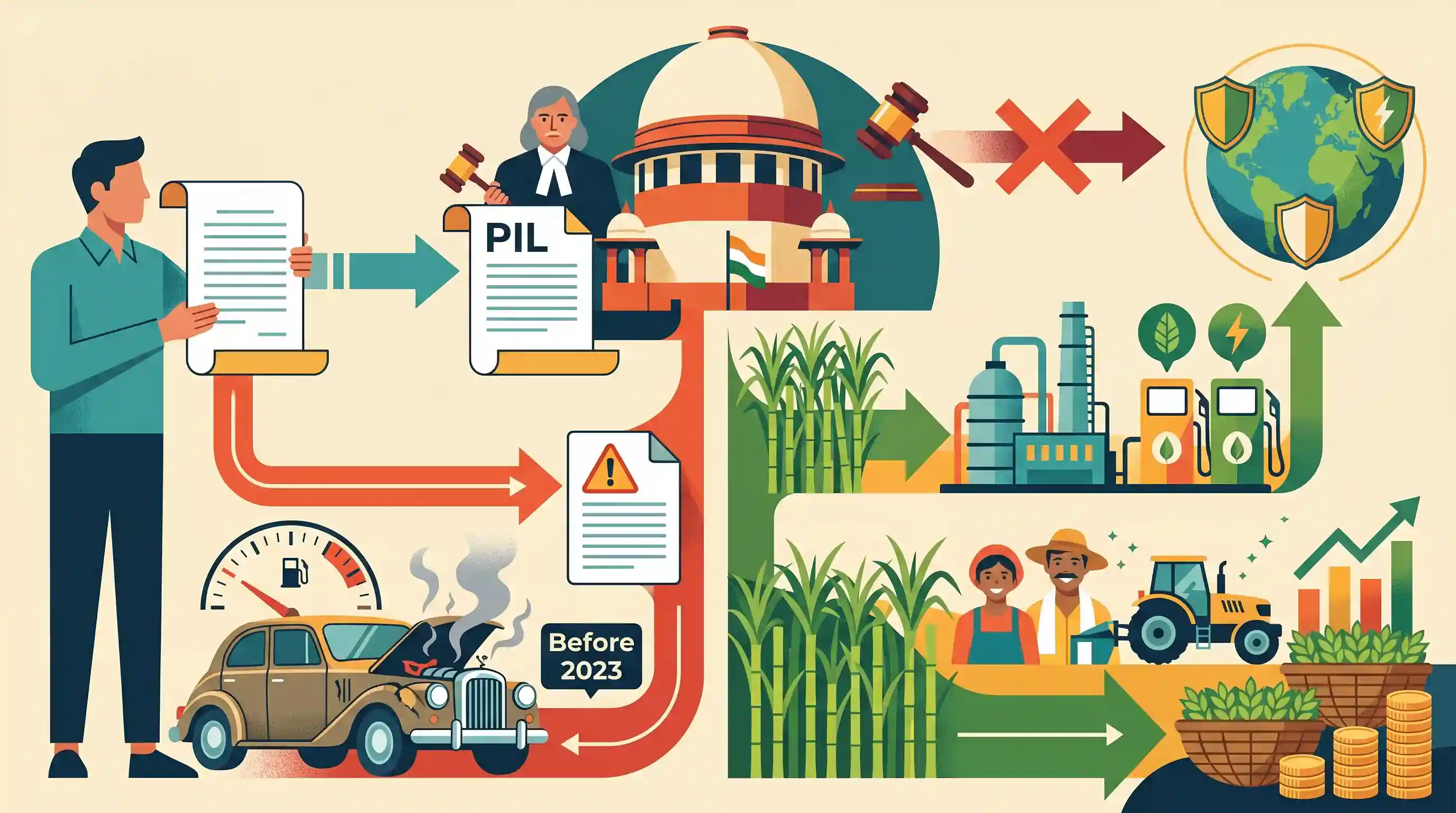
The Supreme Court has dismissed a Public Interest Litigation (PIL) that challenged the Centre's E20 petrol policy (which mandates 20% ethanol blending) and sought an ethanol-free fuel option for consumers with older vehicles. The petitioner argued that E20 fuel damages engines manufactured before April 2023 and reduces fuel efficiency, citing a NITI Aayog report. The Attorney General defended the policy, underscoring its dual benefits of energy security and socio-economic support for sugarcane farmers. The Court's dismissal underscores judicial restraint regarding complex governmental policies on energy and agriculture.
Key Points
- The Supreme Court rejected a PIL seeking an unblended, ethanol-free fuel option for owners of older vehicles.
- The petitioner claimed the E20 policy harms older engines (manufactured before April 2023) and causes a 6% drop in fuel efficiency, referencing a 2021 NITI Aayog report.
- The E20 policy mandates 20% ethanol blending in petrol to enhance energy security, reduce greenhouse gas emissions, and save foreign exchange.
- The Attorney General emphasized the policy's positive socio-economic impact on agricultural communities, particularly sugarcane farmers whose crops provide feedstock for ethanol.
- The ruling highlights the limits of Public Interest Litigation (PIL) and the Supreme Court's reluctance to interfere in complex macroeconomic and environmental policy decisions.
Important Terms
E20 Petrol Policy

A 2023 mandate to blend 20% ethanol with 80% petrol, advanced from a 2030 target to 2025. It aims to reduce crude oil imports and carbon emissions.
UPSC context
GS Paper 3: Infrastructure (Energy) and Environment. Tests understanding of energy security and climate commitments (Panchamrit).
Ethanol Blended Petrol (EBP) Programme
A government initiative launched in 2003 to mix ethanol (ethyl alcohol) with petrol. It serves to reduce energy import dependence and provide remunerative income to sugarcane farmers.
UPSC context
GS Paper 2/3: Government Policies and Agriculture. Crucial for questions on farmer income and import substitution.
Judicial Review
The power of the judiciary (Articles 13, 32, 226) to examine legislative or executive actions for constitutional validity. Courts often exercise 'judicial restraint' in complex technical/economic policies.
UPSC context
GS Paper 2: Indian Constitution and Separation of Powers. Relevant for the limits of Public Interest Litigation (PIL).
NITI Aayog Roadmap
The 2021 'Roadmap for Ethanol Blending in India 2020-25' provided the technical framework, feedstock diversification, and engine compatibility timelines for the E20 rollout.
UPSC context
GS Paper 3: Planning and Mobilization of Resources. Tests the role of think tanks in policy formulation.
National Policy on Biofuels, 2018
A 2018 framework (amended 2022) that categorizes fuels as 1G, 2G, or 3G and expands feedstocks to include surplus foodgrains and damaged crops for ethanol production.
UPSC context
GS Paper 3: Science and Tech/Environment. Essential for understanding India's renewable energy transition and 'Waste-to-Wealth' initiatives.
Prelims Trap
Ethanol under India's E20 blending mandate can only be produced from sugarcane and its derivatives.
The National Biofuel Policy allows multiple feedstocks, including surplus rice with FCI, maize, and damaged food grains unfit for human consumption, to prevent supply bottlenecks.
Static Concepts Connected
How are biofuels classified across different generations?
- First Generation (1G): Produced directly from food crops like sugarcane, corn, and surplus edible grains.
- Second Generation (2G): Derived from non-food biomass such as agricultural waste, wood chips, and crop stubble.
- Third & Fourth (3G/4G): 3G utilizes specially cultivated algae, while 4G combines genetically engineered biomass with carbon capture and storage technologies.
When does the Supreme Court apply Judicial Restraint in PILs?
- Policy Deference: Courts typically avoid interfering in complex macroeconomic, agricultural, or environmental policies formulated by the executive branch.
- Separation of Powers: It prevents the judiciary from overstepping constitutional bounds, ensuring courts do not assume the role of the executive or legislature.
Cross-Topic Patterns
E20 mandate & Food vs Fuel debate
Diverting maize, rice, and sugarcane for ethanol links energy security directly to agricultural inflation and groundwater depletion, overlapping with Mains topics on cropping patterns and MSP.
Green policy vs. Consumer economic burden
The 6% efficiency drop in pre-2023 vehicles mirrors the BS-IV to BS-VI transition, highlighting the hidden economic and infrastructural transition costs of rapid decarbonization policies.

Expect a multi-statement question on Biofuel Policy combining E20 target advancement (2025-26), feedstock diversity, and engine efficiency.
Linked PYQs · 3
Linked PYQs · 3
- 2009PrelimsGS1
In the context of alternative sources of energy, ethanol as a viable bio-fuel can be obtained from
- 2025PrelimsGS1
Consider the following statements : Statement I: Of the two major ethanol producers in the world, i.e., Brazil and the United States of America, the former produces more ethanol than the latter. Statement II: Unlike in the United States of America where corn is the principal feedstock for ethanol production, sugarcane is the principal feedstock for ethanol production in Brazil. Which one of the following is correct in respect of the above statements?
- 2024MainsGS2
Explain the reasons for the growth of public interest litigation in India. As a result of it, has the Indian Supreme Court emerged as the world's most powerful judiciary ?
