सुप्रीम कोर्ट ने सैन्य अनुशासन और धर्म की स्वतंत्रता पर फैसला सुनाया
स्रोत:द हिंदू ↗
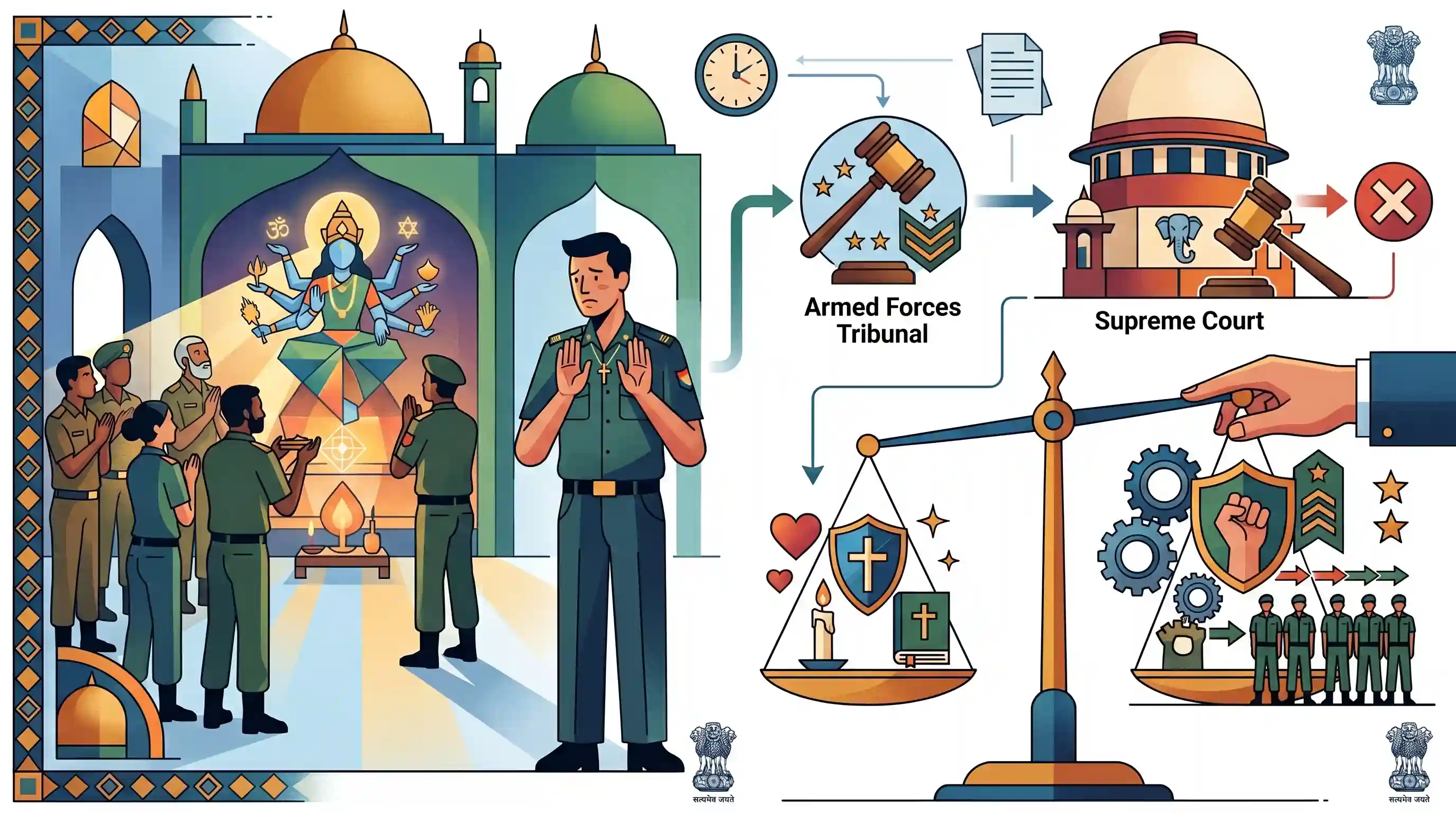
क्यों मायने रखता है
यह मामला मौलिक अधिकारों (अनुच्छेद 25) और सशस्त्र बलों की संरचनात्मक आवश्यकताओं (अनुच्छेद 33) के बीच के तनाव का एक ठोस उदाहरण पेश करता है। यह GS Paper 2 के संवैधानिक प्रावधानों, धर्मनिरपेक्षता की न्यायिक व्याख्या और विशिष्ट राज्य संस्थानों में धार्मिक स्वतंत्रता की सीमाओं से संबंधित प्रश्नों के लिए अत्यंत प्रासंगिक है।
सारांश
सुप्रीम कोर्ट ने एक ईसाई सैन्य अधिकारी की उस अपील को खारिज कर दिया है, जिसमें उन्होंने एक यूनिट पूजा के दौरान रेजिमेंटल मंदिर के भीतरी भाग में प्रवेश करने से इनकार करने के कारण अपनी सेवा समाप्ति (termination) को चुनौती दी थी। अधिकारी ने तर्क दिया कि मंदिर में प्रवेश करना और मूर्ति पूजा में भाग लेना संविधान के अनुच्छेद 25 के तहत उनके धर्म की स्वतंत्रता के मौलिक अधिकार का उल्लंघन है। हालांकि, कोर्ट ने सशस्त्र बल न्यायाधिकरण (Armed Forces Tribunal) के फैसले को बरकरार रखा और इस बात पर जोर दिया कि सैन्य अनुशासन व्यक्तिगत धार्मिक मान्यताओं से ऊपर है। यह निर्णय व्यक्तिगत धार्मिक अधिकारों और सशस्त्र बलों के भीतर मनोबल, एकजुटता और अनुशासन बनाए रखने की आवश्यकता के बीच संवैधानिक संतुलन को उजागर करता है, जिसमें अनुच्छेद 33 के समान सिद्धांतों का उल्लेख किया गया है जो सैन्य कर्मियों के लिए मौलिक अधिकारों को प्रतिबंधित करते हैं।
मुख्य बिंदु
- सुप्रीम कोर्ट ने एक ईसाई सैन्य अधिकारी की बर्खास्तगी को बरकरार रखा, जिसने मूर्ति पूजा के खिलाफ अपनी धार्मिक मान्यताओं का हवाला देते हुए पूजा के दौरान रेजिमेंटल मंदिर के गर्भगृह में प्रवेश करने से इनकार कर दिया था।
- अदालत ने व्यवस्था दी कि यद्यपि अनुच्छेद 25 धर्म की स्वतंत्रता की रक्षा करता है, लेकिन व्यक्तिगत व्याख्याएं सैन्य अनुशासन और यूनिट की एकजुटता (unit cohesion) से ऊपर नहीं हो सकतीं।
- यह निर्णय संविधान के अनुच्छेद 33 के अनुप्रयोग को रेखांकित करता है, जो संसद को सशस्त्र बलों के कर्मियों के मौलिक अधिकारों को प्रतिबंधित करने की अनुमति देता है ताकि कर्तव्यों का उचित निर्वहन और अनुशासन बनाए रखना सुनिश्चित किया जा सके।
- पीठ ने कहा कि अनुच्छेद 25 के तहत मिलने वाला संरक्षण केवल अनिवार्य धार्मिक पहलुओं तक ही सीमित है और यह संस्थागत आवश्यकताओं की कीमत पर प्रत्येक धार्मिक भावना की रक्षा नहीं कर सकता है।
- सशस्त्र बल न्यायाधिकरण ने पहले उल्लेख किया था कि रेजिमेंटल पूजा का उद्देश्य सौहार्द और मनोबल को बढ़ावा देना है, जो विशुद्ध रूप से धार्मिक उद्देश्य के बजाय एक संस्थागत उद्देश्य की पूर्ति करती है।
महत्वपूर्ण शब्द
Article 33

Constitutional provision empowering Parliament to restrict or abrogate fundamental rights for the Armed Forces and security agencies to ensure discipline and duty.
UPSC context
GS Paper 2 (Polity); tests knowledge of constitutional exceptions and the balance between individual rights and national security.
Article 25
Guarantees freedom of conscience and the right to profess, practice, and propagate religion, subject to public order, morality, and health.
UPSC context
GS Paper 2 (Fundamental Rights); vital for understanding religious liberty and its limitations within the Indian secular framework.
Essential Religious Practices Doctrine
A judicial test determining which religious practices are integral to a faith and thus warrant constitutional protection under Article 25.
UPSC context
GS Paper 2 (Judiciary); tests awareness of judicial interpretations and the intersection of law, religion, and social reform.
Armed Forces Tribunal (AFT)
A statutory body established in 2009 to adjudicate service-related disputes and appeals from court-martial decisions within the Indian Armed Forces.
UPSC context
GS Paper 2 (Quasi-judicial bodies); relevant for studying specialized dispute resolution mechanisms and administrative law.
Army Act, 1950
The primary legislation governing the discipline, conduct, and service conditions of the Indian Army, providing the legal basis for military justice.
UPSC context
GS Paper 3 (Internal Security); fundamental for understanding the legislative framework maintaining order within the defense forces.
Sarva Dharma Sthal
A multi-faith place of worship in Indian military units where personnel of all religions pray together, symbolizing the Army's secular ethos.
UPSC context
GS Paper 1 (Social Issues/Secularism); illustrates the unique application of secularism and institutional cohesion in Indian society.
प्रारंभिक ट्रैप
"The President or Ministry of Defence can restrict fundamental rights of the armed forces."
Under Article 33, only Parliament has the power to restrict or abrogate the fundamental rights of armed forces personnel. Executive orders or Presidential decrees cannot do this.
संबंधित अवधारणाएँ
How does Article 33 restrict Fundamental Rights for the Armed Forces?
- Parliamentary exclusivity: Only Parliament (and not State legislatures) can enact laws restricting FRs for armed forces.
- Broad scope: It covers not just combatants, but also non-combatants like barbers, mechanics, and cooks appointed in the forces.
- No judicial review: Laws made under Art 33 cannot be challenged in any court on the ground of contravention of Fundamental Rights.
What is the Essential Religious Practices (ERP) doctrine?
- Origin: The doctrine was coined by the Supreme Court in the 1954 Shirur Mutt case.
- Core principle: It states that only those practices intrinsically essential to a religion are protected under Article 25.
- Judicial determination: The Supreme Court determines what is "essential" based on religious texts, not just the claims of religious heads.
अंतर-विषय पैटर्न
Indian Secularism vs. Institutional Neutrality
The Indian military's "Sarva Dharma Sthal" (all-faith shrines) concept reflects positive secularism (state facilitating all faiths) rather than Western negative secularism, leading to unique clashes between institutional cohesion and individual orthodoxy.
Tribunals: AFT vs CAT Appellate Tracks
While Central Administrative Tribunal (CAT) orders are subject to High Court writ jurisdiction (Chandra Kumar case), Armed Forces Tribunal (AFT) appeals generally lie directly to the Supreme Court.

Expect a multi-statement question on Article 33 in 2026, specifically testing if non-combatants in the military also lose their FRs.
संबद्ध PYQ · 3
संबद्ध PYQ · 3
- 2024MainsGS2
Discuss India as a secular state and compare with the secular principles of the US constitution.
- 2020PrelimsGS1
Consider the following statements: 1. The Constitution of India defines its 'basic structure' in terms of federalism, secularism, fundamental rights and democracy. 2. The Constitution of India provides for 'judicial review' to safeguard the citizens' liberties and to preserve the ideals on which the Constitution is based. Which of the statements given above is/are correct?
- 2024PrelimsGS1
Under which of the following Articles of the Constitution of India, has the Supreme Court of India placed the Right to Privacy ?
