Supreme Court rules on military discipline and freedom of religion
Source:The Hindu ↗
Why It Matters
This case provides a concrete example of the tension between Fundamental Rights (Article 25) and the structural needs of the Armed Forces (Article 33). It is highly relevant for GS Paper 2 questions on Constitutional provisions, judicial interpretation of secularism, and the limits of religious freedom in specialized state institutions.
Summary
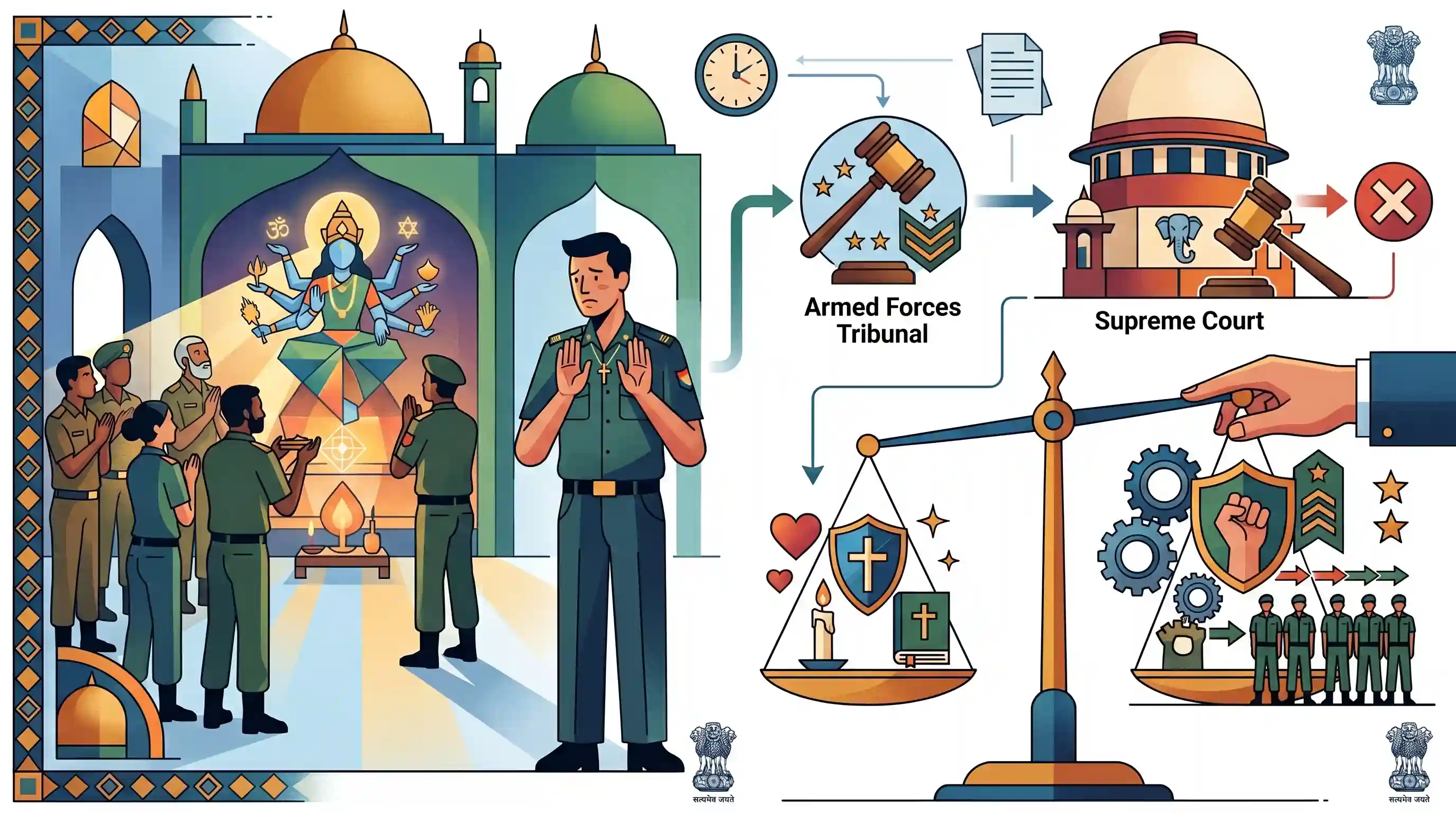
The Supreme Court has dismissed an appeal by a Christian Army officer challenging his termination for refusing to enter the inner part of a regimental temple during a unit pooja. The officer argued that entering the shrine and participating in idol worship violated his fundamental right to freedom of religion under Article 25 of the Constitution. However, the Court upheld the Armed Forces Tribunal's decision, emphasizing that military discipline supersedes personal religious understandings. The ruling highlights the constitutional balance between individual religious rights and the necessity of maintaining morale, cohesion, and discipline within the armed forces, invoking principles akin to Article 33 which restricts fundamental rights for military personnel.
Key Points
- The Supreme Court upheld the termination of a Christian Army officer who refused to enter the inner shrine of a regimental temple during a pooja, citing his religious beliefs against idol worship.
- The Court ruled that while Article 25 protects freedom of religion, individual interpretations cannot override military discipline and unit cohesion.
- The judgment underscores the application of Article 33 of the Constitution, which allows Parliament to restrict the fundamental rights of Armed Forces personnel to ensure proper discharge of duty and maintenance of discipline.
- The bench noted that the protection under Article 25 is limited to essential religious features and cannot protect every religious sentiment at the cost of institutional requirements.
- The Armed Forces Tribunal previously noted that regimental poojas are meant to foster camaraderie and morale, serving an institutional rather than purely religious purpose.
Important Terms
Article 33

Constitutional provision empowering Parliament to restrict or abrogate fundamental rights for the Armed Forces and security agencies to ensure discipline and duty.
UPSC context
GS Paper 2 (Polity); tests knowledge of constitutional exceptions and the balance between individual rights and national security.
Article 25
Guarantees freedom of conscience and the right to profess, practice, and propagate religion, subject to public order, morality, and health.
UPSC context
GS Paper 2 (Fundamental Rights); vital for understanding religious liberty and its limitations within the Indian secular framework.
Essential Religious Practices Doctrine
A judicial test determining which religious practices are integral to a faith and thus warrant constitutional protection under Article 25.
UPSC context
GS Paper 2 (Judiciary); tests awareness of judicial interpretations and the intersection of law, religion, and social reform.
Armed Forces Tribunal (AFT)
A statutory body established in 2009 to adjudicate service-related disputes and appeals from court-martial decisions within the Indian Armed Forces.
UPSC context
GS Paper 2 (Quasi-judicial bodies); relevant for studying specialized dispute resolution mechanisms and administrative law.
Army Act, 1950
The primary legislation governing the discipline, conduct, and service conditions of the Indian Army, providing the legal basis for military justice.
UPSC context
GS Paper 3 (Internal Security); fundamental for understanding the legislative framework maintaining order within the defense forces.
Sarva Dharma Sthal
A multi-faith place of worship in Indian military units where personnel of all religions pray together, symbolizing the Army's secular ethos.
UPSC context
GS Paper 1 (Social Issues/Secularism); illustrates the unique application of secularism and institutional cohesion in Indian society.
Prelims Trap
"The President or Ministry of Defence can restrict fundamental rights of the armed forces."
Under Article 33, only Parliament has the power to restrict or abrogate the fundamental rights of armed forces personnel. Executive orders or Presidential decrees cannot do this.
Static Concepts Connected
How does Article 33 restrict Fundamental Rights for the Armed Forces?
- Parliamentary exclusivity: Only Parliament (and not State legislatures) can enact laws restricting FRs for armed forces.
- Broad scope: It covers not just combatants, but also non-combatants like barbers, mechanics, and cooks appointed in the forces.
- No judicial review: Laws made under Art 33 cannot be challenged in any court on the ground of contravention of Fundamental Rights.
What is the Essential Religious Practices (ERP) doctrine?
- Origin: The doctrine was coined by the Supreme Court in the 1954 Shirur Mutt case.
- Core principle: It states that only those practices intrinsically essential to a religion are protected under Article 25.
- Judicial determination: The Supreme Court determines what is "essential" based on religious texts, not just the claims of religious heads.
Cross-Topic Patterns
Indian Secularism vs. Institutional Neutrality
The Indian military's "Sarva Dharma Sthal" (all-faith shrines) concept reflects positive secularism (state facilitating all faiths) rather than Western negative secularism, leading to unique clashes between institutional cohesion and individual orthodoxy.
Tribunals: AFT vs CAT Appellate Tracks
While Central Administrative Tribunal (CAT) orders are subject to High Court writ jurisdiction (Chandra Kumar case), Armed Forces Tribunal (AFT) appeals generally lie directly to the Supreme Court.

Expect a multi-statement question on Article 33 in 2026, specifically testing if non-combatants in the military also lose their FRs.
Linked PYQs · 3
Linked PYQs · 3
- 2024MainsGS2
Discuss India as a secular state and compare with the secular principles of the US constitution.
- 2020PrelimsGS1
Consider the following statements: 1. The Constitution of India defines its 'basic structure' in terms of federalism, secularism, fundamental rights and democracy. 2. The Constitution of India provides for 'judicial review' to safeguard the citizens' liberties and to preserve the ideals on which the Constitution is based. Which of the statements given above is/are correct?
- 2024PrelimsGS1
Under which of the following Articles of the Constitution of India, has the Supreme Court of India placed the Right to Privacy ?
