Supreme Court Directs Action Plan for Disabled Prisoners
Source:Indian Express ↗
Why It Matters
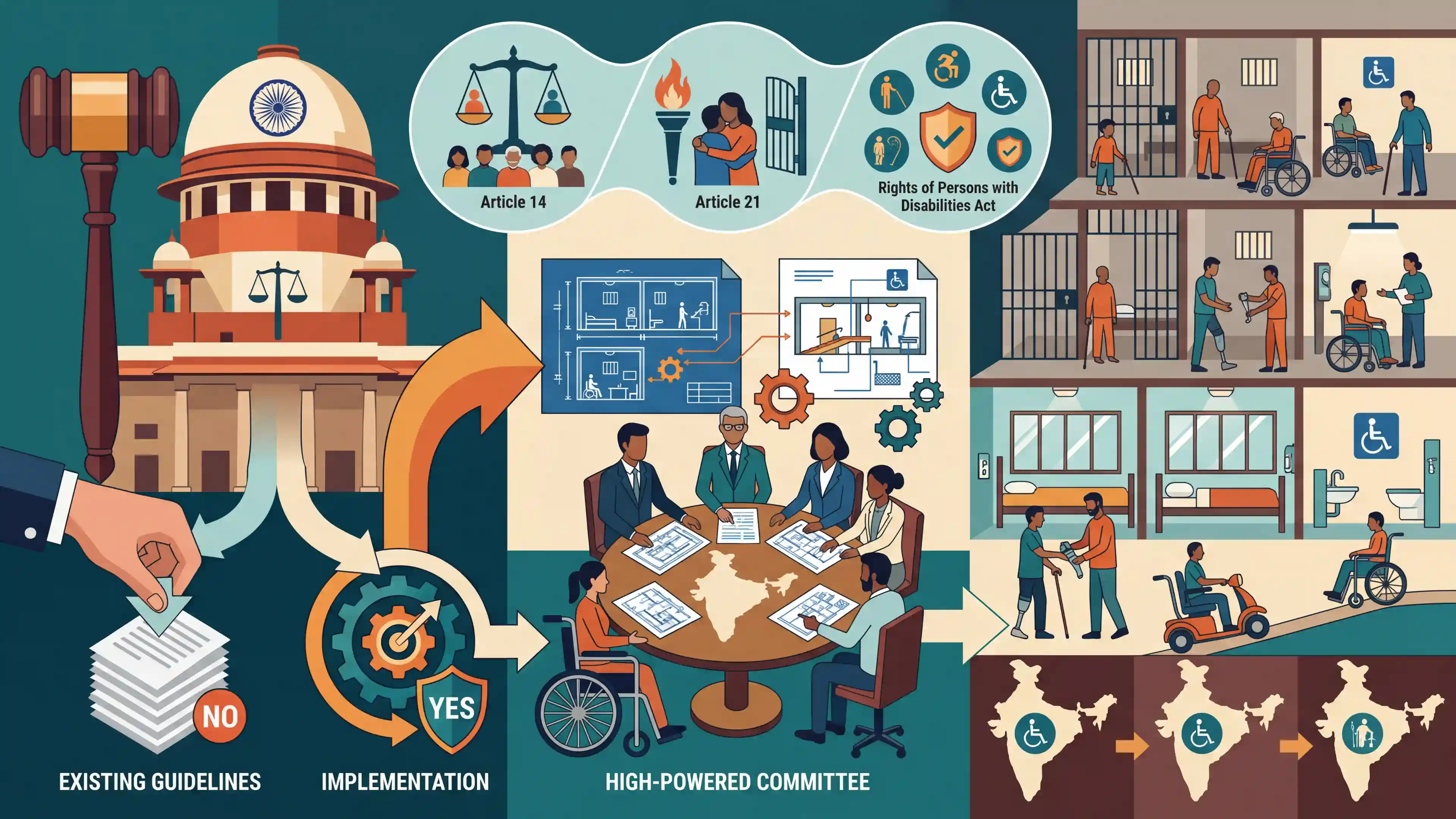
This development is crucial for understanding the ongoing challenges in prison administration and the judicial enforcement of statutory protections (RPwD Act) and constitutional rights (Articles 14, 21) for marginalized communities. It can be directly referenced in answers regarding social justice, human rights of undertrials/prisoners, and judicial mechanisms.
Summary
The Supreme Court of India has reinforced the necessity of protecting the rights of prisoners with disabilities, focusing on actionable implementation over issuing new guidelines. Adjudicating a writ petition that highlighted the denial of basic rights to disabled inmates, the bench directed a previously constituted High-Powered Committee to frame detailed action plans. These plans involve providing necessary mobility aids, prosthetics, and accessible facilities, ensuring that the Rights of Persons with Disabilities Act, 2016, and fundamental rights under Articles 14 and 21 are uniformly upheld across Indian prisons.
Key Points
- The Supreme Court shifted its focus from merely issuing guidelines to ensuring the implementation of the Rights of Persons with Disabilities (RPwD) Act, 2016 in prisons.
- A High-Powered Committee, originally formed during the Suhas Chakma v. Union of India case, has been tasked with drafting concrete action plans for disabled prisoners.
- The action plan focuses on essential provisions such as mobility aids, prosthetics, accessible infrastructure, and regular medical check-ups.
- The Court affirmed that denying these basic facilities to inmates with disabilities is a violation of their fundamental rights under Article 14 (Equality) and Article 21 (Life and Personal Liberty).
Important Terms
Rights of Persons with Disabilities (RPwD) Act, 2016

Landmark legislation replacing the 1995 Act, expanding recognized disabilities from 7 to 21. It mandates accessibility, non-discrimination, and reasonable accommodation, aligning India's legal framework with the UN Convention on the Rights of Persons with Disabilities.
UPSC context
GS Paper II (Social Justice/Vulnerable Sections). Tests legislative knowledge and rights-based governance frameworks for marginalized groups.
National Legal Services Authority (NALSA)
Statutory body established under the Legal Services Authorities Act, 1987, to provide free legal aid to weaker sections. It manages Lok Adalats and operates legal aid clinics in prisons to assist marginalized inmates.
UPSC context
GS Paper II (Statutory Bodies/Judiciary). Tests mechanisms for ensuring access to justice and Article 39A implementation.
Article 21 (Right to Life)
A constitutional guarantee ensuring that no person is deprived of life or personal liberty except via established legal procedure. Courts have expanded it to include the right to live with dignity and accessibility.
UPSC context
GS Paper II (Polity/Fundamental Rights). Tests evolution of judicial interpretations regarding basic human dignity in custodial and digital settings.
Department of Empowerment of Persons with Disabilities (DEPwD)
The nodal department under the Ministry of Social Justice and Empowerment for matters related to PwDs. It coordinates disability policies, oversees the RPwD Act’s implementation, and manages national accessibility initiatives like Sugamya Bharat.
UPSC context
GS Paper II (Governance/Social Justice). Tests knowledge of administrative machinery for welfare and social empowerment of vulnerable sections.
High-Powered Committee (Prison Reforms)
A judicial-mandated body tasked with framing and monitoring action plans for prison reforms. Its mandate was recently expanded by the Supreme Court to ensure uniform implementation of disability rights and accessibility in jails.
UPSC context
GS Paper II (Judiciary/Governance). Tests understanding of judicial activism and committee-driven policy implementation in correctional facilities.
Reasonable Accommodation
A key disability rights principle requiring necessary and appropriate modifications to ensure persons with disabilities enjoy rights on an equal basis with others, without imposing an undue or disproportionate burden on authorities.
UPSC context
GS Paper II (Social Justice). Tests conceptual understanding of substantive equality and State obligations toward the differently-abled.
Prelims Trap
Prison administration and reform of disabled inmates is jointly managed by the Centre and States under the Concurrent List.
Prisons is strictly a State subject (Entry 4, List II). Even though the RPwD Act is central legislation, the primary execution of prison reforms lies with State governments.
Static Concepts Connected
What constitutes 'reasonable accommodation' under the RPwD Act, 2016?
- Statutory Definition: Necessary modifications and adjustments that do not impose a disproportionate or undue burden on the system.
- Core Purpose: Ensures persons with disabilities can enjoy and exercise fundamental rights equally with others.
- Constitutional Link: The Supreme Court has repeatedly ruled that the denial of reasonable accommodation amounts to disability-based discrimination.
Do fundamental rights under the Indian Constitution extend to convicted prisoners?
- Constitutional Guarantee: Yes, incarceration does not completely strip individuals of their fundamental rights under Articles 14 and 21.
- Lawful Restrictions: These rights remain intact but are subject to reasonable restrictions inherent to lawful incarceration (e.g., freedom of movement).
- Landmark Precedent: In the landmark Sunil Batra case, the SC ruled that fundamental rights do not flee a person upon entering prison.
Cross-Topic Patterns
Judicial Activism via Committees
The Supreme Court is shifting from declaratory judgments to supervisory roles, using High-Powered Committees to force executive compliance in human rights cases like prison reform.
Central Statutes vs. State Subjects
Prison administration (State subject) frequently clashes with the enforcement of Central mandates like the RPwD Act or Mental Healthcare Act, necessitating judicial intervention to break implementation stalemates at the state level.

Expect a 2026 Prelims question interlinking 'Reasonable Accommodation' under the RPwD Act with Article 14 and the State subject of Prisons.
Linked PYQs · 4
Linked PYQs · 4
- 2017MainsGS2
Does the Rights of Persons with Disabilities Act, 2016 ensure effective mechanism for empowerment and inclusion of the intended beneficiaries in the society? Discuss.
- 2024PrelimsGS1
Under which of the following Articles of the Constitution of India, has the Supreme Court of India placed the Right to Privacy ?
- 2021PrelimsGS1
'Right to Privacy' is protected under which Article of the Constitution of India?
- 2018PrelimsGS1
Right to Privacy is protected as an intrinsic part of Right to Life and Personal Liberty. Which of the following in the Constitution of India correctly and appropriately imply the above statement?
