Supreme Court Forms Committee to Protect Prisoners with Disabilities
Source:Indian Express ↗
Why It Matters
It showcases the intersection of the criminal justice system and social justice, highlighting how constitutional protections and statutory laws like the RPwD Act, 2016 apply to marginalized populations in state custody. Highly relevant for GS2 questions on vulnerable sections and prison reforms.
Summary
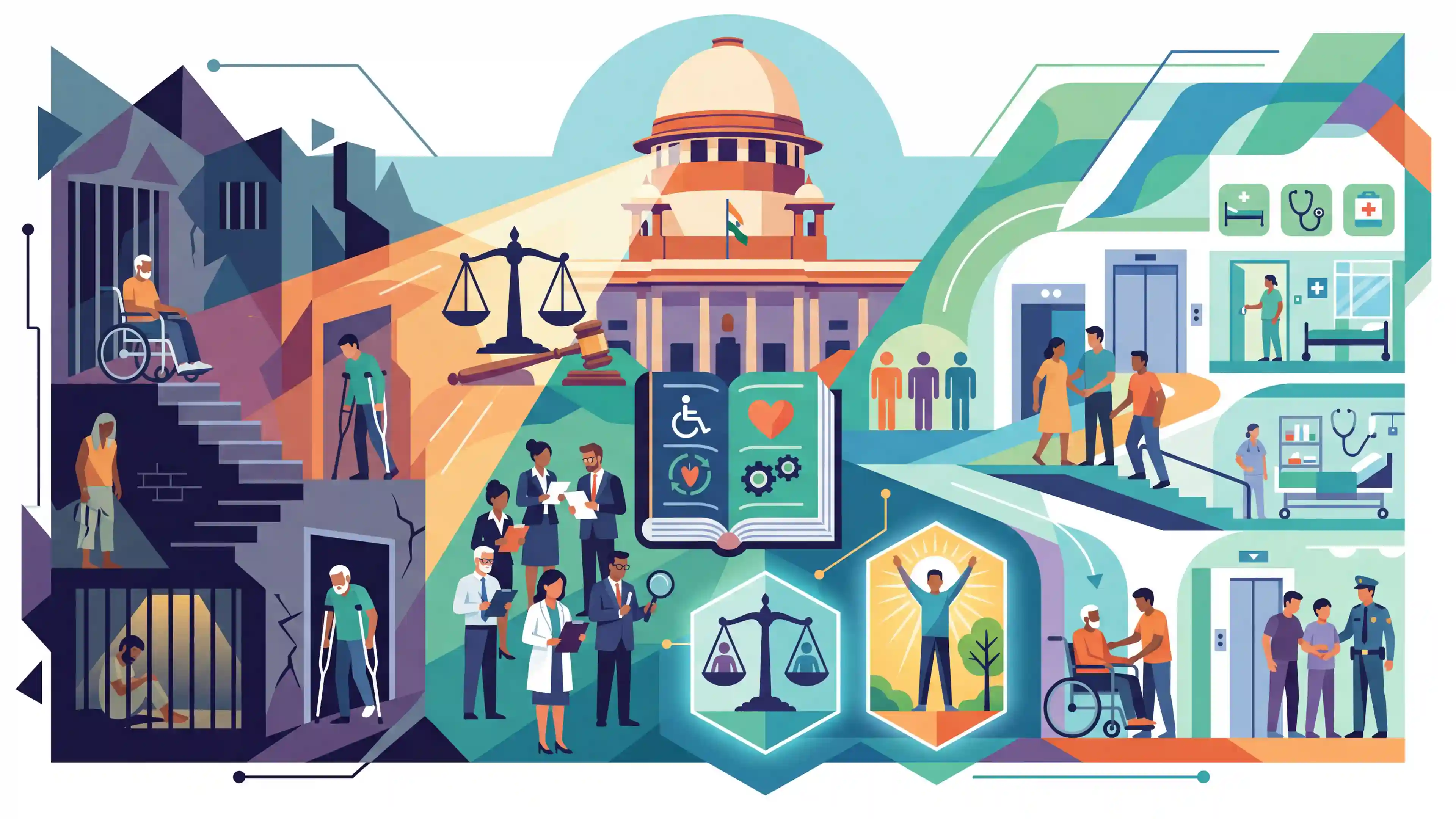
The Supreme Court of India has formed a high-powered committee to investigate and rectify the lack of rights and adequate facilities for prisoners with disabilities across states. The judicial intervention comes in response to systemic neglect and non-compliance with the Rights of Persons with Disabilities Act, 2016 within the penal system. By emphasizing Articles 14 and 21, the Court aims to ensure that incarceration does not strip vulnerable individuals of their fundamental human rights, mandating accessible infrastructure, proper healthcare, and standardized humane treatment in prisons.
Key Points
- The Supreme Court has constituted a high-powered committee to assess and improve the living conditions of prisoners with disabilities in Indian jails.
- The intervention addresses the widespread failure of state prison systems to implement the mandates of the Rights of Persons with Disabilities Act, 2016.
- Inmates with disabilities currently face severe systemic gaps, including a lack of accessible infrastructure, inadequate healthcare, and poor grievance redressal mechanisms.
- The Court reiterated that incarceration does not extinguish basic fundamental rights, emphasizing protections under Article 14 (Equality) and Article 21 (Right to Life and Personal Liberty) for vulnerable prisoners.
- The committee is tasked with standardizing humane prison protocols across all states to guarantee dignified treatment for disabled inmates.
Important Terms
Rights of Persons with Disabilities Act, 2016

Legislation replacing the 1995 Act, expanding disability categories to 21, and mandating universal accessibility, non-discrimination, and reasonable accommodation in all public institutions.
UPSC context
GS Paper 2 (Social Justice/Vulnerable Sections); tests knowledge of statutory frameworks protecting rights of differently-abled citizens.
Article 21
Fundamental right guaranteeing protection of life and personal liberty; interpreted by the Judiciary to include the right to human dignity for incarcerated individuals.
UPSC context
GS Paper 2 (Polity); tests understanding of the expanded scope of fundamental rights through judicial activism.
Article 14
Fundamental right ensuring equality before the law and equal protection, prohibiting the state from arbitrary discrimination against similarly situated individuals.
UPSC context
GS Paper 2 (Polity); core fundamental right testing the application of non-discrimination principles in state administration.
Prison Reforms
Systemic initiatives to transform penal institutions into rehabilitative centers by improving infrastructure, legal aid, and protecting the human rights of inmates.
UPSC context
GS Paper 2 (Social Justice/Governance); relevant for human rights in the criminal justice system and reformatory justice.
High-Powered Committee (HPC)
A specialized oversight body appointed by the Supreme Court to ensure uniform implementation of disability rights and monitor state-level compliance in prisons.
UPSC context
GS Paper 2 (Judiciary/Governance); tests knowledge of ad-hoc judicial mechanisms for policy enforcement and monitoring.
Prelims Trap
Prisons fall under the Concurrent List, enabling the Centre to mandate uniform disability infrastructure across jails.
Prisons are strictly a State List subject (Entry 4). The Centre can only issue model guidelines (like Model Prisons Act 2023), while states handle implementation.
Static Concepts Connected
What are the core features of the RPwD Act, 2016?
- Expanded Scope: Increased the number of officially recognized disabilities from 7 to 21.
- Rights-Based Approach: Mandates "reasonable accommodation" and barrier-free access in all public spaces, shifting from a charity-based to a rights-based framework.
- UNCRPD Alignment: Enacted to fulfill India's international obligations under the UN Convention on the Rights of Persons with Disabilities (UNCRPD).
How are prisons governed and regulated under the Indian Constitution?
- State Subject: "Prisons" and "persons detained therein" fall strictly under Entry 4, List II (State List) of the Seventh Schedule.
- Prisoner Rights: In landmark cases like Sunil Batra, the SC ruled that fundamental rights (Article 14, 21) are not extinguished by incarceration.
- Model Prisons Act: The Centre drafted the Model Prisons Act, 2023 to replace the 1894 Act, focusing on rehabilitation rather than mere retributive punishment.
Cross-Topic Patterns
Judicial Activism in State Subjects
The SC enforcing disability infrastructure in state-run prisons highlights the recurring theme of judicial interventions bridging the gap between Fundamental Rights (Article 21) and State List subjects.
Expanding Article 21 Jurisprudence
Connects to past SC panels on prison reform (like the Amitava Roy Committee) which also utilized Article 21 to mandate undertrial review committees and tackle overcrowding.

Expect a 2026 Prelims question testing the State List status of prisons against the Central RPwD Act's mandates and Article 21 rights.
Linked PYQs · 3
Linked PYQs · 3
- 2017MainsGS2
Does the Rights of Persons with Disabilities Act, 2016 ensure effective mechanism for empowerment and inclusion of the intended beneficiaries in the society? Discuss.
- 2021PrelimsGS1
With reference to India, consider the following statements : 1. When a prisoner makes out a sufficient case, parole cannot be denied to such prisoner because it becomes a matter of his/her right. 2. State Governments have their own Prisoners Release on Parole Rules. Which of the statements given above is/are correct?
- 2024PrelimsGS1
Under which of the following Articles of the Constitution of India, has the Supreme Court of India placed the Right to Privacy ?
