FSSAI Food Labelling Norms Supreme Court Directive
Source:The Hindu ↗
Why It Matters
This ruling addresses critical public health concerns regarding processed food consumption and regulatory accountability, directly tying into food security, health infrastructure, and statutory compliance in India.
Summary
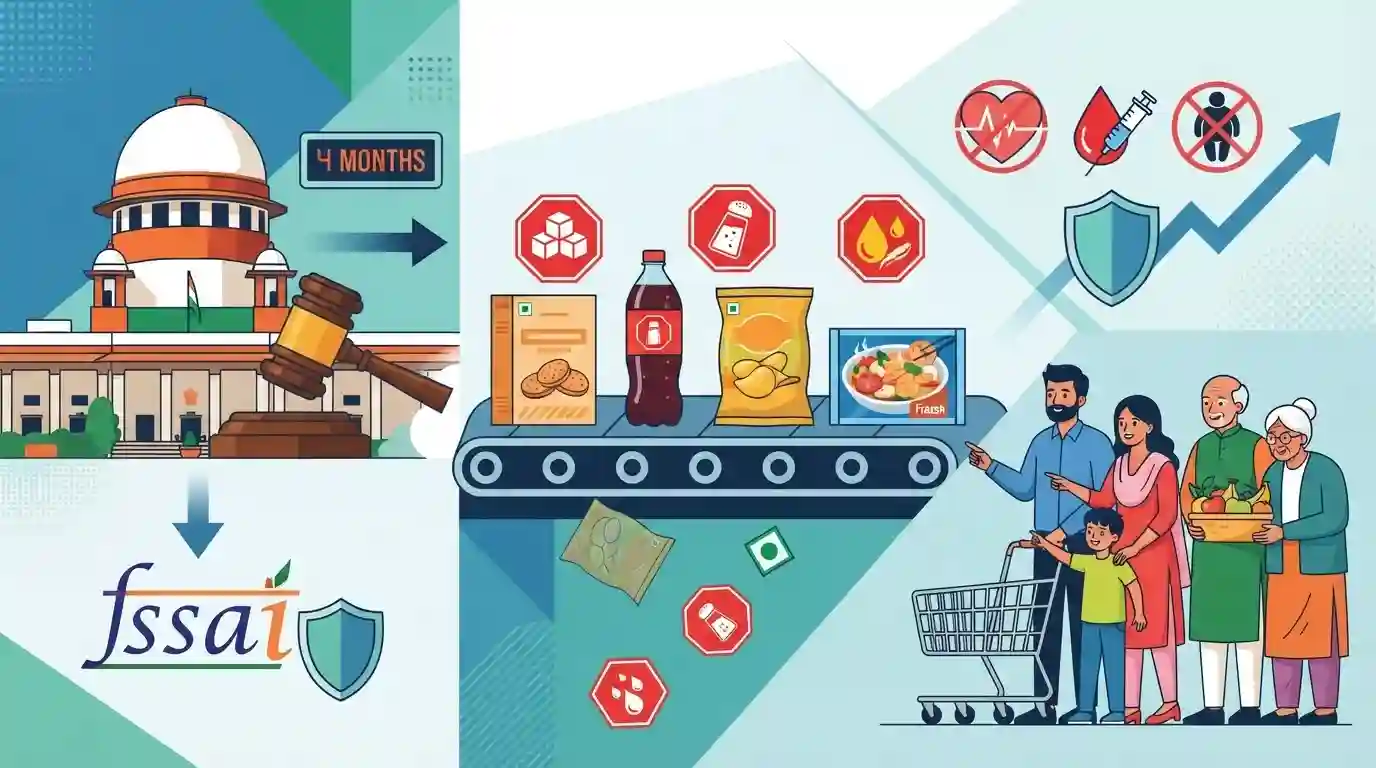
The Supreme Court has given a strict four-month deadline to the Food Safety and Standards Authority of India (FSSAI) to finalise robust front-of-package nutrition labelling (FOPNL) norms. The judicial direction aims to curb rising non-communicable diseases by ensuring consumers receive clear, visible warnings about high sugar, salt, and fat content in pre-packaged foods.
Key Points
- The Supreme Court has directed the Food Safety and Standards Authority of India (FSSAI) to finalise and implement strict front-of-package nutrition labelling (FOPNL) norms within four months.
- The ruling emphasizes public health concerns regarding rising non-communicable diseases (NCDs) linked to processed food consumption, addressing high levels of sugar, salt, and fat.
- Front-of-package labelling aims to empower consumers to make informed dietary choices by providing clear, easily readable nutritional information on food packages.
- The decision pushes back against delays in implementing comprehensive nutritional warning labels on packaged foods.
Important Terms
Food Safety and Standards Authority of India (FSSAI)

A statutory body established under the Ministry of Health and Family Welfare, Government of India, tasked with laying down science-based standards for food items and regulating their manufacture, storage, distribution, sale, and import to ensure safety.
UPSC context
UPSC Prelims/Mains (GS Paper II/III): Tests knowledge of statutory regulatory bodies, governance, health policies, and food safety frameworks in India.
Food Safety and Standards Act, 2006
The principal legislation enacted in 2006 to consolidate various food laws, establishing a unified science-based regulatory framework and creating the FSSAI to regulate food safety and standards across India.
UPSC context
UPSC Prelims/Mains (GS Paper II/III): Tests understanding of core legislative acts, consumer protection mechanisms, and public health governance.
Supreme Court of India
The apex judicial body in India that interprets the Constitution and laws, ensuring fundamental rights, public health protection, and executive accountability through directives and public interest litigations.
UPSC context
UPSC Prelims/Mains (GS Paper II): Tests knowledge of the judiciary's role, judicial activism, enforcement of fundamental rights, and executive-judicial dynamics.
Static Concepts Connected
What are the statutory powers and composition of the Food Safety and Standards Authority of India (FSSAI)?
- Statutory Origin: Statutory Basis: Established under the Food Safety and Standards Act, 2006, consolidating various acts and orders handling food safety across ministries.
- Administrative Control: Nodal Ministry: Operates under the administrative control of the Ministry of Health and Family Welfare.
- Core Mandate: Mandatory Functions: Framing regulations to lay down food standards, scientific advice, licensing of food businesses, and ensuring food safety compliance across India.
Cross-Topic Patterns
Food Labelling vs. WTO Technical Barriers
FSSAI front-of-package labelling mandates intersect with Codex Alimentarius guidelines and non-tariff trade measures scrutinized under WTO SPS/TBT agreements.
Processed Foods and Public Health Burden
Rising non-communicable diseases driven by ultra-processed foods directly burden public health infrastructure, linking nutritional governance to universal health coverage goals.

FSSAI statutory powers under the 2006 Act vs judicial oversight on public health will feature in GS-II governance/statutory bodies.
Linked PYQs · 3
Linked PYQs · 3
- 2018PrelimsGS1
Consider the following statements: 1. The Food Safety and Standards Act, 2006 replaced the Prevention of Food Adulteration Act, 1954. 2. The Food Safety and Standards Authority of India (FSSAI) is under the charge of Director General of Health Services in the Union Ministry of Health and Family Welfare. Which of the statements given above is/are correct?
- 2016PrelimsGS1
With reference to pre-packaged items in India, it is mandatory to the manufacturer to put which of the following information on the main label, as per the Food Safety and Standards (Packaging and Labelling) Regulations, 2011? 1. List of ingredients including additives 2. Nutrition information 3. Recommendations, if any, made by the medical profession about the possibility of any allergic reactions 4. Vegetarian/non-vegetarian Select the correct answer using the code given below.
- 2019MainsGS3
Elaborate the policy taken by the Government of India to meet the challenges of the food processing sector.
