Supreme Court Directs Strict Compliance on Bhojshala Complex Order
Source:The Hindu ↗
Why It Matters
The Bhojshala dispute is a significant flashpoint in Madhya Pradesh's history and cultural heritage, specifically relating to the Parmara dynasty and religious sites in Dhar district. Understanding the role of the Archaeological Survey of India (ASI) and judicial interventions in historical disputes is important for MPPSC aspirants studying State history, culture, and governance.
Summary
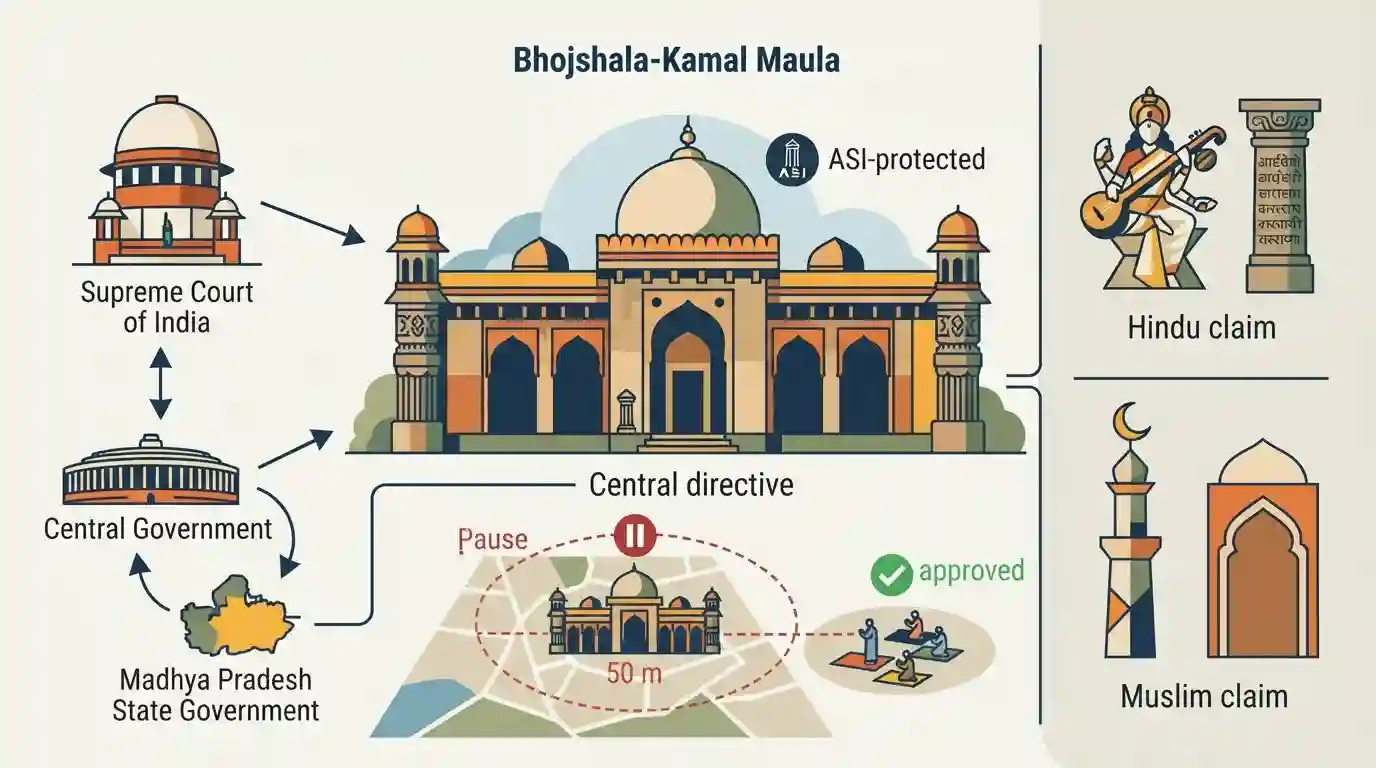
The Supreme Court has ordered the Central and Madhya Pradesh governments to strictly comply with its April 1 directive regarding the disputed Bhojshala-Kamal Maula Mosque complex in Dhar district. The apex court reiterated the need to identify a separate nearby space for Muslims to offer Friday namaz, effectively pausing an earlier MP High Court ruling that mandated a 50-meter radius around the monument for prayers. The 11th-century ASI-protected site is claimed by Hindus as a temple of Goddess Saraswati and by Muslims as a mosque, highlighting ongoing historical and cultural disputes in the region.
Key Points
- The Supreme Court has directed the Centre and the Madhya Pradesh government to fully comply with its April 1 order concerning the Bhojshala-Kamal Maula Mosque complex in Dhar district.
- The April 1 SC order paused an earlier Madhya Pradesh High Court directive that had instructed local authorities to designate a 50-meter radius around the complex for Muslims to offer Friday namaz.
- The SC instructed authorities to identify a separate space in the vicinity where Muslims can peacefully offer Friday prayers.
- The disputed site is an 11th-century ASI-protected monument; Hindus claim it is a temple dedicated to Goddess Saraswati (Bhojshala), while Muslims claim it is the Kamal Maula Mosque.
- The dispute intensified after the MP High Court quashed a 2003 ASI order that had permitted Friday prayers at the site, declaring the complex to be a temple.
Important Terms
Supreme Court of India

The apex judicial body in India established under Article 124 of the Constitution. It functions as the final court of appeal, the ultimate interpreter of the Constitution, and the protector of citizens' Fundamental Rights.
UPSC context
Crucial for GS Paper 2 (Polity); frequently tests judicial review, appellate jurisdiction, and landmark constitutional verdicts.
Madhya Pradesh High Court
The highest state-level judicial authority in Madhya Pradesh, operating under Article 214 of the Constitution. It exercises original, appellate, and writ jurisdictions to administer justice and protect fundamental rights within the state.
UPSC context
Relevant to GS Paper 2 (Polity); covers topics like state judiciary structure, writ jurisdiction (Article 226), and subordinate courts.
Archaeological Survey of India (ASI)
Founded in 1861, this premier agency under the Ministry of Culture manages archaeological research and protects historical monuments. It regulates activities under the Ancient Monuments and Archaeological Sites and Remains (AMASR) Act.
UPSC context
Important for GS Paper 1 (Art & Culture); tests knowledge of heritage conservation, historical site excavation, and architectural preservation.
Prelims Trap
The Places of Worship (Special Provisions) Act, 1991 applies uniformly to all ancient and historical monuments.
Section 4(3) of the Act explicitly exempts monuments, archaeological sites, and remains covered under the AMASR Act, 1958, from its core provisions.
Static Concepts Connected
What are the key contributions of Raja Bhoja and the Paramara Dynasty to art and literature?
- Raja Bhoja: Ruler of the Paramara dynasty of Malwa (c. 1010-1055 CE), famous for transferring the capital from Ujjain to Dhar.
- Literary works: Authored highly acclaimed texts like 'Samarangana Sutradhara' (on classical architecture) and 'Saraswatikanthabharana' (on Sanskrit grammar).
- Patronage: Built the Bhoj Shala (Sanskrit college) at Dhar and the massive Bhojeshwar Shiva Temple at Bhojpur with its giant unfinished lingam.
What are the primary exemptions under the Places of Worship (Special Provisions) Act, 1991?
- AMASR exemption: Section 4(3)(a) explicitly excludes any ancient and historical monument or archaeological site covered under the AMASR Act, 1958.
- Ayodhya dispute: The law did not apply to the Ram Janmabhoomi-Babri Masjid land dispute in Ayodhya, which was handled under Section 5.
- Settled cases: Any suit or proceeding settled by parties or decided by a court of competent jurisdiction prior to the Act's commencement.
Cross-Topic Patterns
Temple-Mosque transition architecture
Explores how early medieval Paramara temple styles transitioned under Malwa Sultanate rule, illustrating structural repurposing and architectural syncretism in medieval India.
Monument protection vs. Religious freedom
Connects archaeological conservation mandates (AMASR Act 1958) with constitutional religious freedoms under Articles 25 and 26 regarding state-regulated access to active worship sites.

AMASR Act exemptions under the Places of Worship Act 1991 and Paramara literary contributions will likely be tested together in 2026.
Linked PYQs · 1
Linked PYQs · 1
- 2025MPPSC_PRELIMSGS1
Which cave of Bagh (District Dhar) is called 'Rang Mahal'?
