Election Commission Control Over Counting Personnel and Supreme Court
Source:The Hindu ↗
Why It Matters
This ruling is highly relevant for GS Paper 2 as it clarifies the administrative hierarchy and allegiance of civil servants during elections. It reaffirms the ECI's sweeping powers under Article 324 to command both Central and State personnel, offering a strong judicial precedent for maintaining the independence of the electoral machinery against claims of political bias or federal disputes over manpower deployment.
Summary
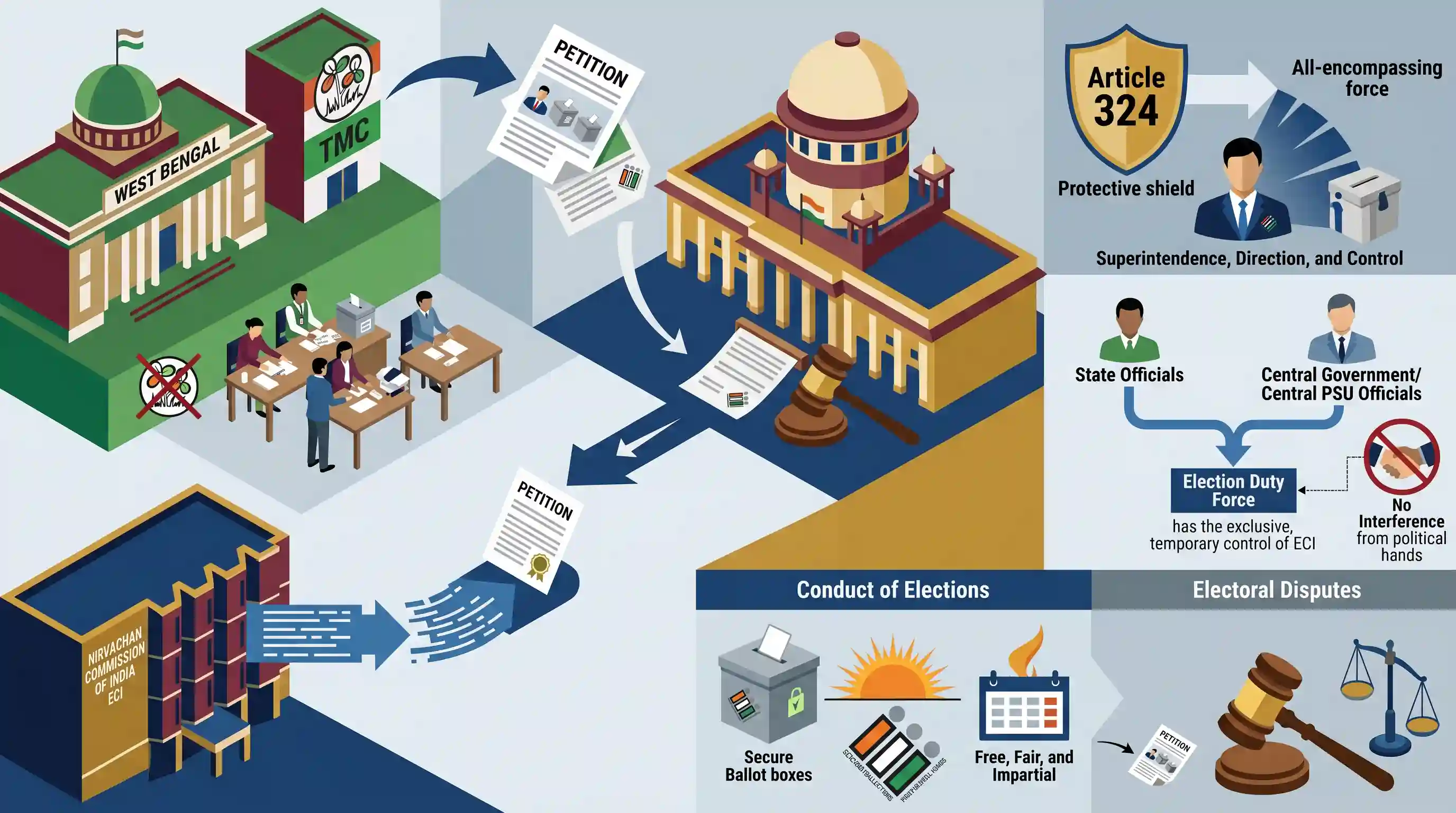
The Supreme Court of India dismissed a petition by the Trinamool Congress challenging an Election Commission of India (ECI) directive that mandated the deployment of Central government or Central PSU employees at counting tables in West Bengal. The Court emphasized that under Article 324, all government officials—whether from the State or the Centre—temporarily come under the exclusive control of the ECI while performing election duties. This arrangement is designed to insulate the electoral machinery from political interference and uphold the constitutional mandate of conducting free, fair, and impartial elections.
Key Points
- The Supreme Court rejected the Trinamool Congress's plea against an ECI circular mandating the appointment of Central government or Central PSU employees as counting supervisors and assistants at counting centres in West Bengal.
- The Court observed that during an election, both Central and State government employees deployed for poll duties belong exclusively to the Election Commission of India (ECI) and owe allegiance only to it.
- The bench noted that having a mix of Central and State employees ensures the impartiality and integrity of the counting process, reinforcing the concept of free and fair elections.
- The ECI clarified that State government employees, acting as returning officers, retain the overarching power to randomly select counting supervisors from the available pool of personnel.
Important Terms
Article 324 of the Constitution

Constitutional provision vesting 'superintendence, direction, and control' of elections in the Election Commission of India, ensuring its independence from executive interference.
UPSC context
GS Paper 2: Polity/Constitutional Bodies. Tests understanding of the ECI's plenary powers and administrative autonomy.
Election Commission of India (ECI)
A permanent, autonomous constitutional body responsible for administering Union and State election processes, including Parliament, State Legislatures, and the Presidency.
UPSC context
GS Paper 2: Statutory/Regulatory Bodies. Core to topics on electoral reforms and democratic governance.
Supreme Court of India
The highest judicial authority in India; it serves as the final interpreter of the Constitution and the ultimate appellate court for electoral disputes.
UPSC context
GS Paper 2: Judiciary. Relevant for judicial review and the protection of democratic 'Basic Structure'.
Superintendence, Direction, and Control
The specific constitutional phrasing in Article 324 that grants the ECI comprehensive authority to manage all aspects of the electoral machinery and personnel.
UPSC context
GS Paper 2: Electoral Reforms. Examines the scope of administrative power over state vs. central officials.
Free and Fair Elections
An essential element of the Basic Structure of the Indian Constitution, ensuring the electoral process is impartial, transparent, and free from political bias.
UPSC context
GS Paper 2: Governance/Democracy. A recurring theme in questions about electoral integrity and constitutional safeguards.
Prelims Trap
Only State government employees deployed for poll duties are deemed to be on deputation to the ECI.
Under Section 28A of RPA 1951, BOTH Central and State government/PSU employees deployed for elections are deemed on deputation to the ECI.
Static Concepts Connected
What is the extent of ECI's plenary power under Article 324?
- Reservoir of power: Grants ECI "superintendence, direction, and control" over elections, acting as a "reservoir of power" where enacted laws are silent (Mohinder Singh Gill case).
- Absolute deputation: Section 28A of RPA 1951 deems all drafted personnel (police, state, or central officials) as temporarily on deputation to the ECI.
What is the statutory role of a Returning Officer (RO)?
- State Appointment: Nominated by the ECI in consultation with the State Govt. Typically a State official (like a District Magistrate), not a Central official.
- Operational Control: The RO retains statutory operational authority to conduct polling and randomly select counting supervisors from the ECI-approved pool of personnel.
Cross-Topic Patterns
ECI Plenary Powers vs Asymmetric Federalism
The unilateral deployment of Central PSU staff in specific states highlights federal friction, pitting the ECI's constitutional mandate for fair elections against state administrative autonomy.
RPA 1950 vs RPA 1951 deputation overlaps
Section 13CC (RPA 1950) handles pre-election deputation for electoral roll revision, while Section 28A (RPA 1951) manages personnel deputation during the actual conduct of polls.

2026 Prelims will likely test the distinction between ECI's overarching disciplinary control and the Returning Officer's statutory powers.
Linked PYQs · 3
Linked PYQs · 3
- 2022MainsGS2
Discuss the role of the Election Commission of India in the light of the evolution of the Model Code of Conduct.
- 2022MainsGS2
Discuss the procedures to decide the disputes arising out of the election of a Member of the Parliament or State Legislature under The Representation of the People Act, 1951. What are the grounds on which the election of any returned candidate may be declared void ? What remedy is available to the aggrieved party against the decision ? Refer to the case laws.
- 2017PrelimsGS1
Consider the following statements: 1. The Election Commission of India is a five-member body. 2. Union Ministry of Home Affairs decides the election schedule for the conduct of both general elections and bye-elections. 3. Election Commission resolves the disputes relating to splits/mergers of recognised political parties. Which of the statements given above is/are correct?
