Judicial Recognition of Pedestrian Rights as Fundamental Rights
Source:The Hindu ↗
Why It Matters
Expands the scope of Article 19 fundamental rights and directly impacts urban planning, highlighting the ongoing tension between pedestrian safety and motor-centric city infrastructure. Highly relevant for questions on dynamic constitutionalism and National Urban Transport Policy.
Summary
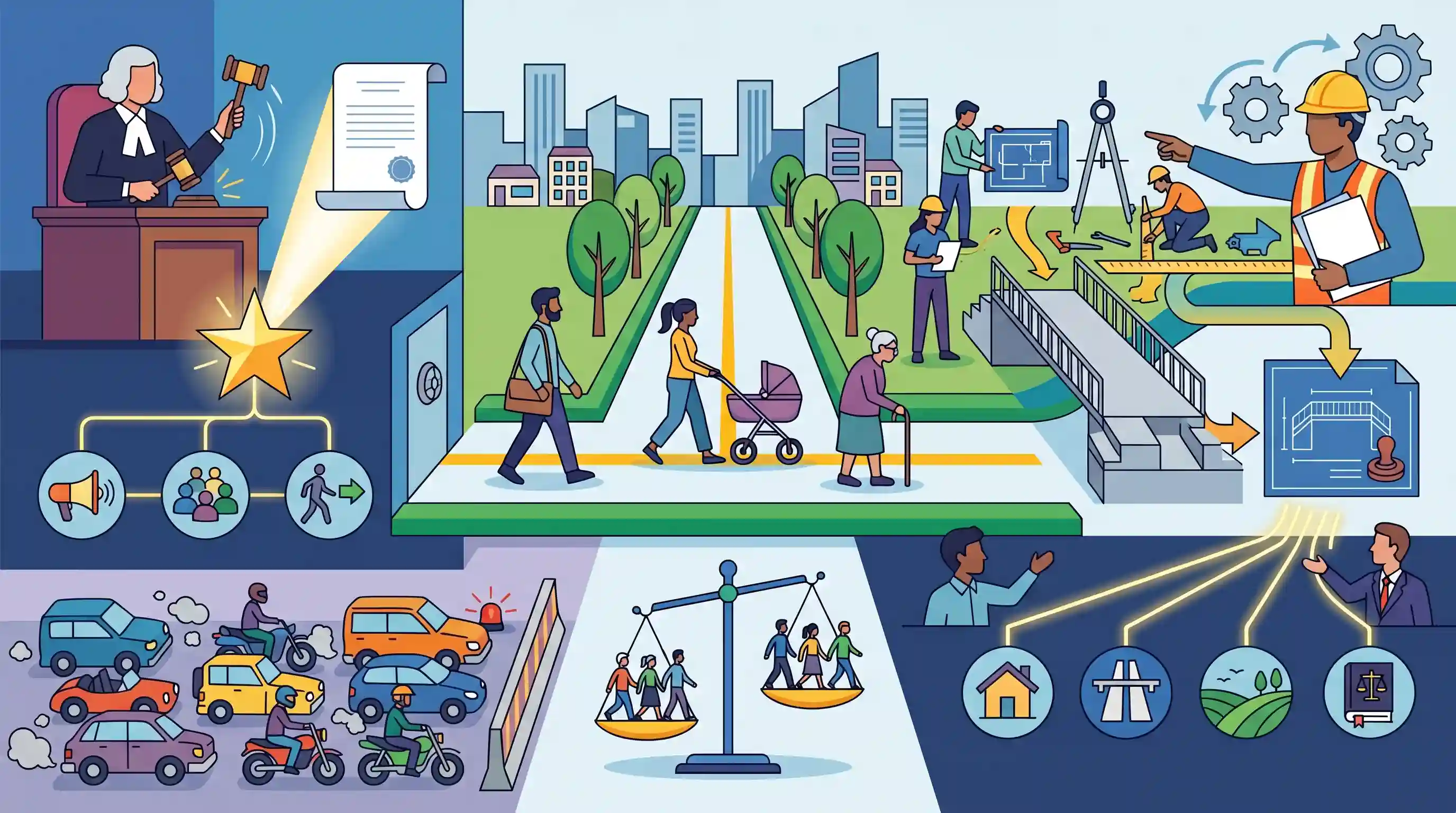
The Supreme Court of India has ruled that citizens possess a fundamental right to walk freely on safe and demarcated footpaths. Authored by Justice P.S. Narasimha, the judgment states that this right forms an intrinsic part of the fundamental freedoms of expression, assembly, association, and movement enshrined in Article 19(1) of the Constitution. Emphasizing that pedestrian rights must override the convenience of motorized vehicles, the Court has called for a dedicated statutory framework and a full-time regulator to maintain and protect pedestrian infrastructure. Ministries concerned with urban affairs, transport, and rural development, alongside the Law Commission, have been tasked with examining this mandate to ensure safer urban mobility.
Key Points
- The Supreme Court declared the right to walk carefree on demarcated, safe, and well-maintained footpaths as a fundamental right.
- The right is recognized as inherently linked to the freedom of speech, expression, assembly, association, and movement under Article 19(1) of the Constitution.
- The judgment prioritizes pedestrian rights over the privilege of motorized vehicles, marking a significant paradigm shift in urban mobility perspectives.
- The Court directed relevant Union Ministries and the Law Commission to explore formulating a comprehensive statutory framework and establishing a full-time regulator to protect pedestrian spaces.
Important Terms
Article 19(1) of the Constitution

Guarantees six fundamental freedoms to citizens, including speech, assembly, and movement. The SC recently interpreted these to include the 'fundamental right to walk' on demarcated footpaths.
UPSC context
GS Paper II (Polity); tests understanding of the evolving nature of Fundamental Rights and judicial overreach/activism.
Law Commission of India
An executive body that advises the Ministry of Law and Justice on legal reforms. The SC tasked it to examine a statutory framework for pedestrian rights.
UPSC context
GS Paper II (Statutory Bodies); tests knowledge of the role of advisory bodies in legislative processes.
Ministry of Housing and Urban Affairs (MoHUA)
The nodal ministry for urban planning and infrastructure in India. It manages missions like AMRUT and Smart Cities, which prioritize non-motorized transport.
UPSC context
GS Paper II/III (Governance/Infrastructure); relevant for urban mobility and sustainable development goals.
Urban Local Bodies (ULBs)
Local self-government institutions (Municipalities/Corporations) responsible for urban services. The SC identified them as the primary 'duty bearers' for maintaining safe pedestrian infrastructure.
UPSC context
GS Paper II (Polity/Local Governance); relates to the 74th Constitutional Amendment and service delivery mandates.
Article 21 of the Constitution
Declares that no person shall be deprived of life or liberty except according to legal procedure. The SC linked pedestrian safety to this right to a dignified life.
UPSC context
GS Paper II (Polity); tests the expansive interpretation of the 'Right to Life' by the Indian judiciary.
Ministry of Road Transport and Highways (MoRTH)
The apex body for formulating and administering rules related to road transport and safety. It is a key party in the SC's mandate for a new pedestrian law.
UPSC context
GS Paper II/III (Governance/Infrastructure); significant for road safety legislation and the Motor Vehicles Act.
Prelims Trap
The right to walk safely on footpaths is an implicit Fundamental Right derived solely from Article 21 (Right to Life).
While it involves safety, the SC explicitly anchored this right in Article 19(1), linking it intrinsically to the freedoms of speech, assembly, association, and movement.
Static Concepts Connected
What are the freedoms guaranteed under Article 19(1) and how are they expanded?
- Six freedoms: Speech/expression, peaceful assembly, association, movement throughout India, residence, and profession.
- Reasonable restrictions: Subject to reasonable restrictions under Art 19(2) to 19(6) on grounds like sovereignty, security, public order, and decency.
- Judicial expansion: The Supreme Court continually expands these via interpretation (e.g., freedom of press, right to internet, and now the right to safe footpaths).
What does the "Right to the City" entail in the human rights framework?
- Core concept: It is the right of all inhabitants to use, occupy, and produce equitable urban spaces, moving away from purely capitalist or motorized urban planning.
- Inclusivity focus: Promotes inclusive cities for marginalized populations, focusing on public spaces, affordable housing, and pedestrian access. This concept was tested in UPSC Prelims 2021.
Cross-Topic Patterns
Fundamental Rights + Urban Infrastructure
This judgment bridges Part III of the Constitution with urban governance, compelling municipal bodies and Smart City missions to legally prioritize pedestrian infrastructure over vehicular carriageways.
Judicial Activism vs. Executive Domain
The Court's directive to ministries and the Law Commission to create a statutory framework highlights the ongoing tension between judicial intervention and executive/legislative domains.

Expect a 2026 Prelims question pairing "Right to the City" with Article 19(1) freedoms, or a Mains GS2 Q on judicial expansion of rights.
Linked PYQs · 3
Linked PYQs · 3
- 2022MainsGS2
“Right of movement and residence throughout the territory of India are freely available to the Indian citizens, but these rights are not absolute.” Comment.
- 2014MainsGS3
National Urban Transport Policy emphasises on 'moving people' instead of 'moving vehicles'. Discuss critically the success of the various strategies of the Government in this regard.
- 2017MainsGS2
Examine the scope of Fundamental Rights in the light of the latest judgement of the Supreme Court on Right to Privacy.
